
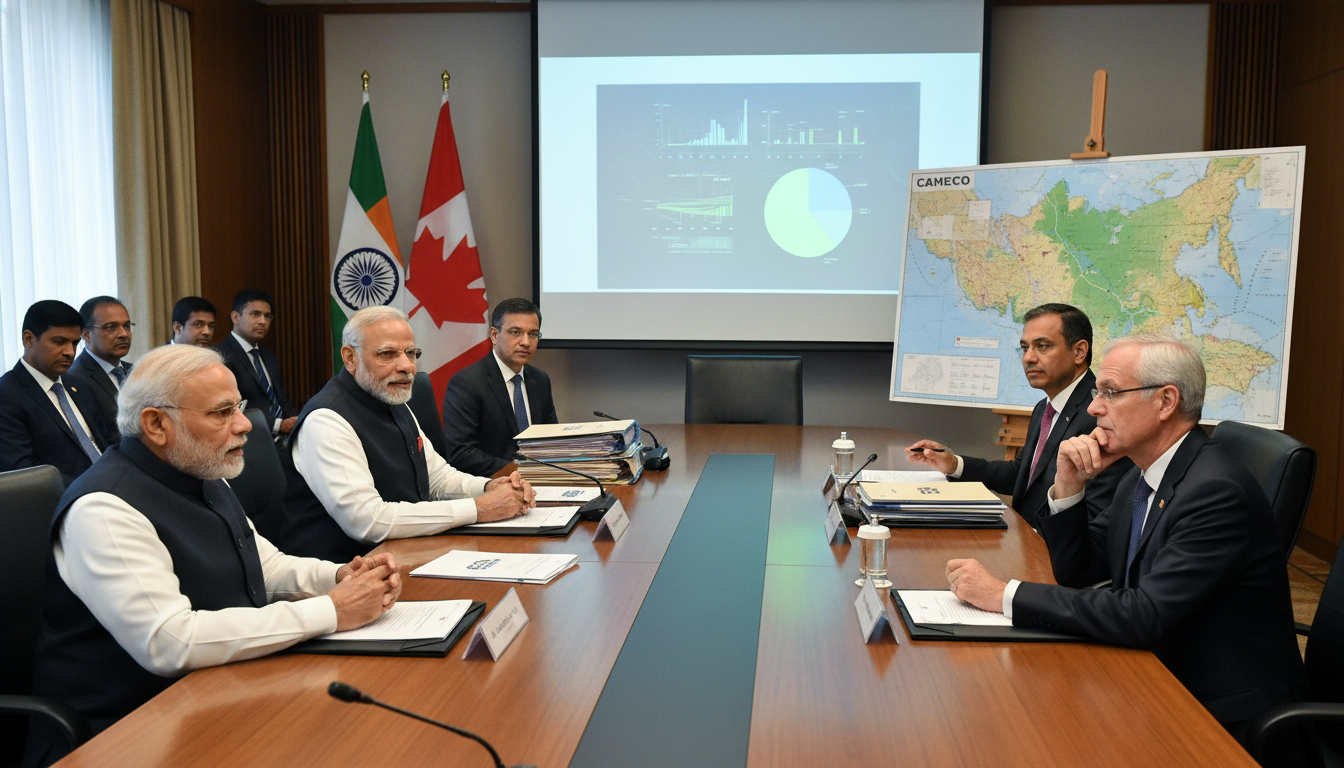
India offers to buy all Cameco uranium as it ramps up nuclear power
India says it will buy as much Cameco uranium as available to fuel its planned nuclear expansion, signalling a deepening energy tie with Canada.
India offers to buy all Cameco uranium
India’s high commissioner to Canada, Dinesh Patnaik, told reporters at a summit in Regina that New Delhi is prepared to purchase as much Cameco uranium as the Saskatoon-based producer can supply.
Patnaik said India would also consider investing in Canadian uranium mines to secure long-term fuel for its expanding nuclear programme.
Details of the Cameco supply agreement
Cameco has already committed to supply nearly 22 million pounds of uranium to India each year from 2027 through 2035 under a recently announced long-term agreement.
A company representative said there are no immediate plans to extend the contract beyond 2035, but Cameco hopes to continue and possibly expand cooperation with India in the future.
Political meetings and reaction
Cameco’s chief executive, Tim Gitzel, visited New Delhi following the March announcement and met with senior officials to advance the energy partnership.
Indian and Canadian officials have framed the arrangement as part of broader efforts to diversify reliable fuel supplies for nuclear generation and to foster industrial cooperation.
India’s nuclear expansion and fuel needs
India plans an ambitious expansion of nuclear capacity, targeting a more than tenfold increase in nuclear generation by 2047 to meet rising electricity demand.
With a population approaching 1.5 billion and rapid economic growth, New Delhi expects its energy needs to grow faster than any other country in the coming decade, driving demand for secure uranium supplies.
Current reactor fleet and operating mix
At present India operates roughly two dozen nuclear reactors, with several additional units under construction to add baseload, low-carbon capacity.
Despite the nuclear build-out, coal remains the dominant source of India’s electricity today, and nuclear expansion is being pursued to reduce emissions and diversify the power mix.
Cameco’s place in the global uranium market
Canada is one of the world’s largest uranium producers, responsible for about one-fifth of global output, and Cameco is its largest mining company.
Globally, production is concentrated in a few countries, with Kazakhstan supplying a larger share and other significant producers including Namibia, Australia and Uzbekistan.
Trade, investment and strategic implications
India’s willingness to buy “as much as Cameco can produce,” as the high commissioner put it, underscores New Delhi’s focus on securing long-term, reliable fuel channels for its civil nuclear programme.
Talks about investment in mines signal a move beyond simple supplier–customer dynamics toward strategic partnerships that could involve equity, joint development and long-term offtake arrangements.
India’s interest carries commercial and geopolitical weight: a stable uranium supply supports its net-zero and energy security goals, while Canada gains a predictable export market for a commodity that is central to low-carbon generation.
Cameco and Indian officials will now face technical, regulatory and commercial steps to translate interest and signed contracts into increased shipments and potential investment, with timelines shaped by mine capacity, permitting and international safeguards.
Negotiations and planning over the next months and years will determine whether the existing 2027–2035 supply deal is extended or broadened, and whether Canadian uranium production is scaled to match India’s long-term ambitions.
