
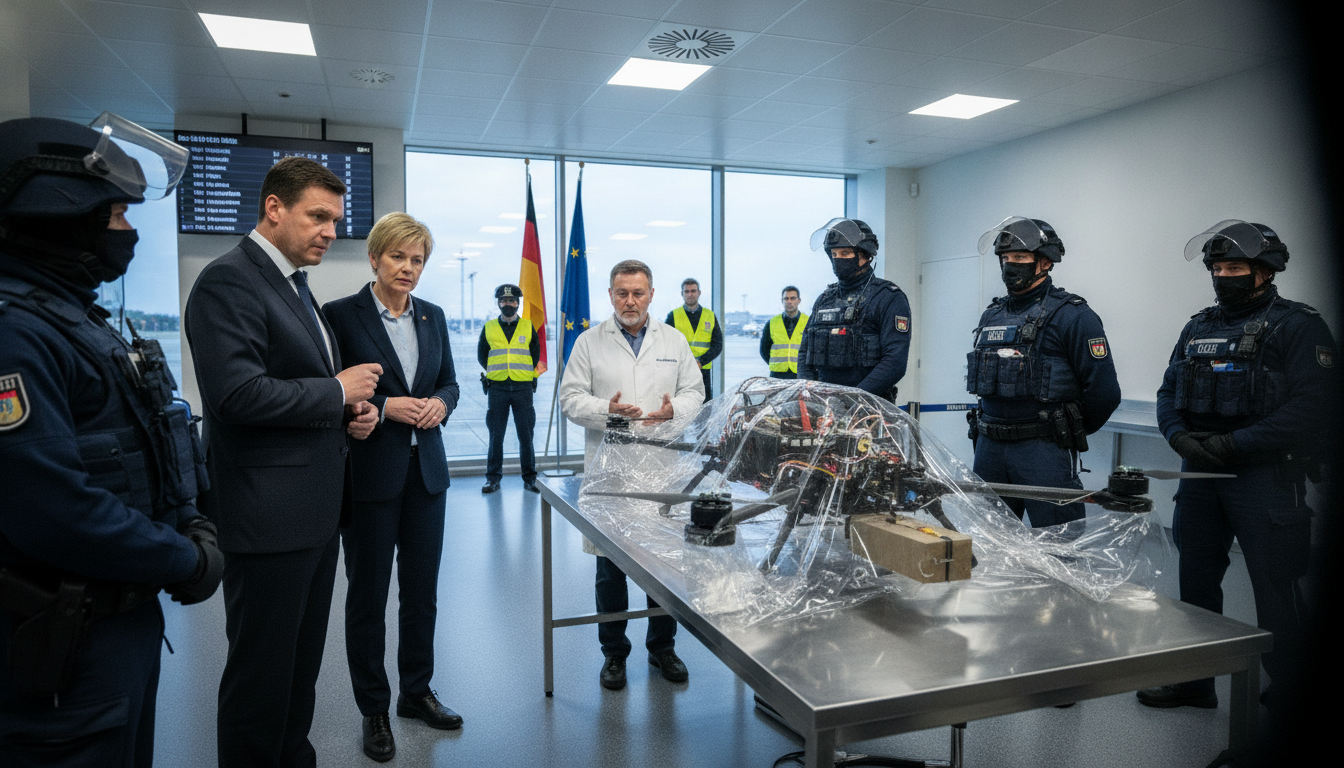
Germany warns of daily "hybrid warfare" after explosive drone found at Leipzig/Halle
Germany warns of daily hybrid warfare after an explosive drone was found at Leipzig/Halle Airport; Berlin will expand anti-drone teams amid NATO concern.
Germany’s interior minister warned on Sunday that the country is being targeted by daily “hybrid warfare” operations, after an explosive-laden drone was discovered at Leipzig/Halle Airport earlier this week. Alexander Dobrindt told a national newspaper that espionage, sabotage and cyberattacks by foreign powers are a continuing threat aimed at unsettling German society and politics. The development has prompted an acceleration of government plans to expand anti-drone capabilities and has renewed security debates across NATO partners.
Interior minister says Germany faces daily hybrid warfare
Interior Minister Alexander Dobrindt said the attacks amount to a constant reality of hybrid warfare rather than a conventional war, signalling a shift in how Berlin frames persistent, multi-domain threats. He told reporters that foreign actors seek to create fear and political division through covert operations, yet he did not publicly name specific states responsible. The comment underscores a policy focus on non-kinetic and irregular threats that combine technology, covert activity and information operations.
Explosive-laden drone discovered at Leipzig/Halle Airport
Authorities found a small unmanned aerial vehicle loaded with explosive material at Leipzig/Halle Airport in eastern Germany earlier in the week, triggering an immediate security response and investigations by federal and local agencies. The discovery prompted temporary restrictions and a forensic sweep of the site while specialists assessed the device and sought any traces of origin or guidance systems. Officials have kept operational details limited as the probe continues, citing the sensitivity of ongoing counterterrorism and counterintelligence work.
Parliamentary debate and accusations point to Russia
Several German lawmakers publicly suggested Russia could be behind recent drone incidents, citing Moscow’s ongoing large-scale war in Ukraine and a history of covert actions that have alarmed Western capitals. The Russian embassy in Berlin rejected such suggestions, dismissing the Leipzig incident as a “fabricated provocation” and calling out what it described as unproven accusations. German political leaders and security officials have so far avoided definitive attribution in public statements, while parliamentary committees and intelligence services continue to examine the evidence.
Berlin moves to double anti-drone specialists and bases
Government sources have told national media that the interior ministry plans to increase its federal anti-drone experts from roughly 150 to 300 and to expand the number of dedicated operational bases from four to eight. The move is intended to improve nationwide coverage for detection, neutralization and rapid response to unmanned aerial threats affecting airports, critical infrastructure and military sites. Officials said the expansion would include investments in counter-UAV technology, training and coordination mechanisms with police and military units.
The Interior Ministry’s proposal follows recent military reports of unmanned aircraft sightings near German facilities and other recent drone events in Europe. Defence forces confirmed sightings over a military base in Mechernich in North Rhine-Westphalia, and a separate explosion involving a drone near the Trans-Balkan gas pipeline in Bulgaria has reignited concerns about cross-border spillover. Berlin has indicated the need to strengthen interagency cooperation and tactical capacity to respond quickly to similar incidents.
Additional drone incidents and NATO alarm across Europe
Officials in Brussels and NATO headquarters have been watching the pattern of drone activity with increasing unease, noting that incidents have occurred in multiple allied countries in recent months. NATO and European Union representatives have previously linked some drone sightings to Russian-linked activity, though Moscow has repeatedly denied responsibility for such operations. The spread of incidents has heightened discussions among allies about airspace policing, intelligence-sharing and layered defence against unmanned systems.
Implications for allies and domestic security preparations
Security analysts say Germany’s focus on hybrid warfare reflects a broader recalibration across NATO toward persistent low-intensity threats that combine kinetic and non-kinetic tools. For partners such as Canada, the United States and other European states, the incidents underscore the need for shared early-warning systems, standardized counter-drone protocols and contingency planning for critical infrastructure. Ministers in allied capitals are expected to raise the issue in upcoming defence and foreign policy meetings to coordinate capability-building and intelligence cooperation.
Domestically, German authorities face the task of balancing transparent public information with operational secrecy while reassuring citizens about safety at transport hubs and energy installations. Expanding technical capacity will require budget allocations, procurement decisions and legal clarity about interdiction measures in civilian airspace, all of which are likely to feature in parliamentary oversight and public debate.
The discovery of the explosive drone at Leipzig/Halle and the interior minister’s stark characterisation of daily hybrid operations mark a significant moment in Germany’s security posture, prompting urgent steps to harden defences and deepen cooperation with NATO partners as investigations continue.
