
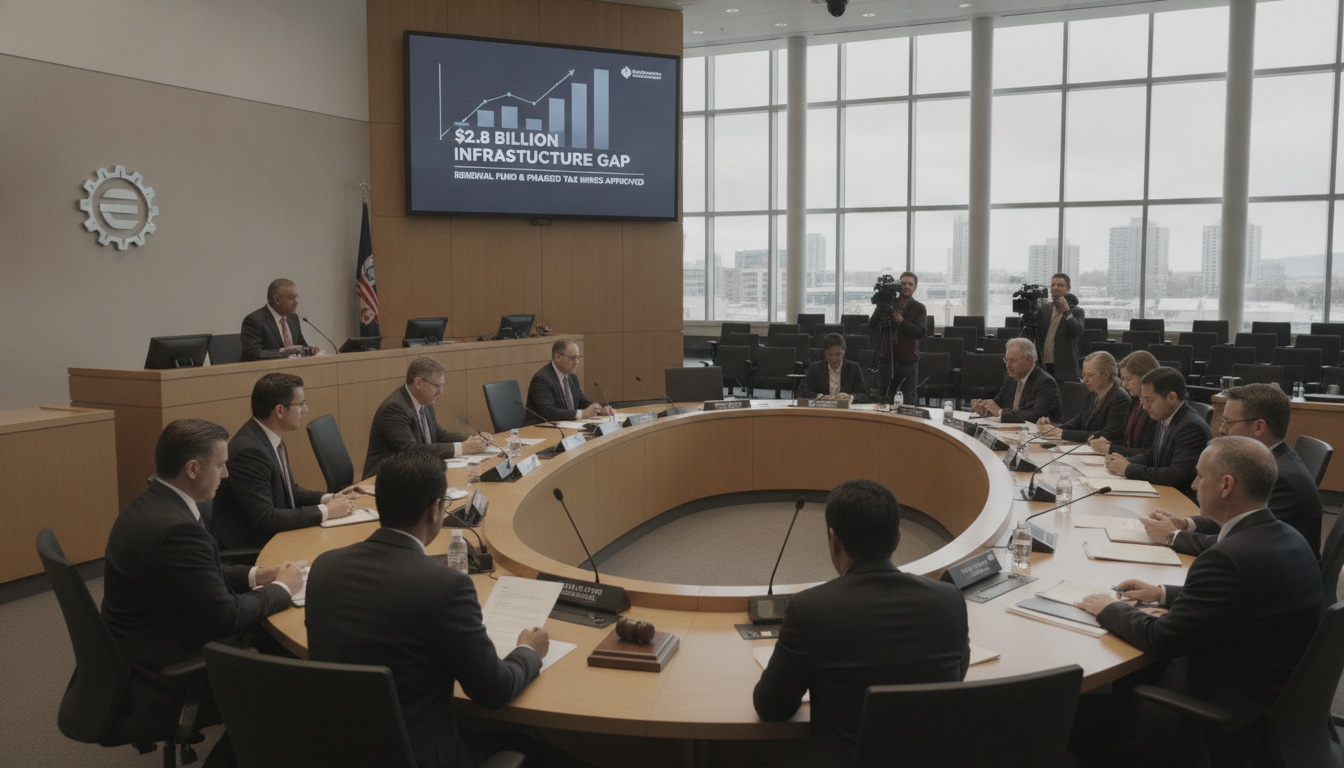
Edmonton council approves dedicated renewal fund to tackle $2.8-billion infrastructure shortfall
Edmonton council approves a dedicated renewal fund to close a $2.8-billion infrastructure shortfall, with phased tax increases from 2027, with fall review
Edmonton city council voted Tuesday to create a dedicated renewal fund to address a projected $2.8-billion shortfall in capital renewal over the next three years, a move that will begin phasing in property tax increases tied to the fund. The renewal fund will be seeded by graduated tax-levy increases that start at a half-percentage-point boost annually and rise to one per cent in later years, with administrators slated to return in the fall with possible further enhancements. Council and city officials said the measure is intended to shift funding toward repairing and replacing aging assets after provincial contributions declined.
Council approves dedicated renewal fund reserve
Nancy Chow, acting director of budget, planning and development, told councillors the dedicated renewal fund reserve will be used to renew existing city assets as approved through the capital budget process. Funds can be applied both to replacing assets with modern equivalents and to repairing infrastructure to extend service life, she said. The reserve is meant to supplement other existing mechanisms such as facility lease renewal, fleet replacement and neighbourhood renewal programs.
Phased tax increases and funding timeline
Council approved a staged tax-levy schedule that administration outlined in March 2025 and reaffirmed Tuesday, with 0.5 percentage-point increases planned from 2027 to 2029, 0.75 per cent annually from 2030 to 2032, and a one per cent increase annually beginning in 2033 until target funding levels are reached. In the short term, council agreed to a policy that will ratchet the tax rate up by a half percentage point each year and eventually accelerate to a one per cent hike annually. City officials emphasized the approach is intended to balance taxpayer tolerance with the need to arrest deteriorating infrastructure conditions.
Extent of the renewal gap and asset risks
Coun. Erin Rutherford pointed to an estimated renewal gap that leaves roughly three quarters of identified needs unfunded, describing the situation as a long-standing problem rather than a new policy choice. Administration warned that without new investment, the proportion of assets rated in poor or very poor condition could climb to about 70 per cent by 2046. Officials highlighted that certain assets, such as major bridges, already receive dedicated funding to avoid catastrophic failures, but competing demands across transit, roads, parks, libraries and public safety mean many other assets are vulnerable.
Fall enhancement review could add further levy increases
Coun. Karen Principe asked whether administration would recommend going beyond the tax increases council has already authorized, and Chow confirmed a separate “enhancement” proposal will be presented during fall budget deliberations. That potential enhancement would require additional tax levy increases and will be framed around council and taxpayer tolerance for higher levies. Stacey Padbury, deputy city manager and the city’s chief financial officer, said the dedicated renewal fund is an important step but acknowledged further action will likely be needed to meet the city’s full renewal requirements.
Operational impacts and neighbourhood consequences
City staff warned that failing to address renewal needs tends to shift costs into operating budgets through increased maintenance, emergency repairs and reduced service reliability. Rutherford cautioned that deferred renewal can lead to closures or scaled-back access at community facilities that residents rely on, increasing long-term costs and eroding public trust. Officials said the reserve is intended to reduce ad-hoc maintenance spending and provide more predictable funding for planned capital work, which could improve scheduling and reduce the cost premium of emergency repairs.
Scope, governance and next steps
Council instructed administration to establish the dedicated renewal fund with explicit governance and reporting back through the capital budget process. Once a minimum reserve balance is reached, funds will be directed to the renewal program as specified by council priorities, Chow said. Administration will return in the fall with options on enhancing the fund and modelling that will show the fiscal trade-offs of higher tax levies versus deferred renewal costs and service impacts.
The dedicated renewal fund marks a policy shift toward steady, predictable investment in Edmonton’s aging infrastructure, but city leaders stress it is not a complete solution. Further budget deliberations this fall will test council’s appetite for additional levies and refine how the reserve will be applied across competing asset classes and neighbourhood priorities.
