
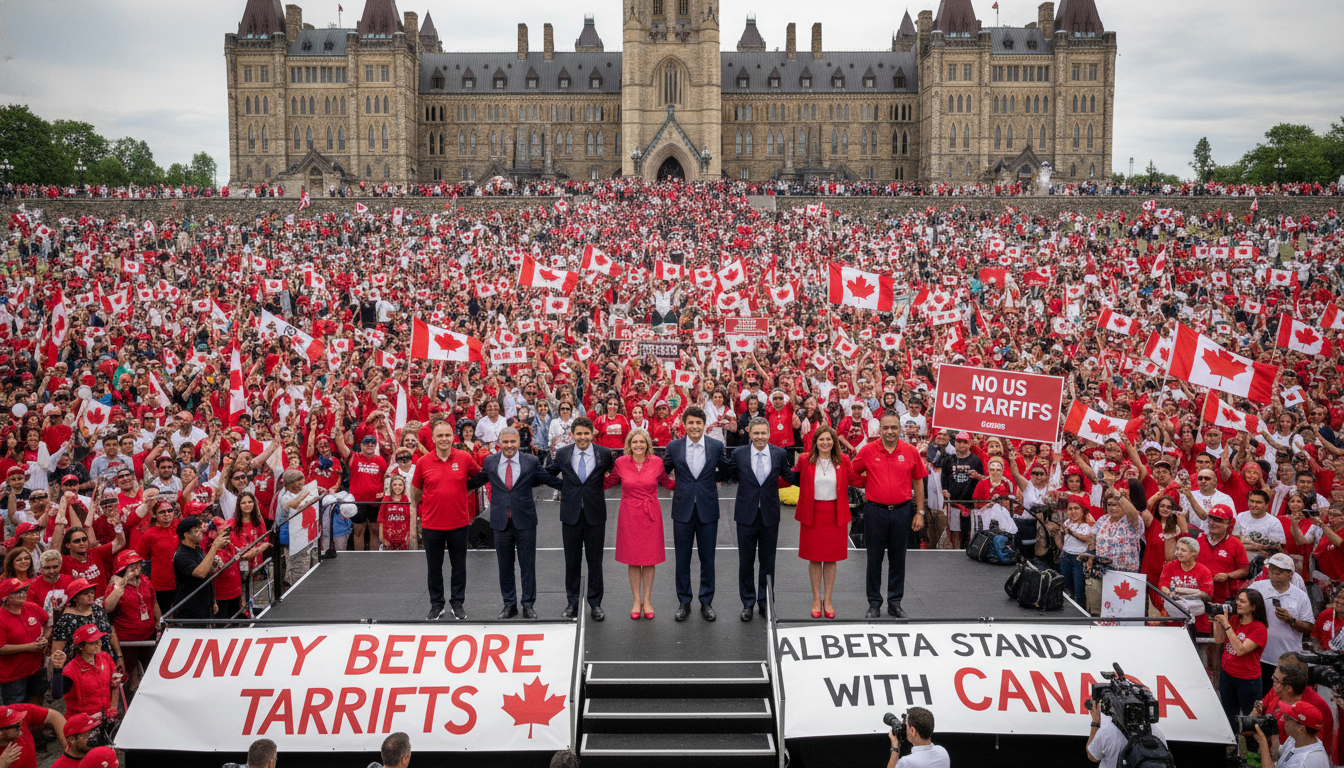
Alberta independence debate intensifies as U.S. tariff clash fuels surge in pro‑unity activity
A spike in public attention toward Alberta independence has coincided with the collapse of Canada‑U.S. trade talks and a sharp escalation in tariffs, prompting a surge in engagement for pro‑unity campaigners ahead of the province’s Oct. 19, 2026 referendum. The trade breakdown and retaliatory measures have been cited by organizers as a key reason for recent online turnout and interest in campaigns that favour keeping Alberta in Canada. The convergence of economic dispute and a high‑stakes provincial vote has tightened the political terrain across Alberta and Ottawa. (axios.com)
Trade talks collapse sparks surge in pro‑unity activity
The bilateral negotiations between Ottawa and Washington broke down in late August, and the United States moved quickly to impose steep additional duties on a range of Canadian goods. The collapse and the imposition of elevated duties have reverberated through Canadian politics and public opinion, introducing new urgency to debates over national cohesion. Federal leaders framed the escalation as an attack on Canadian industries, while premiers and business groups warned about potential economic fallout. (axios.com)
Public reaction in Canada has leaned toward backing a firm stance, with opinion research showing strong support for standing up to Washington’s demands. Polling conducted in the weeks after the talks stalled indicated a majority of Canadians support refusing the U.S. terms and responding with matched counter‑tariffs. That sentiment has been cited by pro‑unity organizers as evidence that the tariff dispute strengthens the case for solidarity. (angusreid.org)
The international dimension of the dispute has given new prominence to provincial political battles that had been mostly confined to Alberta. Observers say the trade confrontation has changed the story from an internal provincial debate into a matter played out on a continental stage, increasing both media attention and grassroots activity. The external shock has therefore become an amplifying factor for campaigns on both sides of the independence question.
Forever Canadian reports spike in engagement
Forever Canadian, the pro‑unity group founded by former deputy premier Thomas Lukaszuk, reported a marked increase in participation at recent events and online gatherings. Organizers said an online town hall drew more than 11,000 viewers over the weekend, a level of reach they described as far above earlier spring virtual meetings. The campaign attributes the jump in interest to concerns over the Canada‑U.S. trade confrontation and the perceived need to present a united national front. (ca.headtopics.com)
The group, recognized for its modified Canadian flag emblem and a petition drive that gathered hundreds of thousands of signatures, has used lawn signs, a “Unity Bus” tour and digital outreach to counter separatist messaging. Forever Canadian’s organizers say the combined ground and online strategy aims to mobilize undecided voters ahead of the binding referendum option that could unfold after the Oct. 19 vote. Volunteers report more inquiries and purchase requests following the tariff escalation. (globalnews.ca)
Campaign officials emphasize their message is grounded in economic stability and national institutions, arguing that increased external pressure—whether diplomatic or economic—heightens the costs of fragmentation. They have also sought to position their outreach as nonpartisan, aimed at preserving Alberta’s place within Canada rather than taking sides in provincial electoral contests.
Separatists interpret tariffs as proof Canada ‘can’t work’
Pro‑independence voices have seized on the tariff clash to argue that the federal system failed to protect Alberta’s interests in the face of an aggressive foreign policy. Prominent online hosts and organizers framed the breakdown as confirmation of long‑standing grievances, suggesting that a sovereign Alberta could pursue more favourable trade arrangements. Some commentators on separatist platforms went further, arguing that the crisis validates calls to withdraw from Confederation. (ca.headtopics.com)
Figures active in the separatist movement said the trade tension offers a political opening to persuade undecided voters that Canada cannot guarantee Alberta’s prosperity or autonomy. They presented the federal government’s handling of the talks as evidence that national decision‑making is tilted toward more populous provinces, and used imagery and opinion graphics to emphasize regional disparity. These narratives are being circulated across social media and independent streaming channels with substantial viewership. (ca.headtopics.com)
Not all independence advocates endorsed confrontational rhetoric, and some in the movement cautioned against alienating moderate voters. Still, strategic messaging from separatist organizers has included appeals to economic self‑determination and scepticism about Ottawa’s ability to shield provincial industries from foreign pressure.
Public opinion and polling show majority support for a hardline response
Recent polling from national research organizations showed a clear tilt in public sentiment toward backing Ottawa’s refusal to accept the U.S. terms and toward reciprocal measures. The Angus Reid Institute’s surveys in the wake of the talks’ collapse reported that a substantial portion of Canadians support rejecting the U.S. proposals and adopting dollar‑for‑dollar retaliatory tariffs. The national inclination toward firmness, while somewhat less pronounced in Alberta, still remains a majority position in the province according to the same research. (angusreid.org)
Analysts say that while public backing for a hardline stance can consolidate a rally‑around‑the‑flag response, it also compresses the rhetorical space for separatist arguments premised on federal incompetence. Poll results suggest that the tariff dispute may have strengthened the hand of those urging national unity, at least for the near term. The timing of the polling relative to the referendum timetable has created a volatile political context in which short‑term events could sway undecided voters. (angusreid.org)
Experts caution that public opinion is fluid and that economic impacts, media coverage and targeted campaigns on both sides will continue to shape sentiment as October approaches. The poll data indicate broad national solidarity for now, but they also reflect anxieties about job security and local economic consequences that could alter preferences if disruptions deepen.
Former premiers and business leaders mount cross‑party campaign for unity
In a notable political development, former Alberta premiers from opposite sides of the provincial spectrum have taken a public role in a business‑backed campaign to keep Alberta within Canada. Jason Kenney and Rachel Notley were named co‑chairs of a Canadian Chamber of Commerce initiative intended to make the economic argument against separation and to reassure investors worried about heightened political risk. The move put two well‑known provincial figures into a joint public posture emphasizing the risks separatism poses to the province’s economy and investor confidence. (globalnews.ca)
Business leaders and chamber officials framed the joint campaign as a non‑partisan response to rising uncertainty and potential damage to Alberta’s investment climate. The campaign’s public materials stress the practical consequences of constitutional disruption, including trade interruptions, investor flight and increased costs for businesses operating across provincial and national borders. Organizers argued the message is aimed at persuading middle‑of‑the‑road Albertans who might be swayed by economic arguments ahead of the referendum. (globalnews.ca)
The Kenney‑Notley partnership underscores how rapidly the issue has moved from fringe to mainstream, with former political rivals—each with significant followings—now unified on a single public campaign. Observers say their involvement is designed to reach different constituencies and to present a broad coalition in favour of staying in Confederation.
Legal and practical timeline for the Oct. 19 referendum and what comes next
The province has formalized the wording and timing of the referendum set for Oct. 19, 2026, and the question will ask whether Albertans want the province to remain part of Canada or to commence a legal process toward a binding referendum on separation. Elections Alberta’s timetable and the provincial government’s order in council lay out the administrative framework for voting and the subsequent steps depending on the outcome. The October vote is a pivotal moment in a process that could trigger further constitutional and legal debate. (tst.elections.ab.ca)
If the referendum result were to favour initiating a binding vote on independence, provincial officials have indicated that a second, legally binding plebiscite could be scheduled in the months that follow, potentially pushing the decisive vote into early 2027. Legal scholars and constitutional experts emphasize that even a binding provincial result would face a complex and uncertain path, including federal responses, court challenges, and the need for negotiated agreements with Indigenous nations. Those procedural and legal realities are central to public discussions about the practical prospects for a successful separation bid. (tst.elections.ab.ca)
Campaigns on both sides are therefore focusing not only on persuading voters for October, but also on setting expectations about the technical and constitutional hurdles that would determine any subsequent course. Messaging on the ballot line is being supplemented with legal briefs, town halls and targeted outreach to communities that could decide the outcome.
A growing number of Albertans say the present moment feels consequential, and both pro‑unity and pro‑independence groups are intensifying their outreach in the weeks before the vote. The trade dispute has added an international dimension that could reshape the calculus for undecided voters, with economic risk and national identity now part of a single political equation.
The combination of an escalated trade dispute with the United States and a scheduled provincial referendum has sharpened the choices facing Albertans in the autumn vote, raising the stakes for campaigns on both sides. The immediate surge in engagement for pro‑unity groups, the increased visibility of separatist messaging, and the entry of prominent cross‑party figures into the campaign mix all point to a contest that will be fought as much in living rooms and online streams as it will be in legislative halls. Whatever the outcome on Oct. 19, the political and legal reverberations are likely to extend well beyond the ballot, shaping Alberta’s role in Canada amid an unpredictable international environment.
