
Federal return-to-office four days a week triggers major lease activity, but capacity questions remain
Government leases equal to 16.6 World Cup soccer fields as Ottawa prepares for return to office four days a week, while departments warn space is still short.
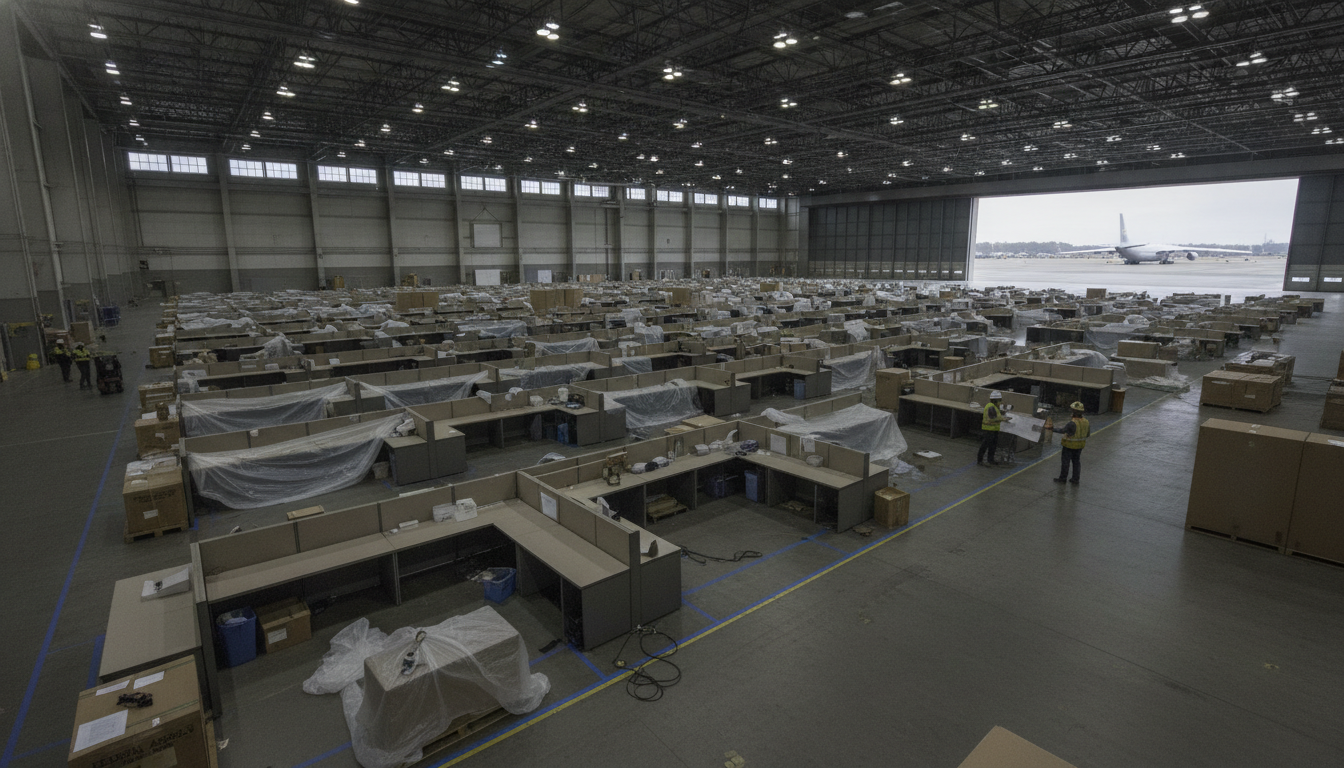
The federal government has leased the equivalent of about 16.6 World Cup soccer fields in office space as it moves to implement a return to office four days a week for public servants. The surge in leasing and a pledge to assign desks to most employees has not resolved concerns from departments that say available space remains constrained. Officials say optimization of existing buildings will be prioritised before further acquisitions are considered.
Leases secured across the country
Public Services and Procurement Canada has signed 39 leases nationwide in recent months, covering roughly 118,937 square metres of floor space. Three quarters of that new leased area is concentrated in the National Capital Region, reflecting the largest demand pressure points for federal workplaces.
A spokesperson for the department stressed that the new agreements do not necessarily represent a net increase in overall space because some leases replace existing arrangements, relocate operations or are part of a broader portfolio rebalancing. Still, the volume of new agreements signals a significant push to shore up capacity ahead of the mandated workplace change.
Treasury Board Secretariat promises assigned seats
Faced with criticism from unions and employees, the Treasury Board Secretariat has committed to providing assigned workstations to the majority of federal employees covered by the new requirement. The Secretariat also told departments that those with more acute space shortages may be allowed to stagger their implementation timelines to reduce operational disruption.
Officials framed the assigned-seat pledge as a response to workforce concerns about predictability and collaboration. At the same time, they emphasised that detailed rollouts will vary by department depending on local footprints and operational needs.
Coworking sites slated for closure and reassignment
As part of a broader realignment, all current federal coworking sites are scheduled to close by the end of September 2026 and be reassigned to departments that face shortages of fixed office space. The government views the closure as a way to redistribute scarce capacity and prioritise ministries with acute in-person needs.
Departments that relied on coworking locations will have to integrate those displaced employees into traditional departmental footprints or into newly leased premises. The reallocation policy has prompted some ministries to accelerate internal reviews of seating plans and team configurations.
Departments push back on timeline over limited space
Several ministries, including Global Affairs Canada and Immigration, Refugees and Citizenship Canada, have already delayed their own return-to-office plans because they do not yet have sufficient space to accommodate employees four days per week. These deferrals highlight the uneven distribution of office capacity across the public service.
Public Services and Procurement Canada itself acknowledges it cannot host all of its unionised staff in-person for four days a week under current arrangements. Some of its employees will remain on three-day office schedules for the foreseeable future, underscoring the practical limits of the overall plan.
Officials stress optimisation before new purchases
Government officials say their immediate approach is to optimise existing real estate before pursuing larger purchases or long-term acquisitions. The department responsible for federal properties has indicated that any decision to add new buildings will follow a comprehensive optimisation exercise to identify underused space and reconfigure workplaces where possible.
A department spokesperson said that if additional premises are still required after that optimisation process, those needs will be considered on a case-by-case basis. This staged approach aims to limit unnecessary expenditure while addressing genuine space shortfalls.
Operational challenges and labour considerations
Beyond square metres and desk counts, the rollout raises operational questions for managers and bargaining units. Assigned seating can improve reliability for teams that need predictable in-person collaboration, but it also requires detailed scheduling, changes to accommodation policies, and potential capital outlays for reconfigured workstations.
Unions have raised concerns about the feasibility of immediate four-day in-person requirements, citing childcare, commuting, and equity considerations for employees with caregiving responsibilities. Departments balancing operational imperatives with labour-management discussions are likely to see uneven implementation timelines across government.
The federal government has presented a mix of lease activity, policy commitments and staged timelines in response to the push for a return to office four days a week. While the newly signed leases expand nominal capacity, officials and departments acknowledge more work is needed to match space to staff in practice.
Longer-term decisions on whether to purchase additional buildings or to rework the federal real estate portfolio will depend on the results of the optimisation exercise and evolving operational priorities. In the meantime, some ministries will delay fuller returns and others will adopt mixed schedules as the public service adjusts to the new workplace requirement.
