
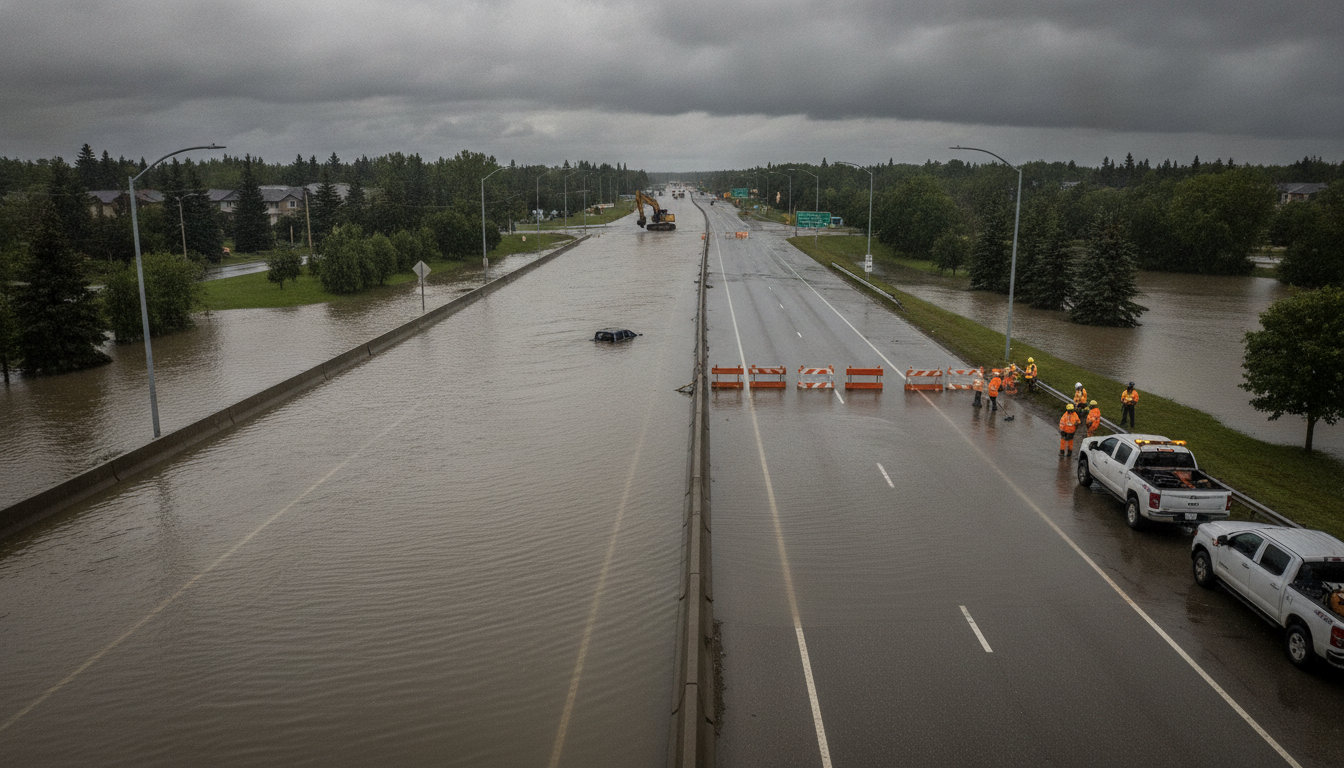
Edmonton flooding forces partial closures after late-night storm; major roads reopen but Whitemud Drive still affected
Edmonton flooding: Major roads reopen after July 25 storm; Whitemud Drive remains closed as city crews and EPCOR work to clear water, debris and restore power.
The city of Edmonton is responding to significant flooding after a severe summer storm late on Saturday, July 25, 2026, that inundated streets and disrupted power and traffic across neighbourhoods. Edmonton flooding affected multiple major routes overnight, prompting city crews and EPCOR to mobilize for water removal, debris clearance and restoration of services. By Sunday morning several key corridors, including Yellowhead Trail and Groat Road, had reopened while portions of Whitemud Drive remained closed as assessments continued. Municipal officials urged residents to exercise caution on roadways and active transportation routes while cleanup and repairs proceed.
Major routes reopen but key arterial still closed
Several of the city’s busiest roadways were declared passable again by Sunday morning after crews cleared standing water and assessed pavement conditions. Yellowhead Trail and Groat Road were among the routes reopened, restoring vital east-west and north-south connections that many commuters rely on. The reopening followed targeted work at low-lying segments and intersections that had taken on heavy water during the downpour.
Despite those reopenings, portions of Whitemud Drive remained closed as crews inspected storm damage and cleared debris from the roadway. The city indicated closures were concentrated where flooding and debris posed ongoing hazards to passing vehicles and emergency response equipment. Motorists were advised to follow signage and detour routes, and to avoid driving through any standing water.
Localized flooding on Connors Road and 127th Avenue
Lower-lying streets and underpasses experienced some of the worst localized flooding during the storm, with Connors Road under the 98 Avenue bridge flooded overnight. City crews were able to reopen the Connors Road underpass by Sunday morning after pumping and debris removal operations. Similarly, 127th Avenue, which saw flooding during the heaviest rainfall, was cleared and reopened once water levels receded and assessments confirmed it was safe for traffic.
These low-clearance crossings often act as collection points in intense rain events, concentrating runoff faster than surrounding streets can drain. The city’s rapid deployment of pumps and road maintenance crews helped restore access to those corridors, but officials cautioned that residual damage such as pavement undermining or potholes could appear once water recedes completely.
Meteorological data and storm timing explain sudden impacts
Environment Canada recorded nearly 30 millimetres of rain in central Edmonton between roughly 9 p.m. and 10 p.m. on Saturday, with sustained winds averaging about 39 km/h and gusts reaching as high as 84 km/h. That concentrated burst of precipitation, combined with strong winds, produced conditions that overwhelmed portions of the drainage system and led to downed trees and reports of sewer backups. Meteorologist Heather Pimiskern said the agency issued its first warning for the city around that 9 p.m. period as the storm moved through.
The combination of intense short-duration rainfall and high winds is a common driver of urban flash flooding because stormwater systems have limited capacity for such rapid inflow. In this event, the timing and location of the heaviest rainfall coincided with densely developed parts of the city, amplifying surface runoff into streets and underpasses.
City and EPCOR crews respond to traffic signal and power disruptions
City of Edmonton teams and EPCOR worked through the morning to address traffic signal outages and scattered power interruptions caused by the storm. The municipality reported traffic signals affected in multiple locations, requiring manual traffic control or temporary signage at busy intersections until electrical systems could be inspected and repairs completed. Residents were warned to treat non-functioning traffic lights as four-way stops and to heed direction from on-site personnel.
As of approximately 11:30 a.m. on Sunday, July 26, EPCOR’s outage map showed 19 areas experiencing power interruptions related to the storm. An EPCOR spokesperson said technicians were on site and anticipated power restoration by about 1:30 p.m., while stressing that timelines could shift if crews encountered downed lines or other safety hazards. Officials asked customers to report outages through EPCOR channels so technicians could prioritize critical locations such as hospitals and community facilities.
Public safety guidance and precautions for drivers and pedestrians
City officials emphasized that even after roads are declared open, conditions can remain hazardous as debris and slick surfaces persist. Drivers were advised to reduce speed, increase following distance and avoid driving through standing water to prevent vehicle damage and the risk of becoming stranded. The city also reminded cyclists and pedestrians that active transportation pathways may be compromised by debris or flooding and to choose alternate routes where necessary.
Authorities urged residents to keep an eye on local updates and advisories, and to report hazards like downed power lines, large branches blocking sidewalks or deep water in roadways. For urgent life- or property-threatening situations, citizens were instructed to contact emergency services; for non-emergency concerns such as localized flooding or blocked catch basins, municipal service lines and EPCOR’s outage reporting were recommended.
Infrastructure damage, sewer backups and tree loss reported
Beyond surface flooding, crews received reports of sewer backups in some neighbourhoods and several trees uprooted by the combined force of rain and wind. Sewer backups can occur when municipal systems are overwhelmed and can pose health risks and property damage, prompting the city to coordinate with drainage and wastewater crews to assess and mitigate impacted properties. Residents facing basement flooding were reminded to document damage and contact their insurers as well as municipal assistance lines.
The storm also left a noticeable trail of tree damage in some areas, with large branches and whole trees coming down on roads, sidewalks and private property. Arborist teams and public works staff prioritized removing hazardous trees from thoroughfares and parks to prevent secondary incidents and to reopen greenway and trail corridors for public use. City officials noted that a full assessment of public-tree damage would take several days as crews complete inspections across neighbourhoods.
Short-term recovery plans and monitoring of drainage systems
City management outlined a phased recovery approach that began with safety assessments and prioritized reopening main traffic corridors and restoring utilities. Following immediate response, attention shifts to inspecting road surfaces for erosion, repairing traffic signals and cleaning storm drains and catch basins to reduce the chance of repeat flooding in the days ahead. These activities include coordination between transportation, drainage, parks and utility teams to ensure a comprehensive recovery.
Officials indicated they will continue to monitor weather forecasts closely and to deploy crews proactively if additional rainfall is expected, recognizing that saturated ground and blocked drains can exacerbate even modest follow-up showers. The municipality also plans to review this incident’s operational response to identify any system vulnerabilities that may be addressed through future capital work or targeted maintenance.
Community supports and information for affected residents
In response to neighbourhood impacts, the city and partner agencies stood ready to offer guidance and services to residents affected by flooding or power outages. Information on where to report localized flooding, who to contact for sewer backup assistance and steps for documenting damage was posted through municipal channels and social media to help expedite support. EPCOR encouraged customers with service interruptions to use its outage tools and to remain clear of downed wires until crews arrive.
Community centres and emergency reception points can be activated if displaced residents require temporary shelter, though no large-scale evacuations were reported as of midday Sunday. Neighbourhood-level volunteers and mutual aid networks often play a role in the immediate aftermath of storms by assisting vulnerable neighbours, and local non-profits and faith groups have historically helped with cleanup and supply distribution following severe weather.
Edmonton residents are being asked to remain cautious during cleanup and to follow official advisories as municipal and utility crews continue work through the day to restore normal operations. The city will provide further updates as assessments are completed and as power restoration timelines are confirmed by EPCOR.
