
U.S. involvement clouds Colombian presidential election as ICE arrest and Trump endorsement escalate tensions
ICE arrests, U.S. rallies and Trump’s endorsement intensify the Colombian presidential election, sparking debate and worries about external interference.
The closing days of the Colombian presidential election have become deeply entangled with events in the United States, as high-profile U.S. visits, an ICE arrest in Arizona and a formal endorsement from former U.S. President Donald Trump have altered the tenor of the runoff. The Colombian presidential election now faces scrutiny for possible foreign influence as supporters and critics of both front‑running candidates marshal allies on U.S. soil. With the second round set for June 21, 2026, the contest’s outcome may hinge as much on transnational political dynamics as on voters in Colombia.
ICE arrest of Colombian activist in Arizona draws sharp reactions
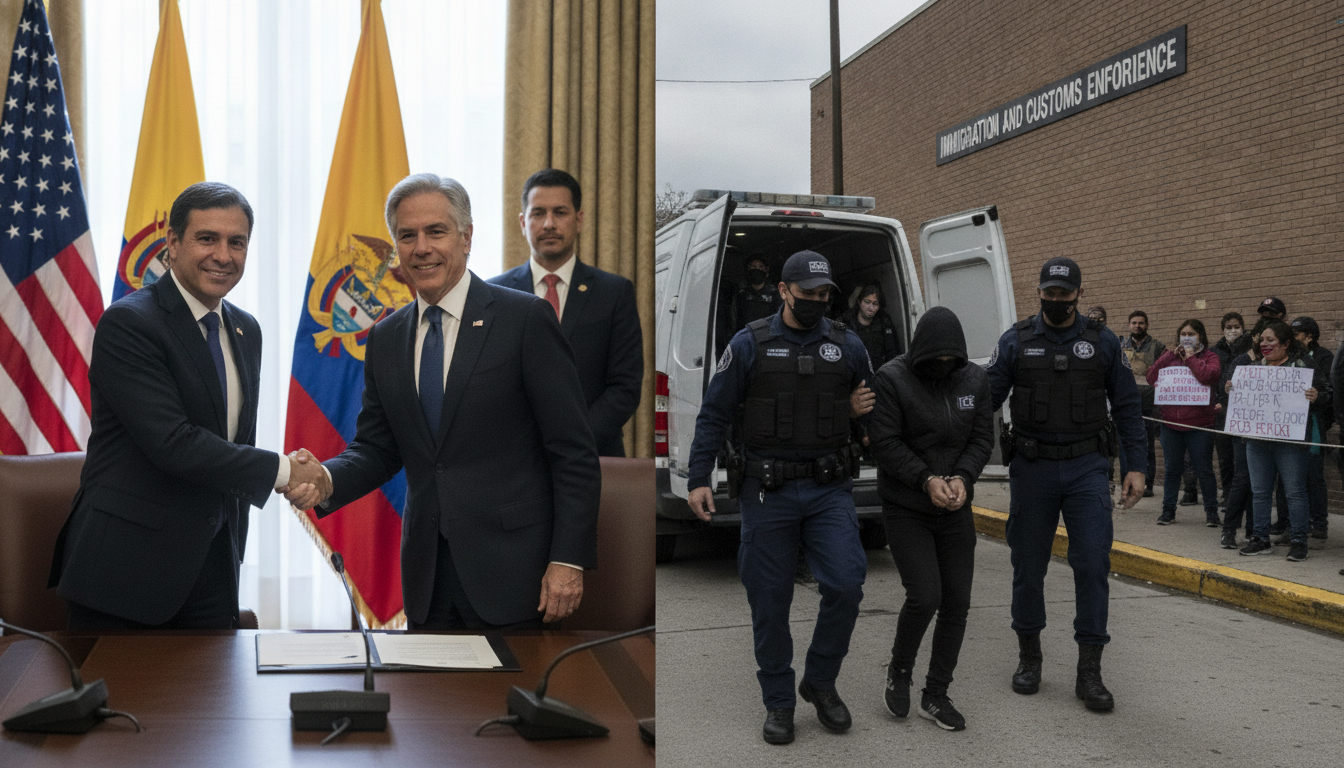
The U.S. Immigration and Customs Enforcement agency arrested a prominent Colombian left‑wing activist, Beto Coral, in Arizona this week, officials confirmed. Coral, who has reportedly lived in the United States since 2015, was detained days after participating in demonstrations opposing Abelardo de la Espriella. The arrest prompted immediate reaction from U.S. politicians and activists who viewed the move as politically consequential rather than purely immigration enforcement.
Republican members of Congress hailed the arrest, while a group of 11 Democratic lawmakers sent a letter to the White House expressing deep concern about what they described as potential interference in Colombia’s democratic process. The contrasting responses have amplified partisan debate in Washington over whether U.S. actions are influencing a foreign election or enforcing immigration law impartially.
High‑profile U.S. rallies for both camps escalate visibility
In recent weeks, large political gatherings in Phoenix, Miami and New York have given the Colombian runoff a U.S. stage, with both Republican and Democratic elected officials attending events. The rallies — sometimes drawing thousands — featured endorsements and public appearances that reinforced each candidate’s U.S. ties and fundraising networks. Organizers said the demonstrations were intended to mobilize expatriate Colombians and sympathetic U.S. constituencies, but critics warn they risk turning American cities into proxy battlefields for a foreign election.
These U.S. appearances amplified messaging on both sides: supporters of Iván Cepeda frame him as a defender of social justice, while backers of Abelardo de la Espriella cast him as a law‑and‑order alternative. The prominence of elected U.S. figures at these events has intensified scrutiny of cross‑border political influence and raised questions about how diaspora politics intersect with domestic Colombian concerns.
Trump’s June 2 endorsement raises international stakes
On June 2, former U.S. President Donald Trump publicly endorsed Abelardo de la Espriella, describing him as a candidate who could deliver economic growth, curb illegal migration and restore order. The endorsement, posted on the former president’s social platform, stressed de la Espriella’s purported alignment with Trump‑style priorities and noted the candidate’s dual U.S. citizenship and prior support for Trump’s campaign. Trump’s intervention has been cast by some analysts as part of a broader pattern of U.S. leaders favoring foreign politicians with compatible political and economic agendas.
Trump’s remarks also framed Iván Cepeda as a “radical left” figure, terminology that supporters of Cepeda have criticized as reductive and inflammatory. The endorsement has added urgency to diplomatic and domestic debates about the appropriateness of prominent U.S. political actors taking sides in another country’s election.
De la Espriella’s calls for U.S. action alarm diplomats
Abelardo de la Espriella has publicly urged U.S. authorities to take punitive steps against political opponents in Bogotá, including requests to revoke visas for President Gustavo Petro and his allies. He has called on the U.S. Department of Justice to investigate and prosecute figures he accuses of corrupt ties, and he has characterized some members of the current Colombian administration in harsh terms. Those demands, voiced in campaign videos and speeches, have raised concerns about the potential use of U.S. legal and diplomatic measures as campaign tools.
Diplomatic observers warn that pressing a foreign government to pursue criminal cases against sitting officials of another country risks straining bilateral relations and could be perceived as external meddling. Legal experts note that U.S. authorities retain discretion over visa and prosecutorial decisions, but political pressure during an active foreign electoral campaign complicates the usual separation between law enforcement and electoral politics.
U.S. lawmakers express concerns about interference and funding ties
The week saw a formal response from a group of U.S. Democratic legislators who wrote to the White House urging caution and a review of alleged ties between de la Espriella and controversial financing networks. The letter warned that U.S. actions could be interpreted as favoring one political camp in Colombia, undermining the country’s sovereign democratic process. Lawmakers asked for transparency and a careful reevaluation of any U.S. role that might influence the election outcome.
On the other side, Republican officials and some analysts argue that highlighting alleged finance links and security concerns is legitimate oversight, framing support for de la Espriella as defense of democratic values and rule of law. The split in Congress reflects the broader partisan divide playing out publicly in the run‑up to the June 21 runoff.
Narrow margins and a fragile peace heighten domestic risks
The runoff itself remains tightly contested after the May 31 first round, in which Abelardo de la Espriella received roughly 10.3 million votes and Iván Cepeda about 9.7 million. Those margins, coupled with Colombia’s history of armed conflict and persistent criminal networks, have analysts warning that tensions could quickly escalate if either side perceives unfair external influence. Colombia’s recent years have seen episodes of unrest and reorganized criminal groups exploiting public disorder, making the electoral period especially precarious.
Campaign strategists in Bogotá say both candidates are mobilizing supporters for a decisive turnout on June 21, 2026, and many Colombians are watching for whether international interventions will sway undecided voters. Observers in Colombia and abroad stress that maintaining electoral integrity and respecting national sovereignty will be central to avoiding a deeper political crisis.
As the runoff approaches, the intersection of U.S. politics and Colombian voting presents a test for diplomatic restraint and electoral independence. Voters in Colombia will decide the presidency at the ballot box on June 21, 2026, while officials and advocates on both sides of the border debate the proper limits of foreign involvement.
