
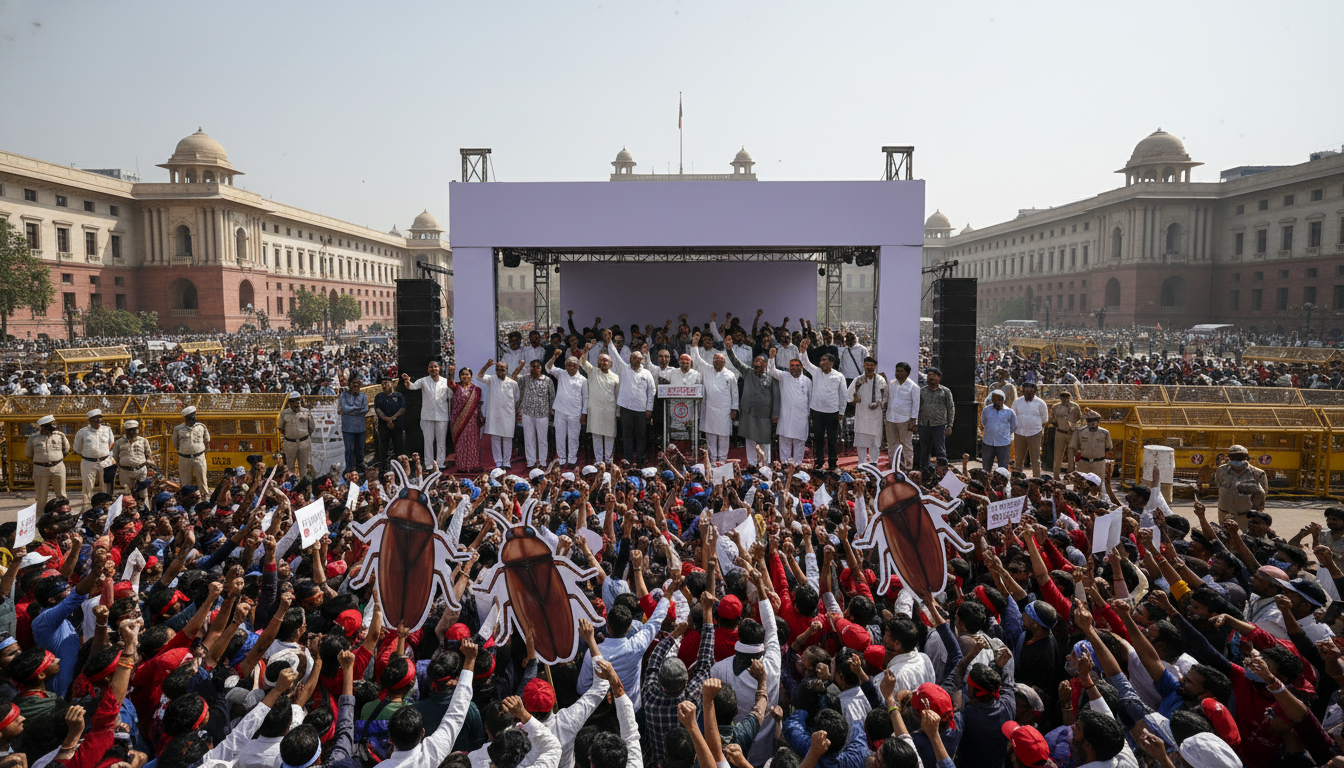
Thousands in India Protest Over Exam Paper Leaks, Demand Education Minister’s Resignation
Thousands in India marched on June 6, 2026, led by the satirical Cockroach Janta Party, demanding the education minister resign over alleged exam paper leaks.
Mass rally across multiple cities
Thousands of members of the online satirical group Cockroach Janta Party took to the streets across several Indian cities on June 6, 2026, to protest alleged exam paper leaks and marking errors. The demonstrators called for the immediate resignation of the country’s education minister, saying systemic failures had harmed students’ futures.
Protest organisers said the turnout reflected widespread anger among families and young people after recent examination controversies, and that the demonstrations were peaceful for the most part. Abhijeet Dipke, founder of the Cockroach Janta Party, was reported to be in India and joined the movement’s public actions.
Allegations of exam paper leaks and marking errors
Protesters accused exam authorities of permitting leaks of key question papers and of failing to correct marking mistakes that affected large numbers of candidates. They say those errors have caused distress, damaged prospects for university admission and employment, and undermined confidence in national assessments.
Organisers and demonstrators framed the protests around demands for accountability, transparent investigations and immediate remedial measures to protect students. Activists pointed to social media posts, group testimony and anecdotal cases as the basis for their claims, while urging formal inquiries.
Families, students point to tragic consequences
Speakers at rallies and in online statements linked the examination controversies to acute mental-health impacts on students, saying pressure, uncertainty and perceived injustice had driven some young people to take their own lives. Those assertions were presented by protesters as a central reason for political and administrative changes.
Advocates for students called for urgent mental-health support at schools and colleges, and for a nationwide review of exam procedures to prevent further harm. Several family members who attended demonstrations sought faster, more compassionate responses from education authorities.
Government and ministry response limited
The Ministry of Education did not immediately issue a detailed public response to the protests, and there was no confirmed statement from the education minister at the time of the demonstrations. Officials at local levels indicated that inquiries were underway in some jurisdictions, but activists said those steps were insufficient.
Civil servants and exam boards that oversee national and state assessments have faced increasing scrutiny in recent months, and some authorities acknowledged receiving complaints about irregularities. Protesters demanded transparent timelines and the release of investigation findings to restore public trust.
Role of the Cockroach Janta Party and online mobilisation
The Cockroach Janta Party, originally a satirical online movement, has increasingly translated social media mobilisation into street-level activism in recent years. Its founder, Abhijeet Dipke, and other organisers used digital platforms to coordinate the June 6 demonstrations and publicise victims’ accounts.
Analysts say the group’s blend of satire and direct action has lowered barriers to political engagement for young people, while also testing the boundaries between online dissent and organized protest. The movement’s ability to gather thousands suggests deep public resonance with concerns about educational fairness.
Calls for systemic reform and independent probes
Beyond immediate resignations, protesters and education advocates demanded comprehensive reforms to exam administration, improved oversight of marking, secure paper handling, and independent audits of recent test cycles. Some legal experts suggested court-supervised investigations as a path to credible review.
Policy analysts highlighted long-standing structural issues in India’s exam system — from high-stakes testing to decentralised boards — and urged reforms that would reduce pressure on students and strengthen quality assurance. Opposition parties and civil-society groups signalled readiness to press the government for concrete measures.
As the demonstrations wound down, organisers vowed to maintain pressure until clear action is taken and formal inquiries are published. Protesters said they would pursue a mix of legal petitions, public campaigns and continued street mobilisation to press their demands for accountability and systemic change.
