
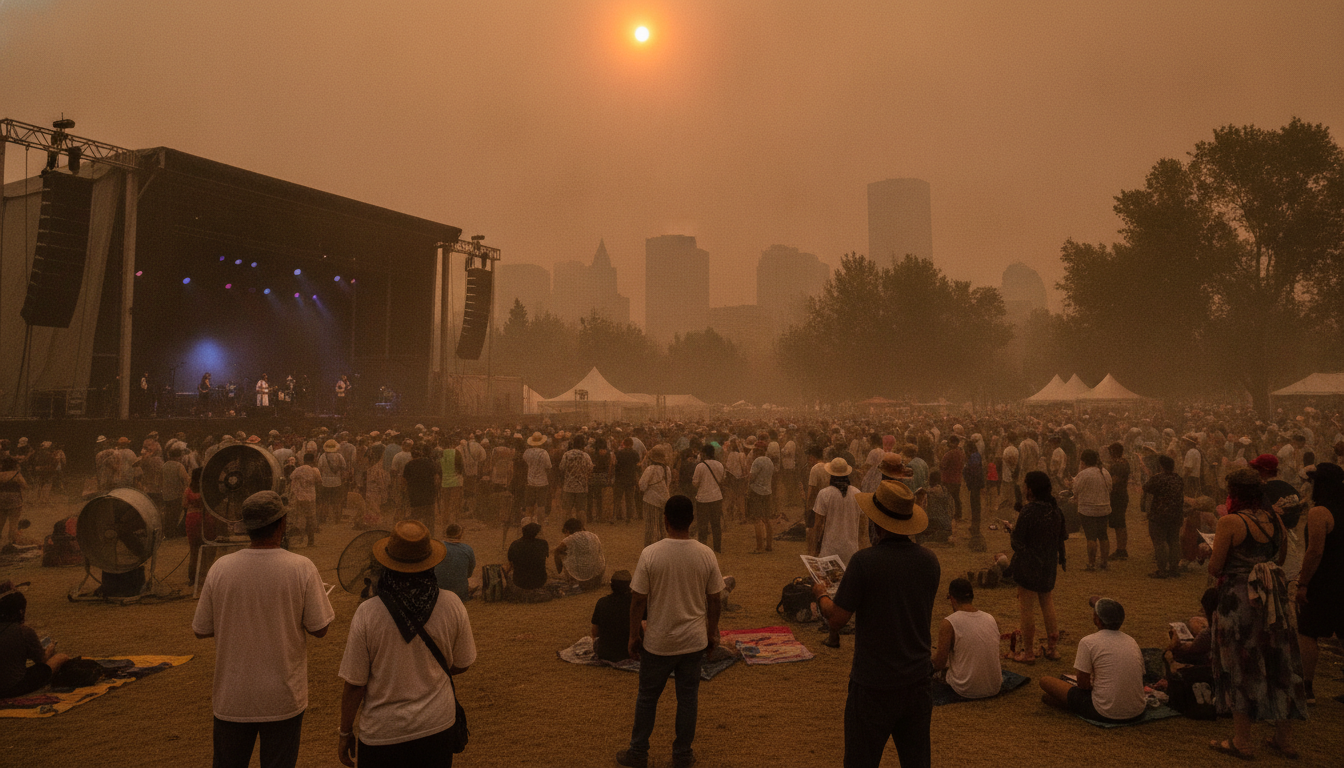
Calgary Folk Music Festival opens July 23-26 amid heat warnings and wildfire smoke
Calgary Folk Music Festival opens July 23-26 amid heat warnings and wildfire smoke; organizers deploy air monitors, misters and a smoke handbook for visitors.
The Calgary Folk Music Festival opened on the evening of July 23, 2026, as organizers and public-health officials warned of high temperatures and intermittent wildfire smoke across the region. Environment and Climate Change Canada issued heat warnings on July 23 for much of southern and east-central Alberta, forecasting daytime highs above 30°C through the weekend and smoke pockets persisting into Friday morning. Festival leaders said they have tools and plans in place — from hyperlocal air monitoring to cooling stations and a newly released wildfire smoke handbook — to help artists and audiences navigate the conditions. The four-day event runs through July 26 on Prince’s Island Park and features more than 70 artists across seven stages.
Heat warnings and smoke advisory issued the day the festival began
Environment and Climate Change Canada released heat warnings for large parts of southern and east-central Alberta on July 23, citing a multi-day stretch of daytime temperatures expected to exceed 30°C. Forecasters also issued a smoke advisory tied to ongoing wildfire activity, predicting widespread hazy conditions through Friday, July 24, with dispersion expected by midday. Public health guidance accompanying the alerts urged people to limit strenuous outdoor activity, stay hydrated and check on vulnerable family members and neighbours during the heat.
Organizers at Prince’s Island Park said they were tracking both heat and air-quality bulletins closely and coordinating with city services to adjust operations as conditions change. The combination of high temperature and reduced air quality can raise the risk of heat-related illness and respiratory irritation, making on-site mitigation measures a priority for the festival’s safety team. Officials emphasized that the situation remains dynamic and that festival plans will be adapted according to the latest meteorological and air-quality data.
Festival deploys air monitors and issues wildfire smoke handbook
Festival staff said they introduced real-time air-quality monitors last year and have since integrated those tools into operational decision-making on site. The monitors provide hyperlocal readings for Prince’s Island Park, enabling staff to compare local exposure levels with broader regional indices and to advise attendees and performers accordingly. Organizers also published a wildfire smoke handbook in June 2026 aimed at outdoor event planners; the guide lays out thresholds for modifying programming, communicating risks and safeguarding participants.
Festival executive staff described the handbook as a practical framework rather than prescriptive regulation, designed to give event operators a common language and set of actions when smoke appears. The document walks through monitoring options, messaging templates and recommended interventions for different ranges of particulate matter. Organizers said they will rely on a combination of federal advisories, local air-monitoring data and medical guidance to make real-time calls about programming or changes to site procedures.
On-site cooling and hydration measures for heat management
To reduce heat stress risks, the festival has installed a network of misters across the island and increased the number of water stations available to patrons and staff. Attendees were encouraged to bring their own refillable bottles; festival staff will supply free water at multiple locations and mark shaded rest areas on site maps and signage. Medical tents and first-aid crews are positioned to respond quickly to heat exhaustion and heat-stroke symptoms, and volunteers have been briefed to look for signs of distress among concertgoers.
Event officials also highlighted practical precautions for visitors, including frequent breaks in shaded spots, moving to air-conditioned spaces when feasible and avoiding leaving people or animals in vehicles. Messaging at entrances and on the festival’s mobile platforms reiterates the standard signs of heat-related illness — elevated body temperature, confusion, fainting and lack of sweat — and instructs anyone who observes these symptoms to seek help from on-site medical teams. Festival organizers said they are prepared to scale up cooling resources if temperatures rise or if smoke reduces the effectiveness of outdoor ventilation.
Programming and lineup remain extensive despite conditions
This year’s Calgary Folk Music Festival presents more than 70 artists across seven stages, maintaining the event’s reputation for breadth and variety even as weather concerns shape operations. Artistic director Kerry Clarke described the lineup as a deliberate mix of legacy acts and rising performers, reflecting a broad interpretation of folk that includes elements of R&B, hip-hop and indie music. Headliners scheduled for the four-day run include Of Monsters and Men, Killer Mike and Thundercat, with workshops and collaborative sets designed to keep the festival’s communal, songwriter-focused ethos intact.
Organizers said they intend to preserve the performance schedule as long as environmental conditions remain within safe operational thresholds identified in their handbook. Contingency plans include shifting some sets to shaded stages, shortening performances when necessary and rescheduling collaborative workshops to later in the evening if smoke or heat levels peak during daytime hours. Ticket-holders were advised to follow the festival’s app and social channels for any last-minute stage or time changes driven by weather or air-quality updates.
Artists and community describe the festival as a crucial gathering
Performers at the festival framed Calgary Folk Music Festival as both a professional platform and a community touchstone that rewards in-person listening and collaboration. Calgary singer-songwriter Kate Stevens, appearing for a second consecutive year, called the event a homecoming where artists reconnect, swap songs and share creative energy across stages. Several musicians cited the intimacy of Prince’s Island Park and the festival’s workshop-style sessions as central to the event’s identity, even as the lineup stretches into diverse genres and larger-scale headliner draws.
Artists and organizers noted that the communal listening experience — audiences attentive to lyrics and storytelling — remains a distinguishing feature, particularly during midday acoustic sets and late-night collaborations. Musicians said the festival’s relatively compact site encourages spontaneous interactions between artists and fans, sustaining a close-knit atmosphere that contrasts with larger commercial festivals. Performers acknowledged the logistical complications posed by heat and smoke but expressed confidence in the festival’s on-site protocols and its emphasis on performer and audience well-being.
Logistics, safety staffing and city coordination for the four-day event
Operational staff said the festival has expanded its safety and medical staffing for 2026 and coordinated closely with city services to ensure rapid response capacity across the site. Security teams, medical personnel and volunteer stewards have been briefed on heat-illness protocols and smoke-response actions, including how to triage patrons who need shade or medical evaluation. Festival command staff also established communication links with Calgary emergency services and real-time weather-monitoring units to support decision-making over the three-day weekend.
Transportation and access plans reflect both the higher expected attendance and the potential for temperature-driven adjustments, with water supplies staged near transport hubs and staff positioned at key entry points to manage queueing in shaded areas. Food and beverage vendors have been asked to increase cold offerings and to post hydration reminders at service points. Event logistics managers said waste and recycling stations were also reviewed to prevent heat-related issues such as food spoilage and to keep circulation paths clear for emergency access.
Final paragraph
Organizers stressed that the Calgary Folk Music Festival’s priority for July 23–26 is to preserve the artistic program while protecting the health and safety of all participants through monitoring, clear communication and on-site interventions.
