
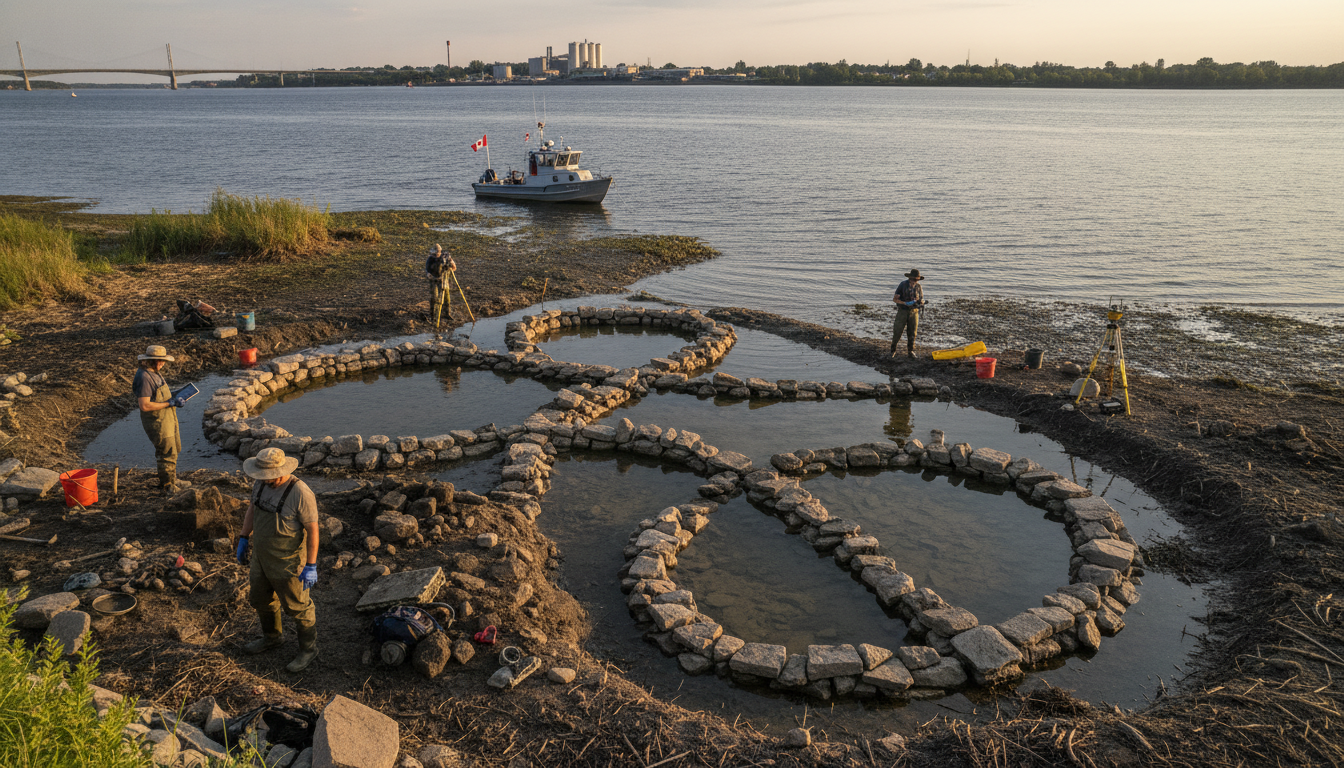
1200-year-old Saint Lawrence fish trap discovered near Contrecœur, Quebec
Archaeologists uncovered a 1,200-year-old Saint Lawrence fish trap near Contrecœur, identified with Indigenous knowledge and found during Port of Montréal works.
A well-preserved oval stone structure believed to be a Saint Lawrence fish trap has been documented on the riverbed between Contrecœur and Verchères in Montérégie. The discovery, made during preventive archaeology linked to the Port of Montréal expansion in 2024, represents the first identified pre-contact Indigenous underwater archaeological site in Quebec. Researchers say the submerged installation, roughly 38 metres long by 12 metres wide, was recognized as a constructed fish-capture system after consultation with Indigenous knowledge holders.
Underwater discovery during port expansion
The investigation began in 2024 as part of mitigation and inventory work tied to the enlargement of port facilities at Contrecœur. Initial multibeam and sonar imaging suggested an anthropogenic anomaly that at first resembled a shipwreck. Follow-up analysis revealed no hull or timber remains and instead showed deliberate layers of stone and rows of boulders covered by aquatic vegetation. The structure sits directly on the clay bottom of the Saint Lawrence and appears largely intact.
Identification with Indigenous expertise
Archaeologists working with the Institut de recherche en histoire maritime et archéologie subaquatique sought guidance from Indigenous specialists and local elders to understand the formation. Members of the w8banaki (Abenaki) community and other nations familiar with traditional fishing technologies recognized the pattern as consistent with stone fish traps still used elsewhere. Knowledge-bearers pointed to small notches and inward-facing barriers that would have channeled spawning fish into confined pockets where they could be harvested.
Construction, size and preservation
Survey data show the feature is oval and built in stepped tiers with stones up to a metre wide in places, indicating coordinated, labour-intensive construction. Its dimensions and masonry suggest communal effort for year-round or seasonal fish capture on a large scale. Although submerged today, the low level of disturbance and the presence of identifiable structural elements mean archaeologists can study construction techniques and possible maintenance patterns used by its builders.
Dating the structure to about 1,200 years ago
Researchers combined sonar imaging with historical aerial photos and regional water-level reconstructions to estimate the structure’s age. Aerial imagery from the 1930s shows the feature sitting on land at an islet historically known as Île aux Bœufs, while hydrological reconstructions indicate the specific water elevation required for the trap’s function last occurred roughly 1,200 years ago (circa 826 CE). Terrestrial archaeological inventories on nearby islands, including pottery fragments and hearth remains, provide complementary context that supports a pre-contact date for the installation.
Cultural attribution and significance for Indigenous history
An official report from the maritime archaeology institute suggests the structure may have been built by the St. Lawrence Iroquoians, a sedentary group documented by 16th-century European explorers. Specialists caution that multiple nations today consider themselves descendants of people who used the river and that oral histories and community perspectives are central to interpretation. The size and design of the trap point to substantial fish yields and therefore to large seasonal gatherings and organized food procurement strategies along the river corridor.
Heritage protection, ecology and the Port of Montréal project
The fish trap emerged while crews planned compensation measures tied to habitat loss from port development, notably the creation of new eelgrass beds intended to offset impacts to the endangered copper redhorse. Port authorities say environmental monitoring will include engagement with First Nations to track the site’s condition. Provincial cultural authorities maintain an archaeological registry but have limited dedicated funding for active protection or public interpretation, a gap that specialists and Indigenous representatives have urged governments to address.
The discovery underscores both the archaeological richness hidden in the Saint Lawrence and the complex overlap of heritage, development and ecological restoration. It also strengthens evidence that fishing played a much larger role in the diets and economies of pre-contact riverine communities than previously documented. The find will prompt further collaborative research, conservation discussions, and conversations with Indigenous communities about stewardship, access to knowledge, and how best to protect submerged cultural resources while meeting contemporary environmental obligations.
