
Canadian Prairies Severe Weather: Heavy Rain and Tornado Threats Span Alberta and Saskatchewan
Environment Canada warns heavy rain and tornado threats in the Canadian Prairies, raising flood and severe storm risks across Alberta and Saskatchewan today.
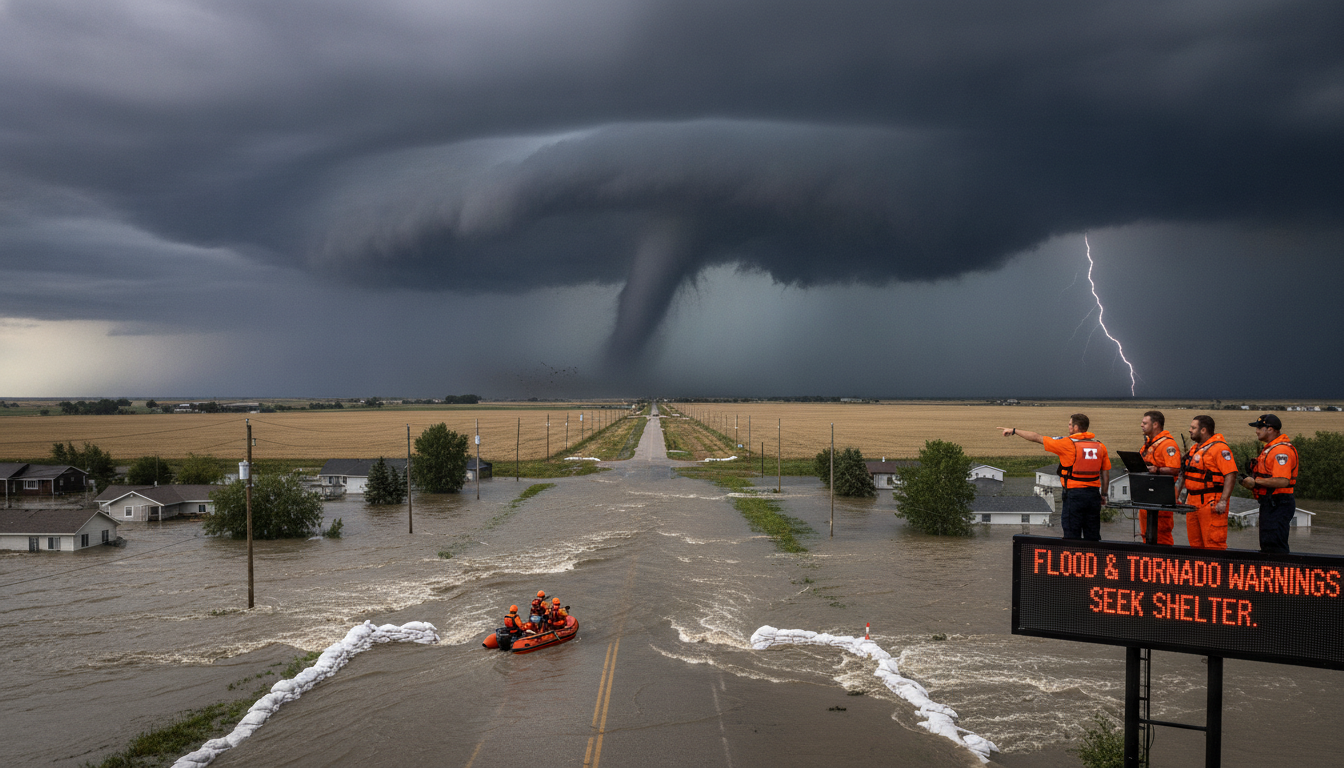
The Canadian Prairies severe weather system brought heavy rain and tornado threats to wide areas of Alberta and Saskatchewan over the weekend, prompting warnings from Environment Canada and local closures in urban centres. Environment Canada issued heavy rainfall alerts for parts of Alberta where 40 to 70 millimetres of rain were forecast, and tornado watches and severe thunderstorm notices were declared across large swaths of Saskatchewan. Authorities warned that saturated soils and recent above-normal precipitation have heightened the risk of overland flooding, washouts and damage to roads and private property.
Heavy rainfall warnings issued for parts of Alberta
Environment Canada placed eastern and central portions of Alberta under heavy rainfall warnings as a slow-moving system crossed the province. Forecast guidance called for pockets of 40 to 70 mm of rain through the weekend, with the heaviest amounts expected where storms trained over the same locations.
Meteorologists noted that much of the region had already recorded above-normal precipitation for June, leaving soils saturated and drainage systems under strain. That preconditioning increases the chance that additional rainfall would produce rapid runoff, localized flooding and erosion along small streams and field drains.
Officials cautioned that overland flooding could inundate low-lying yards, agricultural land and culverts, while persistent standing water might undermine road surfaces and bridges. Municipalities and provincial transportation departments were monitoring roadways closely and preparing for temporary closures where conditions deteriorated.
Local governments were urged to review flood mitigation plans and coordinate with provincial agencies to prioritize vulnerable infrastructure. Emergency managers also said they were readying sandbags and pumps for communities with a history of flood impacts.
Edmonton streets and infrastructure affected by flooding
In Edmonton, persistent rain forced lane closures and prompted traffic alerts from police and municipal officials throughout the weekend. Westbound lanes of Yellowhead Trail at 170 Street were reported closed after flooding made the roadway impassable, and motorists were urged to use alternate routes.
City crews were deployed to clear storm drains and respond to isolated basement flooding in neighbourhoods with poor surface drainage. The sustained precipitation over June has put Edmonton on pace to challenge long-standing monthly rainfall records, according to municipal meteorological summaries.
Transportation authorities warned drivers to avoid flooded stretches of road and not to attempt to drive through standing water, citing risks of vehicle stalling and hidden damage to pavement. Commuters were also advised to expect delays and to follow detour signage while maintenance crews worked to reopen affected corridors.
Municipal planners highlighted concerns about aging drainage infrastructure in older subdivisions and noted that even moderate rain events can cause significant localized impacts when combined with limited capacity. City officials reiterated that residents should report hazardous conditions promptly so crews can triage high-risk sites.
Tornado watches and severe thunderstorm alerts across Saskatchewan
Across Saskatchewan, Environment Canada issued a series of tornado watches and severe thunderstorm warnings as atmospheric conditions became favorable for rotating storms. Watches covered southeastern portions of the province, including areas near Estevan and Weyburn, where forecasters warned tornadoes, large hail and damaging wind gusts were possible.
Severe thunderstorm watches and warnings also stretched to Regina, Moose Jaw and surrounding communities as a line of slow-moving cells tracked through southern Saskatchewan. Radar and storm spotter reports indicated strong convection capable of producing flash flooding and reduced visibility in heavy downpours.
Emergency management agencies advised residents in watch areas to have a way to receive weather alerts and to identify safe shelter locations, particularly for people living in mobile homes or in exposed rural properties. Agricultural operators were urged to secure loose equipment and move livestock to sheltered locations when feasible.
Local storm response teams coordinated with provincial authorities to monitor the evolving situation and to ready response assets such as clearing crews and temporary shelter sites. Forecasters emphasized that the most dangerous conditions would be brief but intense, and that timely sheltering could prevent injuries and property losses.
Meteorological setup: Montana trough fuels storm development
Forecasters identified a surface trough progressing north from Montana as the primary trigger for convective development across the Prairies. This boundary provided the lift necessary for thunderstorms to form, while abundant moisture and sufficient wind shear created an environment supportive of organized, potentially severe storms.
The slow movement of the system meant that some thunderstorms could remain nearly stationary, producing prolonged heavy rainfall over localized areas — a situation known to cause rapid flash flooding. Where storms merged into clusters or formed a quasi-linear convective system, damaging straight-line winds and hail became the dominant threats.
Upper-level dynamics and daytime heating also contributed to the storm potential, with warmer temperatures and high humidity providing the fuel for vigorous updrafts. Meteorologists monitored model trends closely to refine rainfall placement and the timing of peak severe weather risk.
Despite the aggressive storm environment, forecasters indicated a likely decline in the severe threat for Saskatchewan by late Saturday evening as the main energy shifted north and instability waned. Meanwhile, trailing moisture and weaker disturbances could sustain periods of rain across parts of Alberta into the following week.
Risks to homes, roads and agriculture outlined by forecasters
Environment Canada and local emergency officials warned that the combined hazards of heavy rain, hail, wind and potential tornadoes posed multiple risks to residential and rural communities. Flooding can damage foundations and basements, while hail and wind can strip siding, break windows and litter fields with debris.
Rural roadways and secondary highways are particularly vulnerable to washouts when culverts are overwhelmed, and agricultural producers face added concerns about field erosion and crop damage at a sensitive stage of the growing season. Utility infrastructure such as power poles and lines may also sustain damage from fallen trees or wind-scattered debris.
Property owners were encouraged to inspect drainage around homes, clear eavestroughs where safe to do so, and ensure that downspouts direct flow away from foundations. Farmers were urged to consider temporary measures to protect vulnerable equipment and to move animals to higher ground when warnings are issued.
Insurance representatives reminded residents to document damage carefully, take photos before cleanup, and contact insurers promptly to begin claims processes. Local authorities noted that early reporting helps prioritize response and recovery efforts when multiple communities are affected simultaneously.
Public safety guidance and preparedness measures
Officials emphasized personal safety steps that residents should follow during severe weather, including staying informed through official updates and seeking sturdy shelter when storms approach. For tornado threats, the recommended shelter is a basement or an interior room on the lowest floor away from windows.
Motorists encountering flooded roads were urged to turn around rather than risk driving through standing water, as water depth and road conditions can be deceptive and dangerous. Those in mobile homes or temporary structures were advised to move to a nearby permanent building if a tornado watch or warning is issued.
Emergency managers recommended that households assemble or refresh basic emergency kits containing water, non-perishable food, a flashlight, batteries, a battery-powered radio and copies of essential documents. Community flood response plans and evacuation routes were also encouraged to be reviewed by local residents.
Public information channels such as municipal websites, police social media accounts and Environment Canada bulletins remain primary sources for verified updates, and officials asked residents to rely on these channels rather than unconfirmed reports. Neighbourhood-level mutual aid and checking on vulnerable neighbours were highlighted as practical ways to reduce harm during a multi-hazard event.
Environment Canada continued to monitor the Canadian Prairies severe weather outlook and planned to issue updates as storm tracks and rainfall projections evolved. Residents and travellers were advised to stay alert to changing conditions and to follow instructions from local authorities to remain safe while recovery and assessment efforts begin.
