
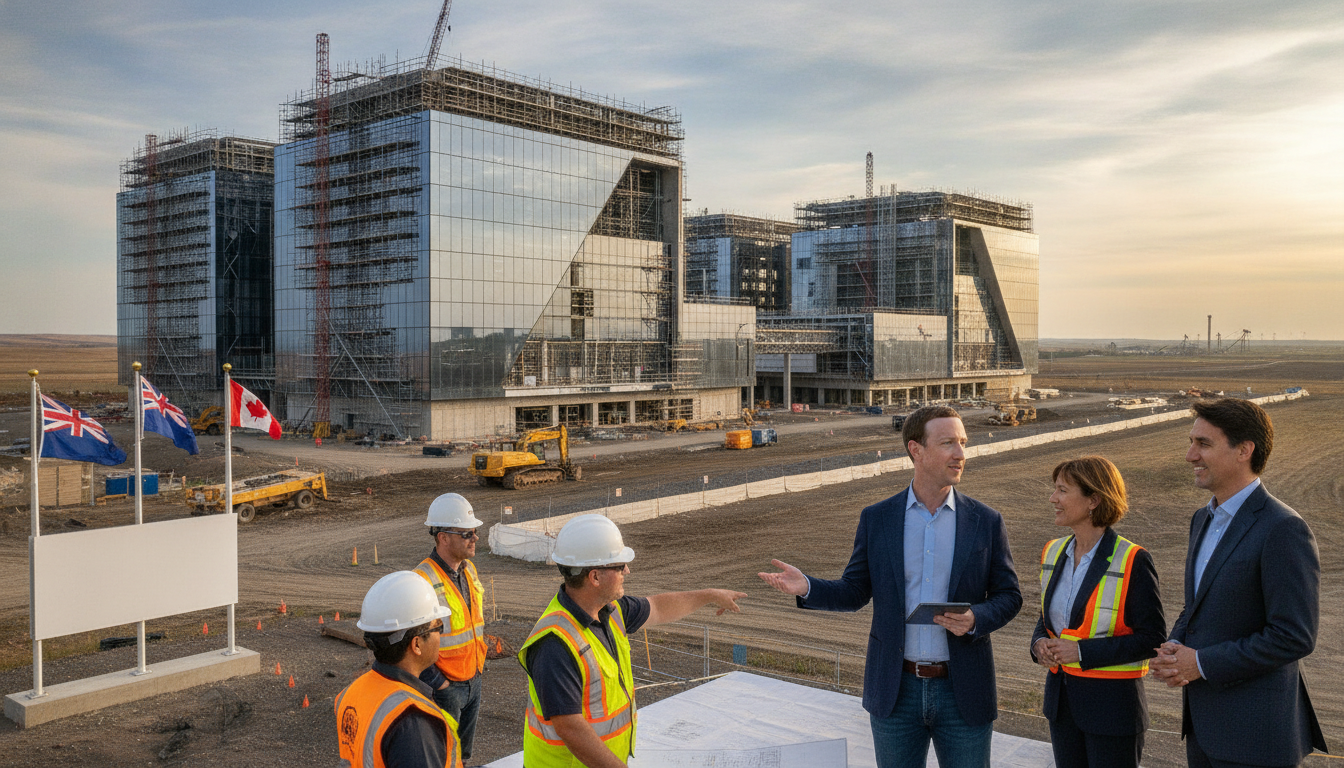
Meta data centre in Alberta: $13B, 1GW AI campus planned for Sturgeon County
Meta will build a 1-gigawatt, AI-focused data centre campus in Sturgeon County, Alberta—$13B investment plus $4.6B power plant, promising jobs and controversy.
Meta is moving forward with plans for a massive data centre campus in Sturgeon County, about 35 kilometres north of Edmonton, marking its first major facility in Canada. The Meta data centre announcement outlines a one-gigawatt-scale development designed specifically for artificial intelligence workloads and roughly 2.9 million square feet of built space. Company and provincial officials say the project will be among the largest private-sector investments in Alberta, combining direct construction spending with an adjacent gas-fired power plant.
Meta to build 1GW AI-focused campus in Sturgeon County
Meta’s vice-president of data centre strategy and development described the campus as a one-gigawatt deployment tailored to AI computing. The company said the site will become its 33rd data centre globally and will mirror the scale of recent announcements in U.S. states such as Indiana and Texas. Meta emphasized that design, construction and operations will be optimized for high-performance computing and large-scale AI workloads.
Scale and cost of the project
The company estimates more than $13 billion in direct investment for the data centre campus, excluding the cost of advanced processors and networking hardware that will be required for AI operations. Facility plans call for roughly 2.9 million square feet of infrastructure, placing the development among the largest in North America. Meta has secured large-scale grid access and plans additional on-site generation as the campus expands to full buildout.
Power supply and the new gas-fired plant
A separate consortium led by Pembina Pipeline, Morgan Stanley Infrastructure Partners and Kineticor announced a new gas-fired facility to serve the site, with an initial capacity near 932 megawatts and regulatory approval to expand to roughly 1,800 megawatts. That Greenlight power project is budgeted at about $4.6 billion and is positioned in the Alberta Industrial Heartland close to the data centre location. Officials say the arrangement will combine grid-connected electricity with on-site generation to provide the continuous power required for AI operations.
Jobs, local investment and fiscal impacts
Provincial estimates forecast about 3,000 construction jobs and roughly 300 permanent operating positions tied directly to the campus. Government briefings project approximately $250 million in annual provincial benefits from taxes, increased natural gas royalties and industry levies once the development is operational. Meta has also committed funds for local infrastructure improvements—officials cited about $60 million—and will pay significant annual transmission fees for its power draw.
Environmental, community and regulatory questions
Large-scale data centres and associated power plants have sparked debate about water use, land impacts, noise and electricity prices in communities across North America. Stakeholders and think tanks have warned that a new generation facility of this size could affect regional gas demand and upward pressure on power costs. Meta and provincial officials say the campus will use closed-loop liquid cooling to limit water consumption and that it will be sited within a zoned industrial park to limit community disruption.
Grid planning and broader industry implications
The Alberta Electric System Operator reports a surge in data centre connection requests, with dozens of projects now seeking grid access and nearly 20 gigawatts of potential load identified. Provincial leaders intended to attract large hyperscalers as part of a broader strategy to diversify energy and technology investment, and officials say the Meta development is intended to catalyze further projects. Energy analysts estimate that a single major facility can unlock many times its own construction cost in additional spending on computing equipment and connectivity.
Meta and provincial ministers signaled the project is fully funded by the company and could spur other hyperscalers to consider Alberta for large-scale AI infrastructure. The company is also screening local clean-energy projects to match its energy consumption, while continuing to rely on a mix of grid power and natural gas generation to maintain reliability. Officials framed the development as both an economic opportunity and a test case for how Alberta will integrate data-centre growth with energy and environmental planning.
The announcement caps more than two years of negotiations and planning between Meta and provincial authorities, and it positions Alberta as a major player in the race for AI infrastructure in Canada. As construction begins, regulators, communities and industry observers will be watching how the project balances rapid technological demand with local impacts on power systems, water resources and land use.
