
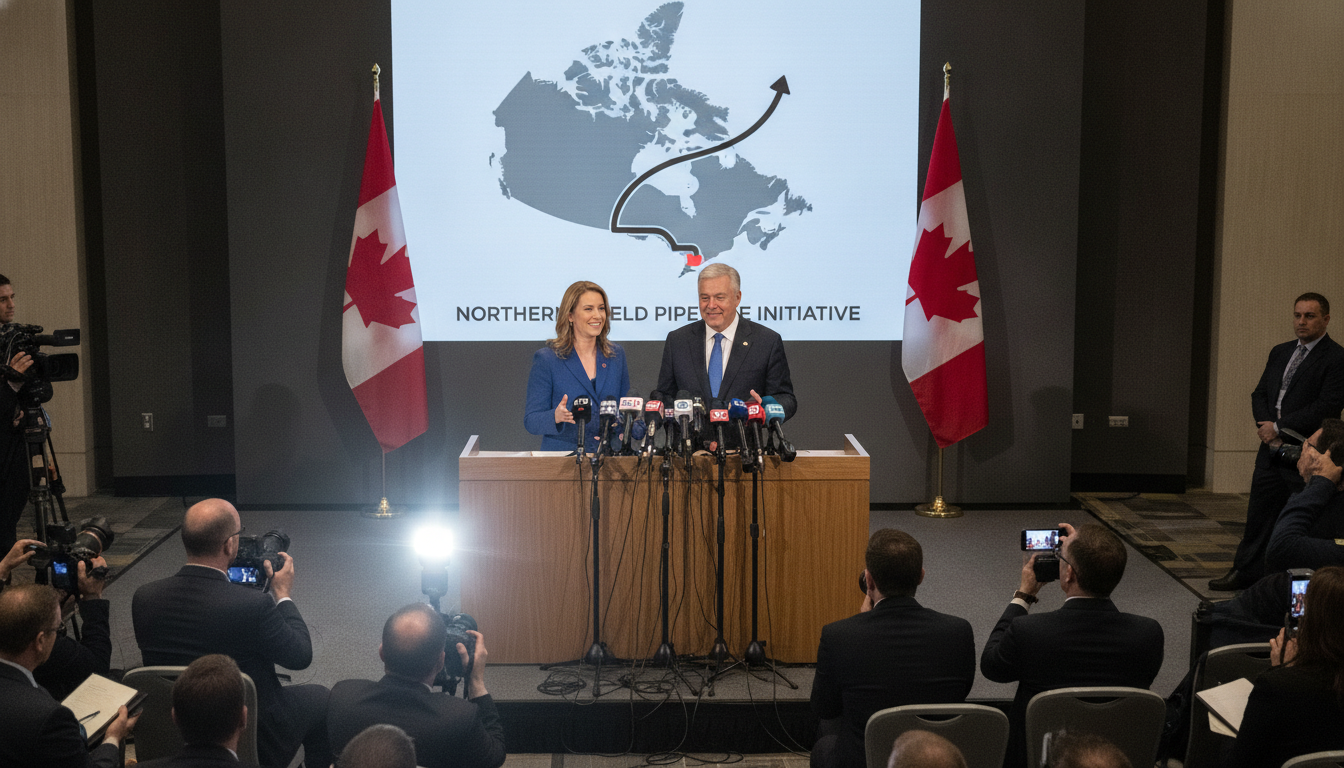
Premiers unveil Northern Shield pipeline route from Hardisty to Sarnia
Alberta and Ontario premiers announced the Northern Shield pipeline route from Hardisty to Sarnia on July 6, 2026; timelines, costs and approvals remain unclear.
Alberta Premier Danielle Smith and Ontario Premier Doug Ford stood together in Calgary on July 6 to unveil the Northern Shield pipeline route, a proposed oil corridor connecting Hardisty, Alta., to Sarnia, Ont. The announcement positioned the project as a national infrastructure priority while leaving critical questions about schedule, financing and federal approvals unresolved. The premiers framed the plan as part of a broader push to expand export options from Alberta’s oilpatch, naming potential west- and east‑coast links and northern extensions in their remarks. Industry and political analysts said the presentation underscored both ambition and uncertainty around who will pay and when construction might begin.
Premiers present Northern Shield as a multi-route strategy
Smith and Ford described the Northern Shield pipeline as one element in a set of corridor options intended to diversify oil export routes. They showed maps and sketched a vision that includes connections to Sarnia, a possible west‑coast export line and theoretical ties to Churchill, Man., and Atlantic terminals. The premiers cast the effort as a coordinated interprovincial initiative designed to reduce bottlenecks and increase market access for Alberta crude. Officials emphasized the rhetoric of economic renewal while offering limited technical or contractual detail at the news conference.
Timing and approvals remain unspecified
While the announcement included optimistic timing suggestions, no firm regulatory approvals or binding construction schedules were produced. The premiers alluded to a fast‑track approval process that could be signalled this autumn and to a potential start of construction next year, but they stopped short of producing documentation. Federal environmental reviews, permitting and indigenous consultation requirements were acknowledged as necessary steps but were not defined in scope or timeline. Analysts warned that without clear milestones and regulatory sign‑offs, proposed dates remain aspirational.
Costs and financing questions persist
There was no definitive breakdown of who would finance the Northern Shield pipeline or how taxpayers might be exposed to costs. Smith spoke broadly about billions in potential revenue flowing to Alberta from new infrastructure, and Ford highlighted interprovincial support, yet neither premier outlined private‑sector commitments or public funding mechanisms. Observers noted that major pipeline projects typically involve complex mixes of equity, debt and potential government guarantees, each carrying political and fiscal implications. Until investment agreements and financing terms are disclosed, the economic impact of the route cannot be reliably assessed.
Political context and electoral optics
The timing of the announcement — delivered during Calgary Stampede events and ahead of a high‑profile provincial vote — drew immediate attention to the political optics. The premiers presented the initiative as a symbol of “Team Canada” co‑operation, portraying provincial alignment with federal actors who have floated support in public forums. Critics cautioned that public displays of unity do not guarantee operational progress and pointed to lingering public scepticism about rapid project rollouts close to electoral calendars. The announcement will likely become an element in ongoing provincial debates over energy policy and regional relations.
Industry reaction and market implications
Energy sector stakeholders greeted the route announcement with guarded interest, noting the potential to relieve existing export constraints if the project advances. Market analysts said additional pipeline capacity to eastern refineries could alter trade flows and open new grading and destination options for bitumen and synthetic crude. However, the industry also flagged persistent uncertainties: final routing, right‑of‑way agreements, cost escalation risks and the pace of permitting remain material to commercial viability. Until those factors are clarified, most firms will treat the plan as an announcement rather than a committed supply‑chain change.
Public sentiment, legal proceedings and indigenous consultation processes will also shape the project’s path forward. Several paragraphs at the event referenced the need to engage affected communities and to secure the federal government’s concurrence, but no detailed stakeholder engagement plan was released. Environmental groups and some municipal authorities are expected to scrutinize potential routes closely, and any litigation or protracted consultation could affect schedules and costs.
The Northern Shield proposal establishes an ambitious interprovincial narrative about expanding Canadian energy exports, yet it leaves major practical questions unanswered. Officials framed the move as a step toward economic growth and energy security, but until financing details, regulatory approvals and community agreements are published, the route remains a roadmap rather than shovel‑ready reality. Observers will be watching for formal investment commitments, federal decisions and the start of permitting processes in the weeks and months ahead.
