
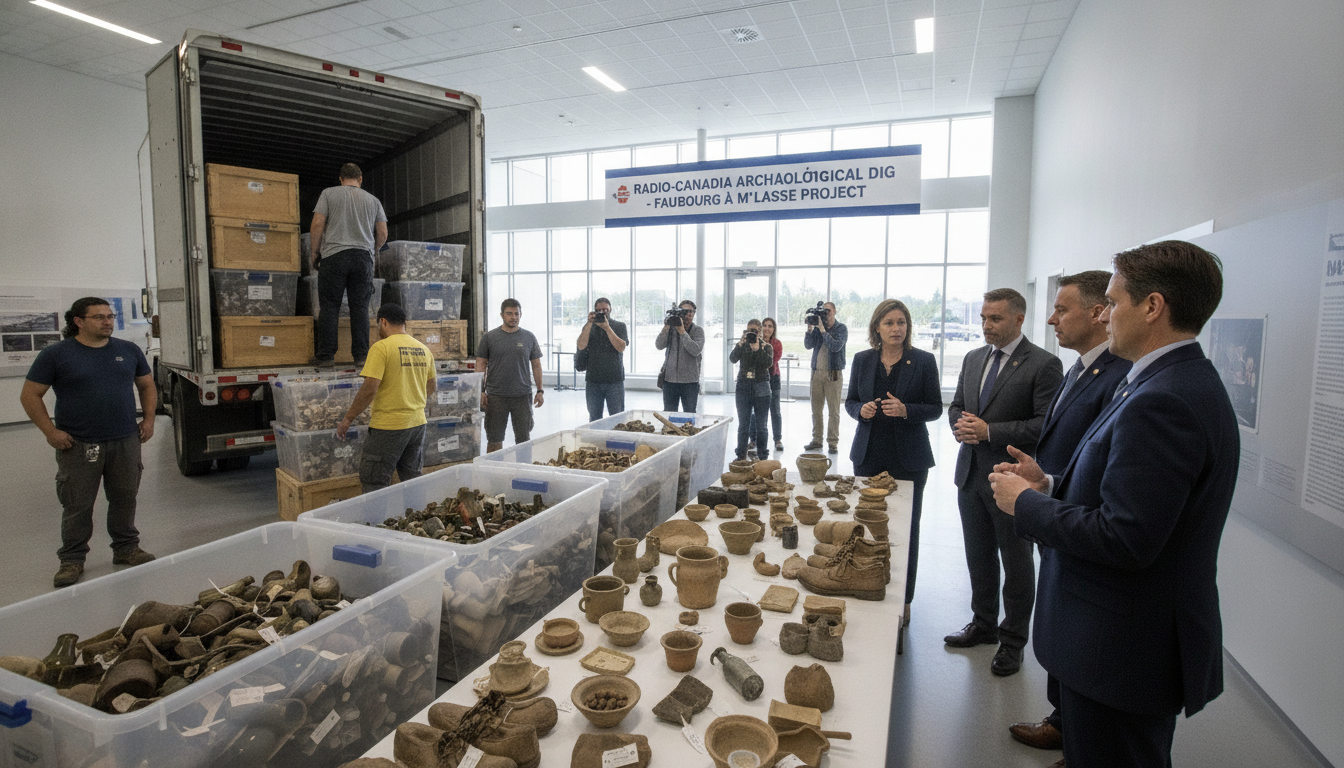
Faubourg à m’lasse artifacts from Radio‑Canada site handed to Montreal archives
A trove of Faubourg à m’lasse artifacts uncovered during construction at the Radio‑Canada site has been transferred to the City of Montreal’s archaeological reserve, where researchers will gain access to the material. The collection, unearthed during excavations in 2016–2017, illuminates domestic and industrial life in a working‑class neighborhood razed in the 1960s.
Major trove transferred to city custody
Montreal officials confirmed the transfer of thousands of artefacts and ecofacts recovered from the parking lot of the Radio‑Canada site to the municipal Reserve of Archaeological Collections. The donation follows fieldwork carried out by the archaeological firm Ethnoscop during site preparation for the new Maison de Radio‑Canada.
City representatives said the collection’s preservation in the public reserve will allow qualified scholars to study items that document urban life in Faubourg à m’lasse from the 19th and early 20th centuries. No public exhibition has been scheduled at this time, but officials signalled the material will be available to researchers.
Scope of the excavations and the finds
Excavations conducted between October 2016 and December 2017 recovered more than 5,000 separate objects and, in total, catalogued upwards of 31,000 small finds and ecofacts tied to roughly 5,380 distinct artifacts. Archaeologists identified roughly 2 percent of those as the most striking and have prioritized them for detailed cataloguing and conservation.
The volume and preservation of whole objects surprised the teams on site, providing unusually rich deposits from privies and refuse pits that preserved intact ceramics, bottles, buttons and other domestic items. That concentration of material creates a powerful dataset for reconstructing household economies and daily life.
Bottles that trace industrial change and tastes
Among the notable faunal and material remains are a number of bottles that reflect evolving production technologies and consumer habits. One glass bottle bears the mark of Chas Gurd Co., a firm established in 1868, and displays physical traces consistent with automated bottle‑making introduced in the early 20th century.
Archaeologists noted an “Owens” style scar on the base of that bottle, linking it to the mechanized bottling processes that reduced manual glass‑blowing and helped standardize consumer packaging. Other recovered vessels include a torpedo‑style soda bottle, a “fluid beef” broth bottle and a medicinal bottle from R.R.R. Radway of New York, items that together reveal both everyday diets and the circulation of imported remedies.
Pipes, local industry and tariff pressure
The site yielded fragments from nearly 200 clay pipes, underscoring Montreal’s role in the 19th‑century tobacco industry and local pipemaking. Archaeologists linked some of the material culture to the presence of Scottish pipemakers such as Henderson and Bannerman, who used regional clay in nearby factories.
Dating clues on some pipes and associated finds suggest production before the turn of the 1890s, a period when international tariff regimes and labelling rules began to affect trade in consumer goods. Those regulatory shifts had consequences for local manufacturers and for the kinds of objects that entered or left urban markets.
A rare infant‑feeding artifact and public‑health history
One unusual item recovered from a privy was a clay stopper associated with a late‑19th‑century “Princess” baby bottle, a design produced in Manchester between 1871 and 1890. The stopper includes a small perforation intended to feed milk via a rubber tube to a nipple, a configuration now linked to repeated contamination risks.
Medical authorities eventually condemned such designs, and by the early 20th century they were effectively removed from widespread use. The presence of this “killer bottle” component on the Faubourg à m’lasse site highlights the intersection of consumer goods, infant care practices and emerging standards of public hygiene.
Everyday accessories and imported luxury goods
The assemblage also contains large numbers of buttons in glass, metal, bone and mother‑of‑pearl, plus rarer rubber specimens marked with early patents. These small items speak to clothing production, repair and the material culture of distinct social groups within the neighborhood.
Imported items surfaced as well, such as a pot of anchovy paste produced by Charles Wix emblazoned with British heraldry. Archaeologists interpret such products as indicators of dietary preferences among wealthier households in the faubourg, contrasting with staples found in other deposits.
Ecofacts deepen dietary and ecological picture
Beyond manufactured objects, the excavations produced a rich suite of ecofacts — animal bones, shells and plant remains — that will be subjected to zooarchaeological and macro‑botanical analysis. Those studies can distinguish diet, market access and food preparation practices across social strata in the district.
Researchers involved in the project emphasize that deposits from latrines and rubbish pits are particularly informative because they often preserve whole items and concentrated waste. Over successive digs covering decades, Faubourg à m’lasse has yielded a long‑term record: the Radio‑Canada site carries the administrative label BjFj‑185 among more than 230 catalogued sites east of Mount Royal.
The transfer to Montreal’s Reserve of Archaeological Collections opens the door for specialized study of these Faubourg à m’lasse artifacts, with teams now able to request access for conservation, scientific analysis and publication. For the city, the material offers a renewed window into lives and industries that shaped the neighbourhood before its mid‑20th‑century demolition.
