
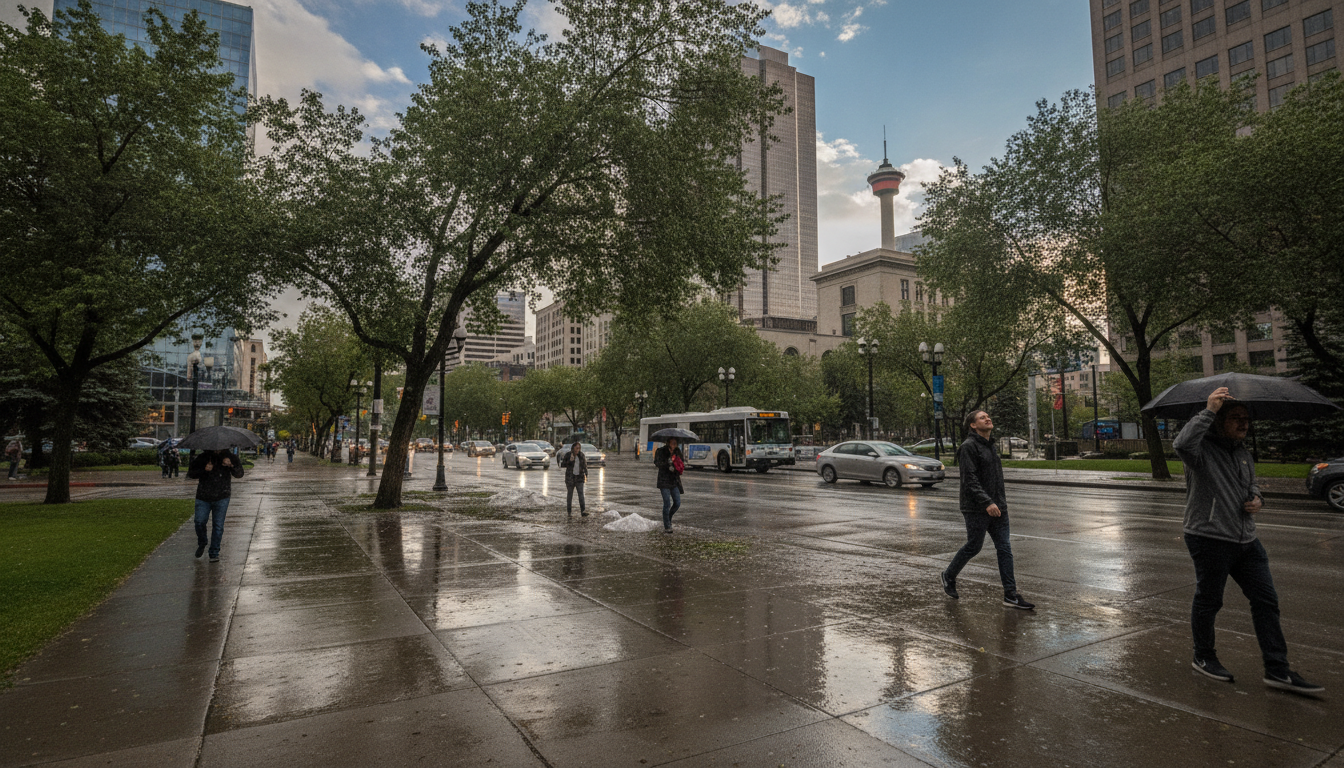
Severe thunderstorm warning lifted for Calgary after heavy rain and quarter-size hail
Severe thunderstorm warning lifted for Calgary after Tuesday afternoon storms brought heavy rain, gusts and hail. Air quality warning from smoke remains in effect as levels are expected to ease by Wednesday.
Warning lifted for Calgary after Tuesday storm
Environment Canada lifted the severe thunderstorm warning for the Calgary area late Tuesday evening, saying the immediate threat had passed. The alert covered portions of the city after a fast-moving system tracked across the south end during the afternoon of June 30, 2026.
The warning had cautioned residents about strong wind gusts, heavy downpours and hail up to quarter size. Authorities and emergency services reported no widespread injuries as the system pushed eastward out of the city limits.
Heavy rain and hail struck south Calgary neighbourhoods
Several neighbourhoods in Calgary’s southern quadrants received the most significant rainfall as the storm moved through, producing swift surface runoff and localized ponding. Drivers and pedestrians reported sudden drops in visibility and standing water on low-lying streets during the peak of the event.
Hail up to approximately quarter size was reported in isolated pockets, accompanied by sharp gusts that toppled small branches and scattered debris. While some residents described minor property impact from hail, there were no immediate reports of major structural damage.
Environment Canada’s alert described gusts, rain and hail
The advisory issued by Environment Canada late Tuesday afternoon outlined the potential for damaging winds, intense rainfall rates and hail as the primary hazards. Meteorologists said the storm developed rapidly and moved across the city in a relatively short time window, increasing the risk of sudden impacts for people caught outdoors.
Officials repeatedly urged Calgarians to stay updated through official channels as the system evolved, emphasizing that conditions could change quickly during severe convective events. The agency continued to monitor the broader regional pattern for any downstream development.
Air quality warning from smoke remains active
An air quality warning that was issued on Monday, June 29, 2026, remains in effect for Calgary, with officials describing smoke concentrations in the moderate to high risk range. Environment and health agencies said smoke levels were expected to diminish through Wednesday, July 1, 2026, as winds shift and particle concentrations disperse.
Public health advisories advise people with respiratory conditions, older adults and young children to limit prolonged or intense outdoor exertion while the air quality warning persists. Residents were encouraged to check local air quality indexes and to move activities indoors when smoke is most noticeable.
City services and public safety guidance
Municipal crews were mobilized to respond to reports of localized flooding and debris on roadways after the storm’s passage. Residents were urged to exercise caution on slick roads and to avoid driving through flooded intersections, which can hide hazards and stall vehicles.
City communications also recommended that Calgarians secure loose outdoor items and inspect property for any minor storm damage. Anyone encountering downed power lines or significant structural concerns was advised to contact emergency services and their utility provider promptly.
Short-term outlook and what to watch next
The severe thunderstorm threat for Calgary has diminished for the immediate term, but scattered showers and isolated thunderstorms may still occur as the atmosphere gradually stabilizes. Meteorologists advised checking updated forecasts for any renewed convective development later in the week.
Air quality is expected to improve through Wednesday as smoke sources weaken or shift and as dispersion increases. Residents should continue to monitor official Environment Canada and air quality reports for the latest guidance and any further advisories.
Calgarians are asked to remain vigilant when weather warnings are in effect and to prioritize safety by heeding advisories from Environment Canada and local authorities. Monitoring forecasts and taking simple precautions can reduce risk during quickly evolving summer storms.
