
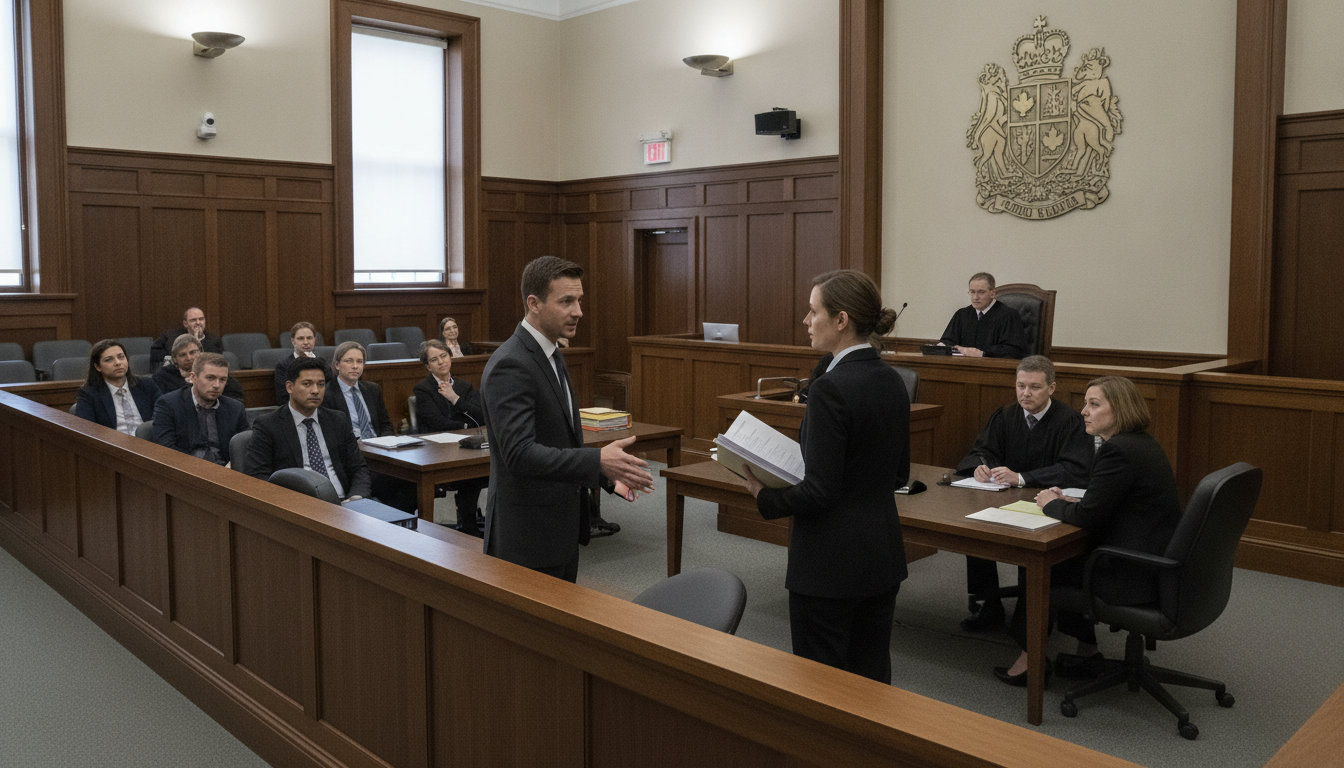
Defence Lawyers Challenge Sufficiency of Evidence in Calgary Court of King’s Bench Hearing
Defence lawyers in Calgary argued that the prosecution lacked sufficiency of evidence to send four accused to a Court of King’s Bench jury, court heard.
The defence of Alexandra Faith Doman, Troy Jordan Lemke and Jarvais Ljay Eisnor lodged a joint challenge on whether the Crown had produced enough evidence to justify a jury trial in the Court of King’s Bench. Defence counsel — Kirstin Lancee for Doman, Greg Dunn and Joshua l’Abbe for Lemke, and Dale Fedorchuk for Eisnor — pressed the issue during submissions before the court. The question now is whether a judge will rule that the matter should proceed to a jury or be stayed at this stage.
Defence teams press challenge over sufficiency of evidence
The defence lawyers contended that the Crown’s material did not reach the threshold required to send the case to a jury in the Court of King’s Bench. Each counsel argued that gaps in witness statements and evidentiary links undermined any reasonable prospect of a conviction. Their submissions asked the court to examine whether the prosecution had advanced a coherent evidentiary foundation sufficient for a jury to properly consider the allegations.
Those arguments focused on the legal standard that governs pre-trial screenings in serious criminal matters. Defence counsel requested the judge review whether the evidence, taken at its highest, could support a verdict by a properly instructed jury. The defence framed the challenge as a procedural safeguard against exposing the accused to an unnecessary or prejudicial trial.
Crown’s burden at the preliminary stage
Prosecutors responding to the defence challenge noted that the Crown’s role at this stage is to show the existence of evidence that could reasonably support the charges, not to prove guilt beyond a reasonable doubt. Crown counsel argued that the material disclosed to the defence contains admissible evidence and that credibility and weight are questions for trial. The Crown maintained that the collected statements and investigative findings satisfy the threshold to proceed.
The judge was asked to weigh documentary exhibits, witness statements and investigative reports in determining whether the issue should be left to a jury. Crown submissions emphasized that the committal or transfer decision requires only a prima facie foundation, meaning if the evidence could lead a reasonable jury to convict, the case should advance. Defence counsel countered that the record lacked necessary corroboration on key elements of the allegations.
Details on the accused and representation
Court records show the three accused are represented by established defence counsel in Calgary. Kirstin Lancee appeared on behalf of Alexandra Faith Doman and argued the evidence against her was circumstantial and insufficient to warrant a jury trial. Greg Dunn and Joshua l’Abbe jointly represented Troy Jordan Lemke and highlighted alleged inconsistencies in the Crown’s narrative.
Dale Fedorchuk for Jarvais Ljay Eisnor focused his submissions on alleged gaps between witness accounts and the factual matrix needed to sustain the charges. While the specific nature of the allegations was not expanded on in open court during the challenge, the defence teams uniformly sought judicial scrutiny before any trial scheduling.
Potential impact on trial timeline and court resources
A successful defence challenge could delay or even halt a jury trial, reshaping the Crown’s approach and the court calendar. If the judge finds the Crown has not met the threshold, charges could be quashed or the Crown might be given an opportunity to bolster its record. Conversely, a ruling that the matter should proceed will move the case toward preliminary scheduling, disclosure obligations and potential trial dates before the Court of King’s Bench.
Legal observers say these kinds of challenges can be strategically used to test weaknesses in the prosecution’s case early and can prompt further investigative steps by authorities. They also note such hearings consume judicial time but serve as an important filter to prevent unjustified trials.
What the Court of King’s Bench decision will determine
The presiding judge will have to decide whether the evidence, taken at its highest, could lead a properly instructed jury to convict the accused. That determination does not evaluate credibility but assesses if there is evidence on each element of the charged offences. The judge’s ruling will either commit the matter to trial or remove it from the jury process if the threshold is not met.
A decision to proceed typically results in case management steps including setting dates for disclosure compliance, motions and ultimately a trial calendar. A decision that the evidence is deficient could result in dismissal, stayed charges, or leave the Crown to re-evaluate investigative avenues.
Broader legal context in Alberta courts
In Alberta, serious criminal matters are tried in the Court of King’s Bench where juries sit for indictable offences that require them. The standard applied at this pre-trial filter is well-established in Canadian criminal procedure and aims to balance the rights of the accused against the public interest in effective prosecution. Defence challenges to sufficiency of evidence are a routine but consequential part of that process.
The outcome of the hearing will also inform how lawyers prepare for trial, whether further disclosure will be sought, and whether any plea or resolution discussions might occur. It underscores the role of preliminary judicial oversight in ensuring that only cases with an evidentiary basis proceed to full jury scrutiny.
A judge will issue a ruling after considering oral submissions and the materials filed by both Crown and defence, and that decision will determine whether the matter proceeds to a Court of King’s Bench jury.
