
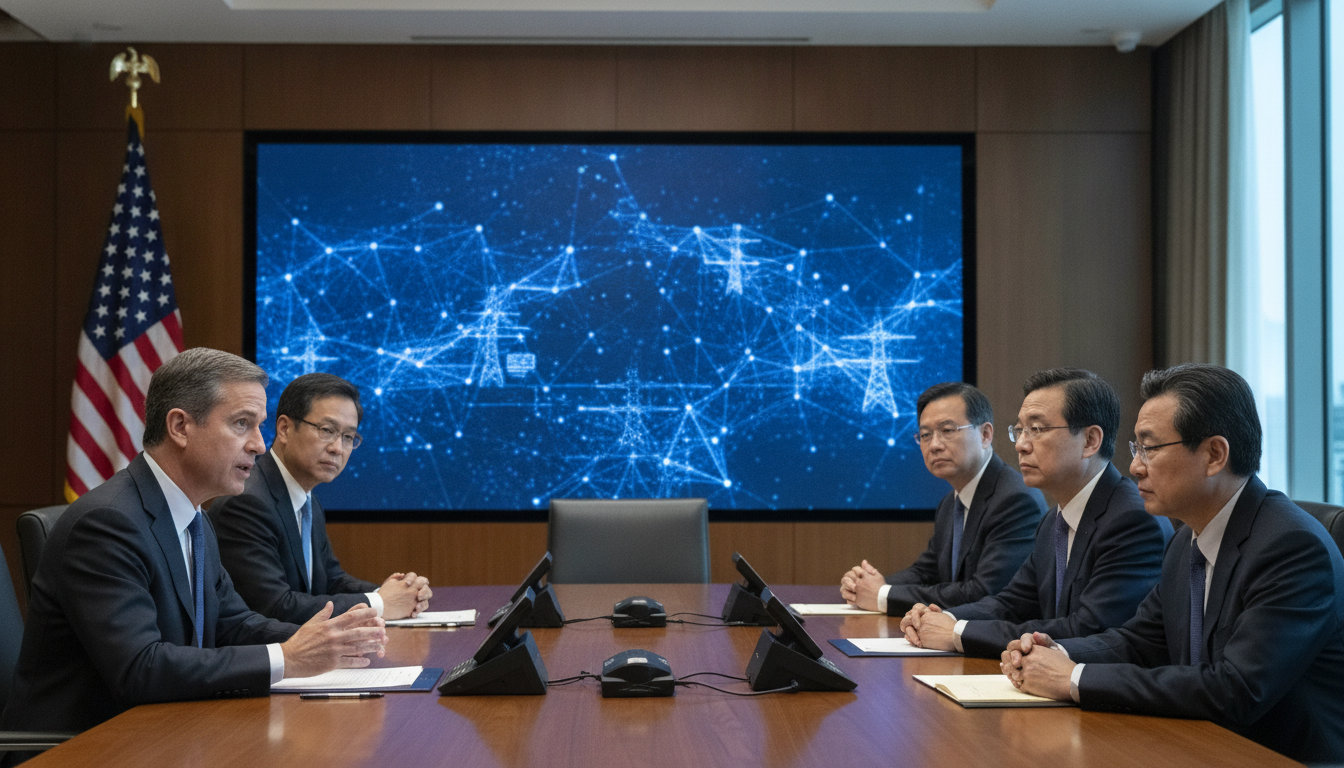
U.S. Officials Sound Alarm Over Security Risks Posed by Powerful AI Models
U.S. officials warn powerful AI models could bypass cyber defenses, threaten critical infrastructure and fall into rival states’ hands; rules largely voluntary.
The White House and federal cybersecurity officials have stepped up warnings about the security risks posed by powerful AI models, saying the systems could be used to defeat defensive tools, disrupt critical infrastructure and be acquired by rival states. Government statements describe growing concern that capabilities once limited to research labs are now within reach of adversaries and malicious actors. With no uniform, binding legal framework in place, U.S. authorities are relying mainly on voluntary industry guidelines and ad hoc interventions.
White House Relies on Voluntary Guidelines
The White House has pursued a policy of voluntary guidance for developers of powerful AI models rather than issuing a comprehensive regulatory regime. Administration officials say the approach allows faster engagement with industry while regulators study technical and policy trade-offs. The reliance on nonbinding measures has prompted criticism from some lawmakers and security experts who argue that voluntary steps may not be sufficient to manage national security risks.
Cybersecurity Officials Flag Operational Risks
Federal cybersecurity agencies have warned that advanced models could be repurposed to evade detection by automated defenses and mimic legitimate traffic. Officials have told industry partners that sophisticated generative systems can produce code, devise attack sequences and tailor social-engineering lures at scale. These features, agency briefings say, increase the threat surface for critical infrastructure operators and private-sector defenders.
Federal risk assessments emphasize scenarios where model-driven automation accelerates the pace and complexity of attacks. Investigators say the combination of speed, scale and subtlety could overwhelm existing incident-response procedures if left unchecked.
Concerns About State Acquisition, Including China
National security officials cite the risk that powerful AI models or the expertise to build them could be acquired by competing states, with China frequently identified as a primary concern. Sources familiar with interagency discussions say policymakers worry less about abstract research than about operational capabilities that could improve adversary cyber operations or help destabilize sensitive systems. The possibility that models might be reverse-engineered, exported indirectly, or recreated from open research compounds those worries.
Officials underscore that the risk is not limited to any single country and that nonstate actors could also exploit these systems. The emphasis in government briefings has been on preventing escalation and limiting the transfer of capabilities that materially change military or critical infrastructure balances.
No Binding Legal Framework for Advanced AI
Despite the warnings, there is currently no single, enforceable U.S. statute that specifically governs the development, deployment or export of large-scale AI models. Regulatory responsibility is fragmented across agencies that regulate telecommunications, exports, cybersecurity, and consumer protection. That fragmentation has left gaps when confronting fast-evolving technologies that blur commercial and national-security lines.
In practice, the administration has used a patchwork of voluntary standards, targeted guidance and case-by-case interventions to address acute threats. Legal experts caution that such an approach may slow enforcement and create uncertainty for companies operating across jurisdictions.
Industry Responses and Oversight Gaps
Major AI developers have responded with transparency measures, model safety research, and voluntary risk-mitigation frameworks, but independent observers say these steps do not replace enforceable rules. Companies increasingly publish red-team results, adopt staged model releases, and build guardrails intended to limit misuse. However, critics point out that incentives remain mixed: commercial pressure to scale and monetize models can run counter to careful rollout.
Civil society groups and some lawmakers are pressing for clearer accountability mechanisms, including auditability, mandatory reporting of high-risk deployments, and limits on dual-use exports. The debate has also extended to international coordination, with calls for shared norms among allies to prevent adversarial procurements and harmonize oversight.
Industry trade associations say they are open to constructive regulation but warn that heavy-handed controls could stifle innovation and drive talent and investment abroad. The balance between fostering technological progress and managing security risks remains central to policy discussions.
Final paragraph
As policymakers weigh options, the question facing Washington is whether incremental, voluntary steps will be enough to manage the risks posed by powerful AI models or whether a more structured legal framework is required. For now, officials continue to press companies for safeguards and to deploy targeted measures where threats are identified, even as lawmakers and experts debate longer-term solutions.
