
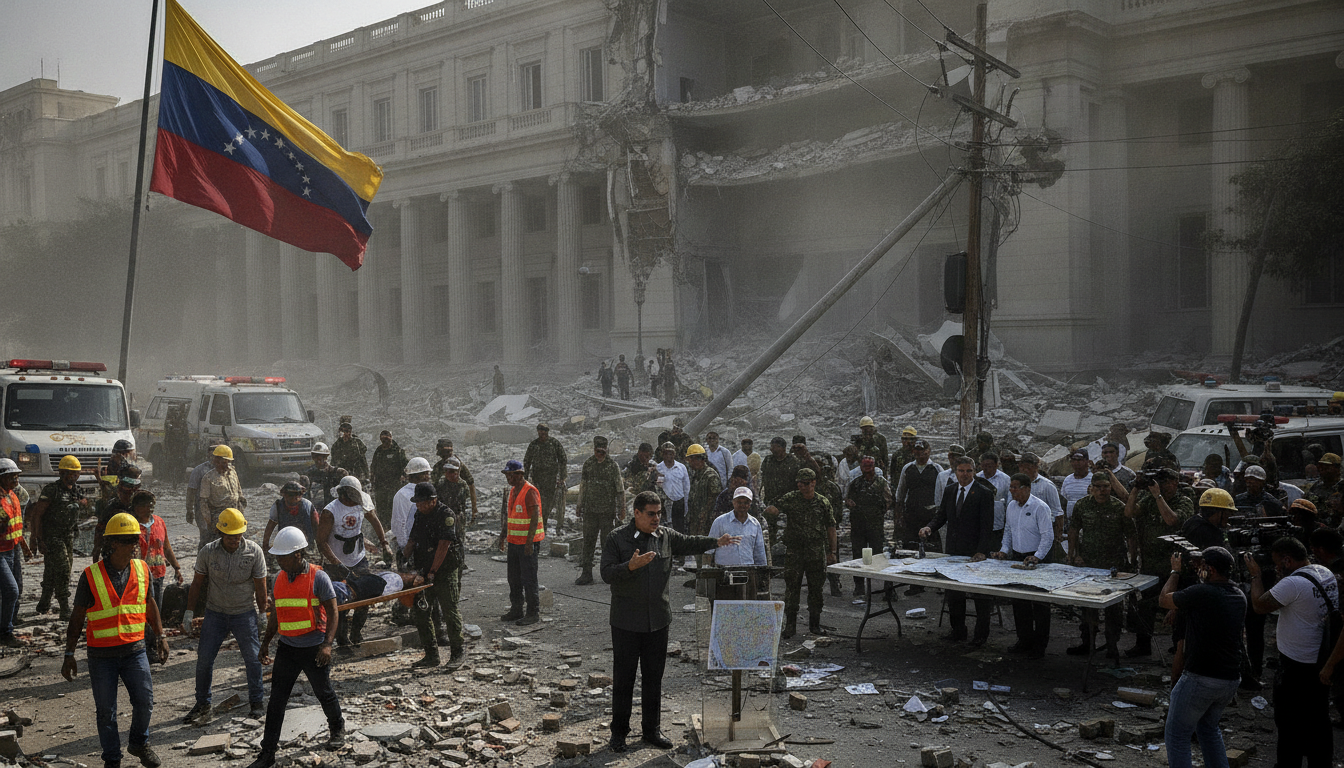
Venezuela earthquakes leave at least 235 dead as rescuers race to find survivors
Venezuela earthquakes kill at least 235 and injure thousands as rescuers race to find survivors after two shallow, powerful quakes struck Caracas and La Guaira.
Rescue teams raced against the clock after two powerful earthquakes — magnitudes 7.2 and 7.5 — struck northern Venezuela, leaving hundreds dead, thousands wounded and many trapped beneath rubble. The health ministry reported at least 235 fatalities and more than 4,300 injuries, with officials warning the toll is likely to rise as search efforts continue. Acting President Delcy Rodríguez declared a nationwide state of emergency as damage concentrated in La Guaira and the capital, Caracas, forced thousands from their homes. Simon Bolívar International Airport in Caracas was closed after sustaining damage, complicating relief logistics.
Twin shocks and immediate impact
The first quake was recorded west of the capital and was followed seconds later by a stronger tremor, sending intense shaking across the northern coastal corridor. Both quakes were shallow — less than 20 kilometres deep — which magnified surface shaking and increased the likelihood of structural failure. Local officials reported dozens of buildings collapsed or made unsafe, while whole neighbourhoods in La Guaira and sections of Caracas were left without power or running water. Municipal authorities quickly converted schools and public facilities into emergency shelters for displaced families.
Search-and-rescue in the critical first 72 hours
Emergency responders and volunteers focused on the vital first three days after the disaster, when chances of finding survivors beneath collapsed structures are highest. Teams prioritised rapid extrication, medical triage and the provision of water and basic first aid, mindful that dehydration and crush injuries become life-threatening within hours. Urban search-and-rescue crews worked amid unstable debris while coordinating with local hospitals to move seriously injured patients. Authorities warned that every hour mattered and urged patience as teams used specialised equipment to locate voids and trapped people.
Why the shaking was so destructive
Venezuela sits along the boundary of the Caribbean and South American tectonic plates, a region prone to large, damaging earthquakes. The combination of strong magnitude, shallow depth and local geology amplified the effects in populated areas built on soft sediments. Informal housing — dense, self-built barrios on hillsides around Caracas — proved particularly vulnerable because many structures lack reinforced foundations and modern seismic design. Those factors, officials say, contributed to the pattern of collapses seen in both coastal towns and urban neighbourhoods.
Aftershocks and risks to recovery operations
Rescue work was repeatedly interrupted by aftershocks, some strong enough to further weaken buildings and force evacuations of rescue teams and survivors. Authorities logged dozens of aftershocks in the hours after the main events and warned that significant tremors were likely to continue in the coming days. Those secondary quakes complicate shoring and heavy lifting, increasing the hazard for crews working in unstable zones. Residents were advised to stay clear of damaged structures, large trees and compromised infrastructure while inspections and shoring continued.
International assistance and coordination
A number of countries and international organisations offered immediate assistance, dispatching search-and-rescue teams, medical personnel and relief supplies. Brazil sent a specialist contingent of firefighters and technicians, and teams from Mexico, France and Switzerland were among those mobilised to support operations. The International Federation of Red Cross and Red Crescent Societies and UN-coordinated urban search-and-rescue units activated regional response mechanisms to funnel aid and expertise. The United States announced humanitarian assistance funding to support emergency relief and medical response.
Scale estimates, uncertainty and humanitarian concerns
Officials cautioned that casualty figures would remain provisional for days as teams reach collapsed buildings and process missing-person reports. In the immediate aftermath, local reports surfaced piecemeal from municipal authorities, hospitals and emergency services before national aggregates emerged. Independent rapid-assessment systems had produced broad fatality ranges reflecting worst-case scenarios, but on-the-ground results suggested that some buildings suffered less catastrophic failure than initially feared. Humanitarian agencies warned that economic factors, damage to transport hubs and barriers to finance and logistics could slow aid delivery, prompting calls from some groups to ease restrictions that might hamper relief.
Recovery efforts will hinge on sustained search-and-rescue capacity, safe access to affected neighborhoods and the rapid restoration of basic services. As Venezuela begins the long work of accounting for the missing and rebuilding, immediate priorities remain saving lives, treating the injured and sheltering those who lost their homes. The coming days will be critical for both humanitarian relief and assessing the full scale of the disaster.
