
Edmonton police use of force rises amid extortion surge, commission hears
Edmonton Police Service data show an uptick in use of force incidents tied to extortion; most pursuits last under a minute and injuries to officers are rare.
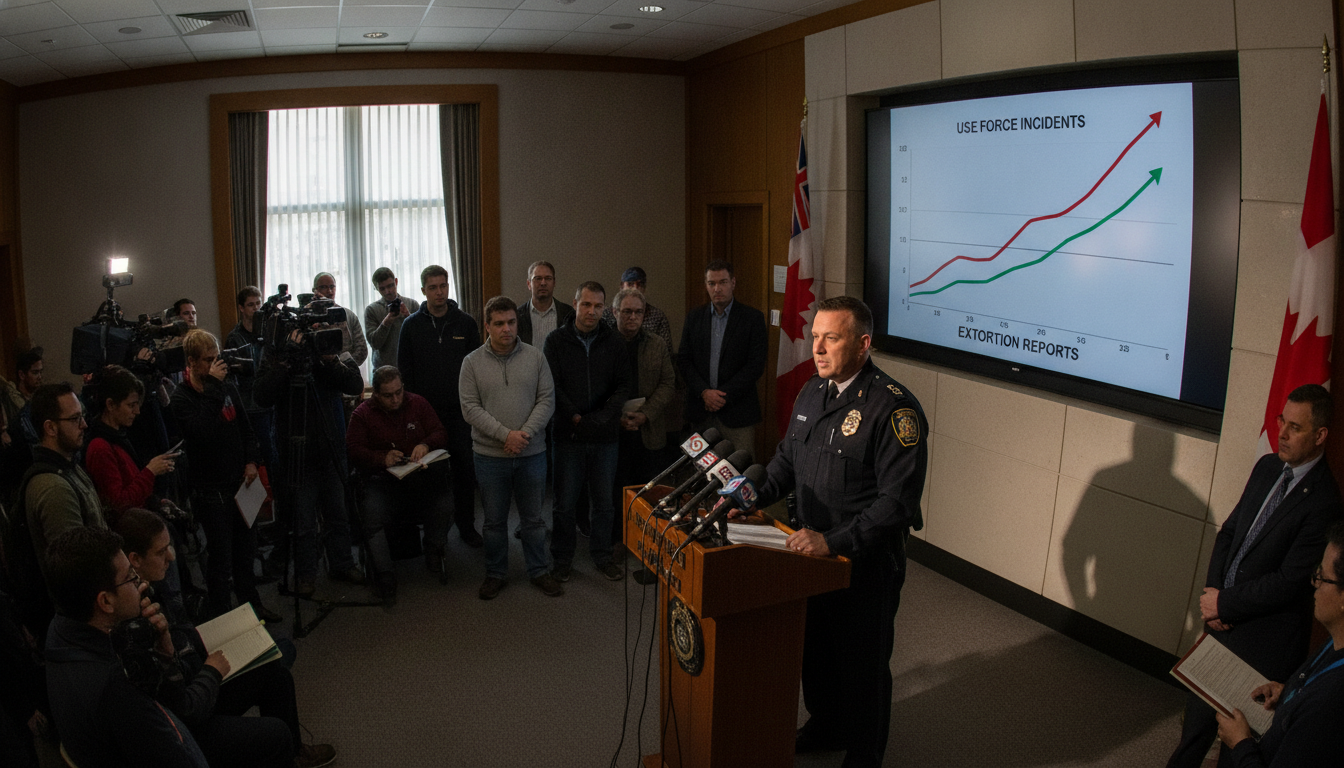
Edmonton Police Commission members heard Thursday that incidents involving Edmonton police use of force have increased, a trend the service links in part to a rise in extortion-related violence. Commissioners were presented with operational statistics showing higher reporting and response numbers, even as most encounters did not result in injury to officers or civilians. Acting Inspector Glen Klose told the commission the pattern reflects changing criminal behaviour and the EPS’s expanding response footprint across the city.
Increase in violent reports connected to extortion
Commission materials showed a measurable rise in violent incidents over recent reporting periods, and EPS officials flagged extortion as a contributing factor. Acting Insp. Glen Klose said investigators have identified a string of extortion events that have escalated into violent confrontations with officers called to intervene. The service emphasized that the surge in reports is at least partly explained by responding to more incidents rather than a single, sustained upward trend in one neighbourhood.
Police sources told the commission that extortion schemes can trigger unpredictable responses from suspects and victims, increasing the likelihood that officers arrive on scene to find volatile situations. That volatility, Klose added, is one reason the EPS is re-evaluating tactics and training to reduce the risk of harm during those calls.
Injury rates remain low as de‑escalation is stressed
Despite the rise in reported violent incidents, EPS data show that 86 per cent of use-of-force reports did not record injuries to civilians or other non-officers. Reports of injuries to people taken into custody are also trending downward, according to the presentation. Officers escaped uninjured in 97.5 per cent of reported use-of-force events, the service said, a statistic officials described as a sign of effective protective practices.
To build on that record, the EPS is prioritizing de‑escalation techniques in training and operations. Klose explained that officers are being coached to slow interactions and improve communication with subjects in distress, with the goal of reducing physical confrontations while still preserving public safety.
Batons reviewed as usage falls
Commission members were told that batons are now seldom employed, both in occasions classified as potential use of force and in incidents of actual force. That low frequency has prompted internal discussions about whether to continue equipping and training for baton use as currently structured. Police officials indicated the service is studying the cost-benefit picture, including training expenses and operational value, and has not ruled out phasing the tool out if alternatives prove safer and more effective.
The EPS said any decision on equipment would follow analysis of incident data, training outcomes and comparative practices elsewhere, and that any change would be implemented with clear operational directives and oversight.
Most pursuits are brief; intervention and prevention rates high
Statistics on suspects fleeing from police showed inconsistent year‑to‑year patterns, with EPS analysts unable to identify a clear long-term trend. What stood out, however, was the short duration of the majority of pursuits: most lasted less than one minute. The service noted that risk escalates with pursuit length, underscoring why officers and supervisors weigh duration heavily when deciding how to proceed.
Operational performance measures presented to the commission showed a 95.1 per cent success rate for interventions when a suspect was fleeing and a 97.2 per cent success rate in situations deemed preventable. EPS officials offered examples such as safely intercepting a suspected impaired driver who had been reported asleep at the wheel, illustrating how timely response and precautions can avert higher-risk encounters.
Calls for broader data sharing and strategic planning
At the meeting, Klose urged the commission to consider policing trends beyond Edmonton’s borders, pointing to the value of regional, national and international comparisons. He argued that better data sharing among municipal police forces, provincial units and federal agencies would help identify emerging threats and inform where resources should be concentrated. The EPS suggested that integrated datasets could improve prevention strategies and make enforcement more targeted and effective.
Commission members expressed interest in pursuing stronger interagency information exchange and in using comparative data to test new training and equipment policies. They emphasized that any operational changes should be transparent and accompanied by clear metrics to monitor community safety and officer conduct.
The commission meeting underscored the balancing act facing the Edmonton Police Service as it responds to a rise in reported violence while keeping injuries low and limiting high‑risk pursuits. The EPS said it will continue to refine training, review equipment choices and seek better data links with other agencies as part of a broader effort to adapt to evolving criminal behaviour and protect public safety.
