
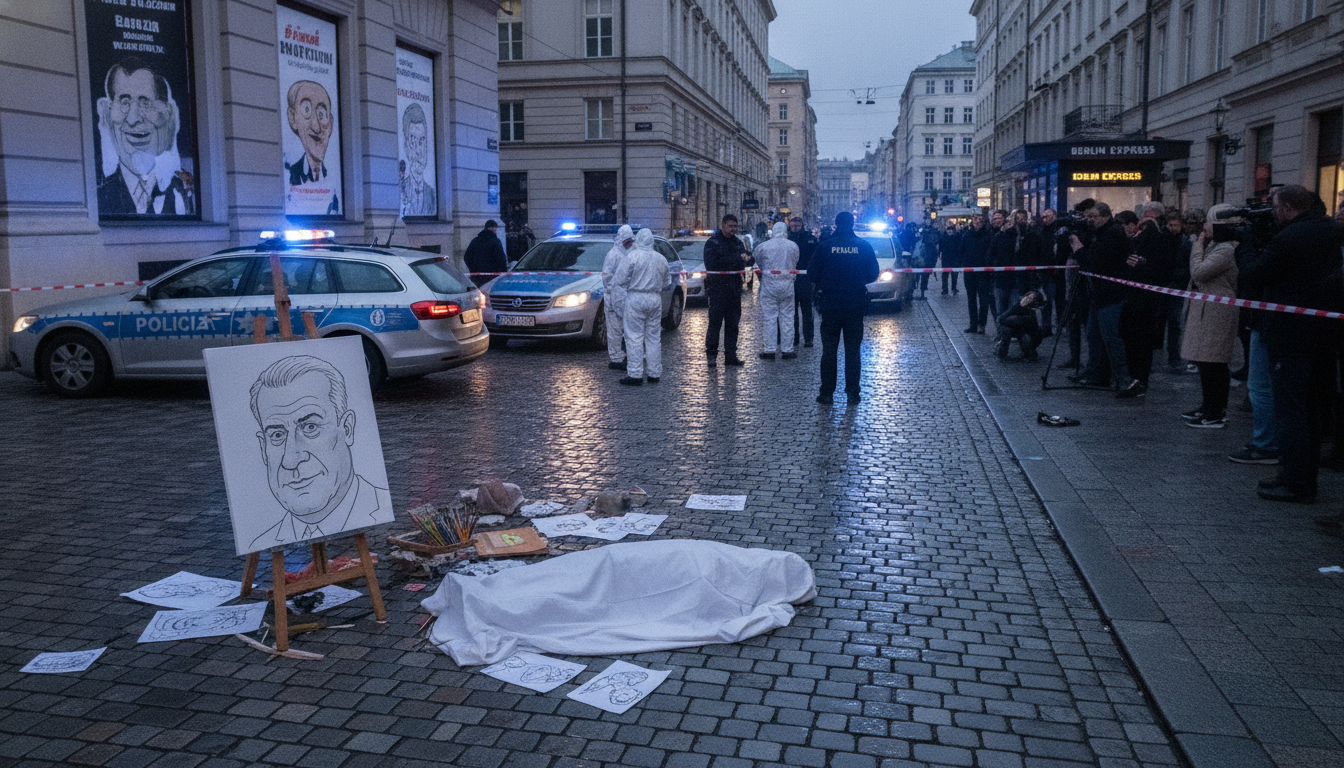
Semyon Skrepetsky Shot Dead in Poland Days After Berlin Embassy Protest
Semyon Skrepetsky (Robert Kuzakov), a Russian artist known for caricatures of Vladimir Putin and Alexei Navalny, was shot dead in Poland three days after staging a performance protest in Berlin near the Russian embassy.
Artist Semyon Skrepetsky Found Shot in Poland
Robert Kuzakov, who performed under the name Semyon Skrepetsky, was found shot dead in Poland, according to initial accounts of the incident. The killing came shortly after a high-profile street performance he staged in Berlin, drawing attention for its proximity to the Russian embassy. Authorities and news outlets reported the sequence of events, highlighting the tight timing between the protest and the fatal attack.
Skrepetsky had been widely identified by his artistic persona, and his death has raised immediate questions about motive and the circumstances surrounding the shooting. Available descriptions state only that the artist was killed in Poland, with reporting that places the Berlin protest three days earlier.
Performance Protest in Berlin Days Earlier
Three days before he was killed, Skrepetsky carried out a performance protest in Berlin near the Russian embassy, an act that attracted observers and media coverage in several cities. The demonstration was theatrical in nature and intended to draw attention to political issues, consistent with the satirical focus of his public work. Organizers and witnesses described the action as part performance art and part political protest.
The proximity of that protest to the embassy and the subsequent fatal shooting have been noted in coverage of the case, though the exact linkage between the two events has not been established publicly. The timing has nonetheless intensified scrutiny from colleagues, rights groups and commentators who follow threats against dissident artists.
Caricatures Targeted Russia’s Leaders
Skrepetsky was best known for bold caricatures and satirical depictions of prominent Russian figures, including President Vladimir Putin and opposition figure Alexei Navalny. His artwork often used exaggerated imagery and public performances to critique political power and corruption. That style earned him recognition within communities of émigré artists and among audiences that follow political satire.
His visual commentary spanned prints, street actions and social-media posts, and it positioned him among a cohort of artists who use satire as a tool of political expression. Those familiar with his work described it as confrontational and unapologetically political, intended to provoke discussion as much as to lampoon individual figures.
Environment of Risk for Exiled Critics
Skrepetsky’s death arrives against a backdrop in which dissidents, journalists and artists who openly challenge political authorities sometimes face intimidation and violence. Observers note that public acts of dissent by Russians abroad can attract attention from supporters and opponents alike, and that the safety of outspoken cultural figures is an ongoing concern. Artists working in exile frequently weigh the risks of public provocation against the desire to maintain a visible critique.
Advocates for free expression argue that the murder of a visible critic carries wider implications for artistic communities and for the ability of exiles to speak freely in European capitals. The incident has prompted renewed calls from some quarters for enhanced protection and clearer monitoring of threats to artists who engage in political satire.
Reports, Details and Official Inquiries
Public accounts of the shooting have not, as of initial reports, provided a full chronology of events or identified suspects and motives. Coverage has concentrated on the proximity in time between the Berlin protest and the killing in Poland, while noting Skrepetsky’s public profile as a political satirist. Official statements from law enforcement agencies have been limited in early reporting, with investigations typically prioritizing scene examination and witness interviews.
Journalists covering the story emphasize that establishing a causal link between the protest and the attack will require formal investigative steps, including forensic work and verification of witness testimony. The pace and depth of any investigation will determine how quickly authorities can clarify whether the killing was targeted, random, or related to other factors.
Community Reaction and Artistic Legacy
News of Skrepetsky’s death has reverberated among fellow artists, activists and communities that followed his work, many of whom praised his willingness to confront powerful figures through satire. Colleagues described his performances and drawings as central to a body of work that blended humor with political critique, and they signalled that his absence will be felt in creative circles that prize outspoken commentary.
Skrepetsky’s cartoons and street actions had drawn attention beyond his immediate audience, contributing to debates about artistic freedom and the role of satire in political life. For supporters, his work represented both a cultural response to political events and a personal commitment to using art as dissent.
The killing has already prompted public conversations about the protection of artists and activists who operate in exile, and it is likely to continue generating debate as more facts emerge.
Semyon Skrepetsky’s death leaves unanswered questions about motive, responsibility and the broader environment for dissenting artists, even as it renews scrutiny of safety and freedoms for those who use creative expression to challenge authority.
