
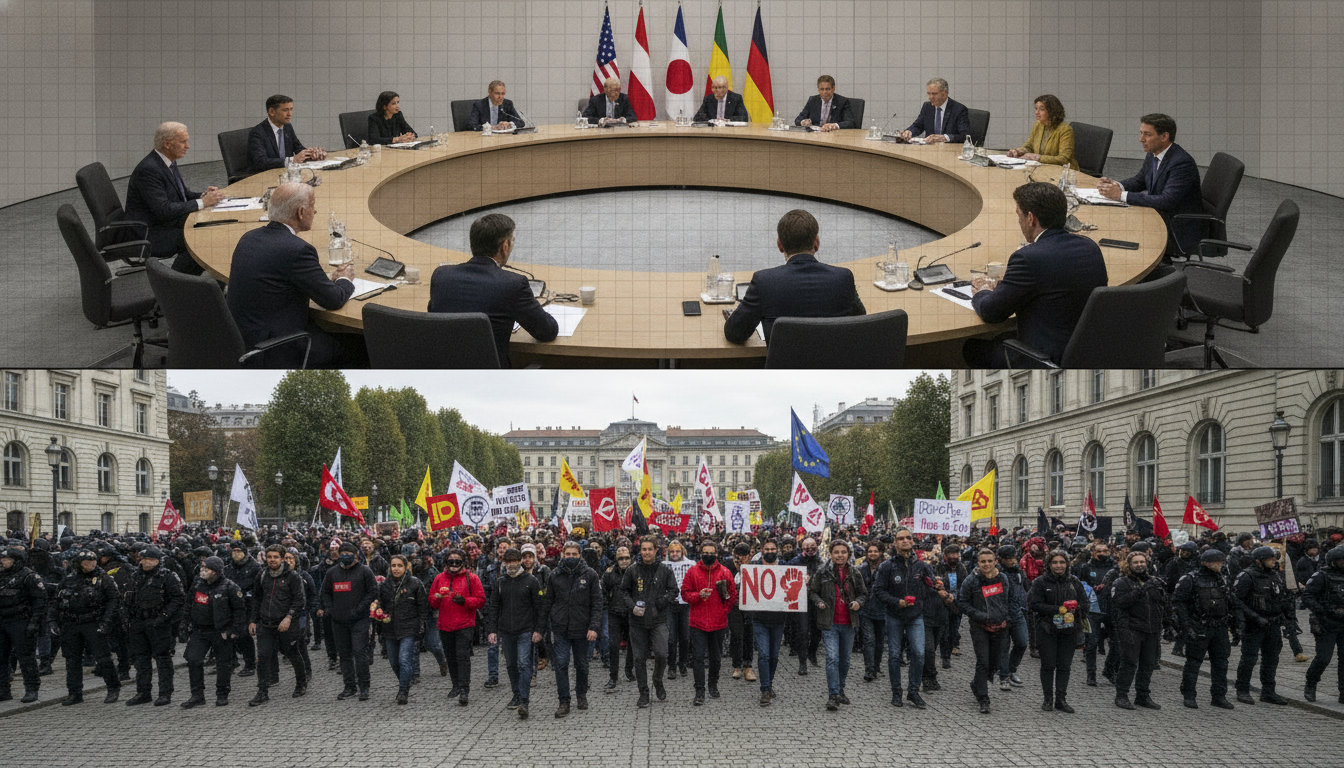
G7 summit protests draw thousands to Geneva ahead of Evian meeting
Thousands rallied in Geneva ahead of the G7 summit in Evian, staging G7 summit protests over climate, conflict and inequality as authorities tightened security.
Geneva march brings thousands to city streets
Thousands of demonstrators converged in central Geneva on Sunday in a large march organised by the No-G7 coalition, calling for an alternative global agenda ahead of the three-day G7 summit in nearby Evian-les-Bains. The protesters said their G7 summit protests targeted policies they described as favouring wealthy nations and perpetuating global inequality. Organisers estimated turnout in the thousands, and observers noted a diverse turnout that included environmentalists, feminist groups and Palestinian rights advocates.
The rally was peaceful for much of the day, with demonstrators carrying banners and chanting near key transport hubs before streaming toward a designated protest area. Local media and on-the-ground reporters described a mixture of planned events, spontaneous demonstrations and a flotilla of around 20 boats on Lake Geneva that displayed anti-G7 and pro-Palestinian messages. Authorities reported several detentions in the days leading up to the summit, reflecting rising tensions around the international gathering.
No-G7 coalition outlines grievances and demands
The No-G7 coalition, which bills itself as a federation of more than 60 groups, said its demands range from climate justice to an end to what it calls militarised foreign policy. Spokespeople told reporters they were protesting what they see as policies that fuel conflict, deepen poverty and ignore the planet’s environmental limits. One coalition representative warned that leaders attending the summit do not represent the interests of the wider global population.
Protesters highlighted the perceived disconnect between the G7’s agenda and priorities in the Global South, citing trade rules, debt burdens and climate finance as central concerns. Demonstrators carried placards condemning tariffs and military interventions while calling for more equitable international governance. Organisers said they planned coordinated actions throughout the summit to maintain pressure on visiting leaders.
Swiss and French authorities expand security operations
Swiss and French authorities deployed thousands of police officers across the border region to secure the summit and preempt unrest, officials said. Measures included road closures, bans on unauthorised gatherings and a visible law-enforcement presence around transport corridors and key meeting venues. Authorities also warned of restrictions on access to certain public spaces and urged residents and businesses to follow local directives.
Businesses in Geneva and on the French side of Lake Geneva boarded up storefronts and installed temporary protections after scenes of damage during past demonstrations. Local officials have offered financial support to enterprises that expect losses from the heightened security measures, reflecting concern about the economic impact of protests and restrictions. Police statements emphasised a dual approach of protecting the right to protest while preventing violence and property damage.
Detentions and reports from the scene
Swiss media reported that approximately 20 people were detained in separate incidents during the weekend, including an evening round-up on Friday as protesters gathered near the lakefront. Authorities did not immediately release detailed information about charges, citing ongoing investigations and public order considerations. Organisers said most detentions were of peaceful activists, while police described some actions as necessary interventions against unlawful conduct.
Journalists at the demonstration relayed contrasting scenes: largely peaceful marches punctuated by tense encounters where law enforcement moved to clear unauthorised groups. Photographs distributed by news agencies showed crowds, signage and the flotilla on the lake, underscoring the symbolic nature of the protests as much as their physical presence. Both organisers and authorities indicated that monitoring would continue through the summit period beginning Monday.
Global context: questions about G7 legitimacy
Critics of the G7 pointed to long-standing questions about the forum’s representativeness, noting that the group of seven wealthy democracies now accounts for a smaller share of global economic output than in previous decades. Analysts have observed that the G7’s proportion of world GDP has fallen from about 70 percent in past decades to roughly 40 percent, even as other blocs and emerging economies expand their influence. The BRICS grouping, which has added new members, was cited frequently by demonstrators as evidence of shifting global power dynamics.
Protesters and commentators argued that the G7’s narrow membership limits its ability to address global challenges equitably, particularly on climate finance and international security. Supporters of the forum counter that the G7 remains a useful platform for coordination among like-minded democracies on issues such as sanctions, trade policy and technological cooperation. The debate over the club’s role has sharpened as international crises and economic competition reshape diplomatic priorities.
Summit outlook and potential flashpoints in Evian
The G7 summit is scheduled to run from June 15 to June 17 in Evian-les-Bains, where leaders are expected to discuss an agenda that includes climate, trade and security matters. The proximity of Geneva has made the Swiss city a staging ground for protests and a focal point for civil society organisations seeking to influence the summit’s outcomes. Officials on both sides of the border said they were prepared for sustained demonstrations throughout the meeting, with contingency plans for crowd management and travel disruptions.
Organisers vowed to continue activities while urging participants to remain non-violent, and summit hosts signalled a commitment to protect delegates while respecting lawful demonstrations. As world leaders converge in Evian, the unfolding protests in Geneva are likely to be one of several public-facing tests of the summit’s political climate. The coming days will show whether demonstrators’ pressure alters the tenor of discussions or remains a separate expression of dissent from the main summit agenda.
The G7 summit protests in Geneva underscored deep public unease over global inequality, climate policy and conflict, and set the stage for a closely watched meeting in Evian where leaders will face both diplomatic challenges and visible public scrutiny.
