
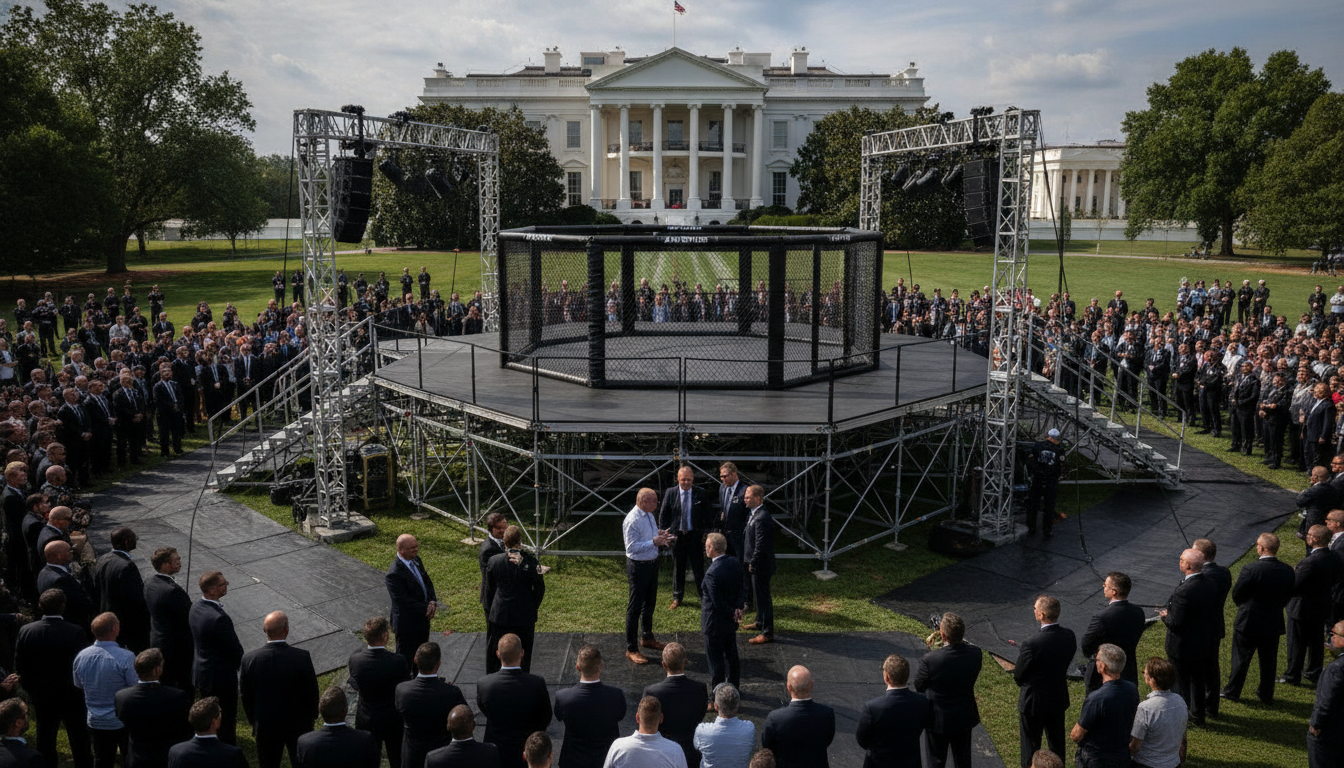
UFC White House event: inside the logistics of staging Freedom 250 on the South Lawn
Inside the logistics of the UFC White House event: engineering fixes, a Belgian ‘claw’ superstructure, security screening and weather contingency for Freedom 250.
The UFC’s plan to stage Freedom 250 on the White House south lawn has required months of intensive planning, complex engineering and tightly coordinated security work. The UFC White House event faces a web of hurdles from multi-agency permitting to moving hundreds of trucks through the capital’s security checkpoints. Organizers say the production’s footprint, custom structures and weather contingencies were designed specifically to protect athletes, the historic grounds and broadcast sightlines.
White House Logistics Complicate UFC Freedom 250 Setup
The operation to get equipment onto the south lawn has resembled a small military deployment, with each tractor-trailer subject to exhaustive security screening that can take most of a workday. Organizers reported that a single trailer can require six to eight hours to clear before it can unload, and dozens of such vehicles are needed to deliver crates, staging materials and technical gear. In addition to trucks and trailers, thousands of staff, contractors and vendors have moved through credentialing gates and security sweeps over the past week.
Accommodating spectators has added another layer of complexity for the UFC White House event. The approved seating around the octagon and auxiliary areas was designed with maximum capacity in mind while avoiding adjacent infrastructure, and the Ellipse across from the White House will host a fan festival capable of handling large crowds. Coordinating entry, circulation and emergency access for performers, officials and nearly 5,000 on-site ticket holders required daily calls between UFC logistics teams and federal security partners.
Engineering Fixes Address South Lawn’s 22-Foot Slope
The south lawn’s unusual topography posed a major obstacle: a 22-foot elevation change between north and south. Engineers conducted ultra-precise laser surveys and devised a leveling solution that relies on galvanized scaffolding and structural supports hidden behind a southern perimeter. That scaffolding created a stable, level platform for the octagon and spectator seating while minimizing impact on the historic landscape.
Final plans squeezed the octagon and primary seating into a footprint sized to avoid nearby trees, walkways and infrastructure, while allowing room for backstage and support zones. National Parks Service teams reviewed landscaping impacts and groundskeepers contributed to plans for protecting turf, which organizers say will be repaired after the event. The permitting process involved a dozen government entities, each assessing a different aspect from public safety to environmental effects.
‘Claw’ Superstructure Built in Europe and Tested in Pennsylvania
To carry lights, screens and other overhead production elements without blocking views of the White House, the UFC selected a four-pronged steel frame known colloquially as “the claw.” Manufactured by a European stage specialist, the span-and-leg design creates a 120-by-120-foot support grid with a high central apex that keeps rigging off the sightlines into the historic residence. The unit was shipped to the U.S. after a full-scale test assembly in Pennsylvania to verify dimensions and assembly time.
Organizers said the superstructure and its ballast were engineered to support a dense array of lighting, audio and broadcast equipment within a roughly 15,000-square-foot footprint. The build was rehearsed once in full, disassembled and then transported to Washington for reassembly, allowing the production team to refine timelines and camera placements. Those rehearsals enabled technical crews to confirm how the structure would integrate with the bespoke canvas, camera rigs and broadcast positions required for a national pay-per-view event.
Production Design Focused on Preserving White House Sightlines
A central production priority for the UFC White House event was keeping the White House visible in television frames while supporting a full arena-style broadcast. That meant suspending typical arena trusses and distributing lights, speakers and video screens across the claw so they would not obstruct key sightlines. Camera directors and producers worked closely with engineers to preserve a clear window behind the octagon for live and highlight shots.
The superstructure was topped by a custom, watertight canopy that stretches to nearly 100 feet at its apex and is intended to shield the ring and equipment from light rain while providing modest cooling. Production designers also installed a sun-protective canvas over the fighting surface to mitigate heat build-up during daylight hours and queued a pair of spare canvases in case replacements were needed mid-event. Those measures, combined with careful camera placement, were intended to balance athlete safety, broadcast quality and the visual prominence of the White House backdrop.
Weather Forecasts and Contingency Procedures for June Heat
Weather emerged as one of the biggest uncontrollable variables for the UFC White House event, with June in Washington historically bringing high humidity, heat and scattered thunderstorms. The promotion contracted multiple meteorological services and maintained an on-site weather specialist who escalated forecasts from daily to hourly as the event approached. Organizers prepared for three principal hazards: rain, high winds and lightning, and developed communication protocols to notify department heads and broadcast partners in real time.
Contingency plans include evacuation procedures for lightning, alternate broadcast positions if certain areas became unsafe, and protocols for delaying the show during heavy precipitation. UFC officials indicated they planned to proceed through light-to-moderate rain but would consider a pause for severe downpours. They also noted that timing flexibility is constrained by athlete health and weight-management schedules, which limit how far the event window can be shifted without risking competitors’ safety.
Security, Permitting and Post-Event Recovery
Securing the White House site required coordination across the Secret Service, the National Parks Service and other federal agencies that evaluated crowd safety, airspace restrictions and landscape impacts. No uncrewed aircraft beyond government-operated drones were permitted near the White House, eliminating a common aerial-capture option for large outdoor productions. The UFC said all aspects of the site plan, from access routes to seating maps, underwent repeated review before final permits were issued.
Once the final bell rings, organizers will move into a sustained deconstruction phase, packing out hundreds of trucks, dismantling the claw and shipping components back overseas. Load-out work is expected to continue around the clock for several days, followed by turf restoration and ground repairs. UFC production executives described the recovery as a deliberate process designed to return the historic grounds to their original condition as quickly as possible.
Craig Borsari, the UFC executive overseeing the effort, framed the operation as a test of logistics and creativity that pushed his team to adapt engineering, security and broadcast practices for an unprecedented outdoor U.S. presentation. He said the experience will inform future large-scale productions and, despite the strain, the promotion is already thinking about what challenges might come next.
