
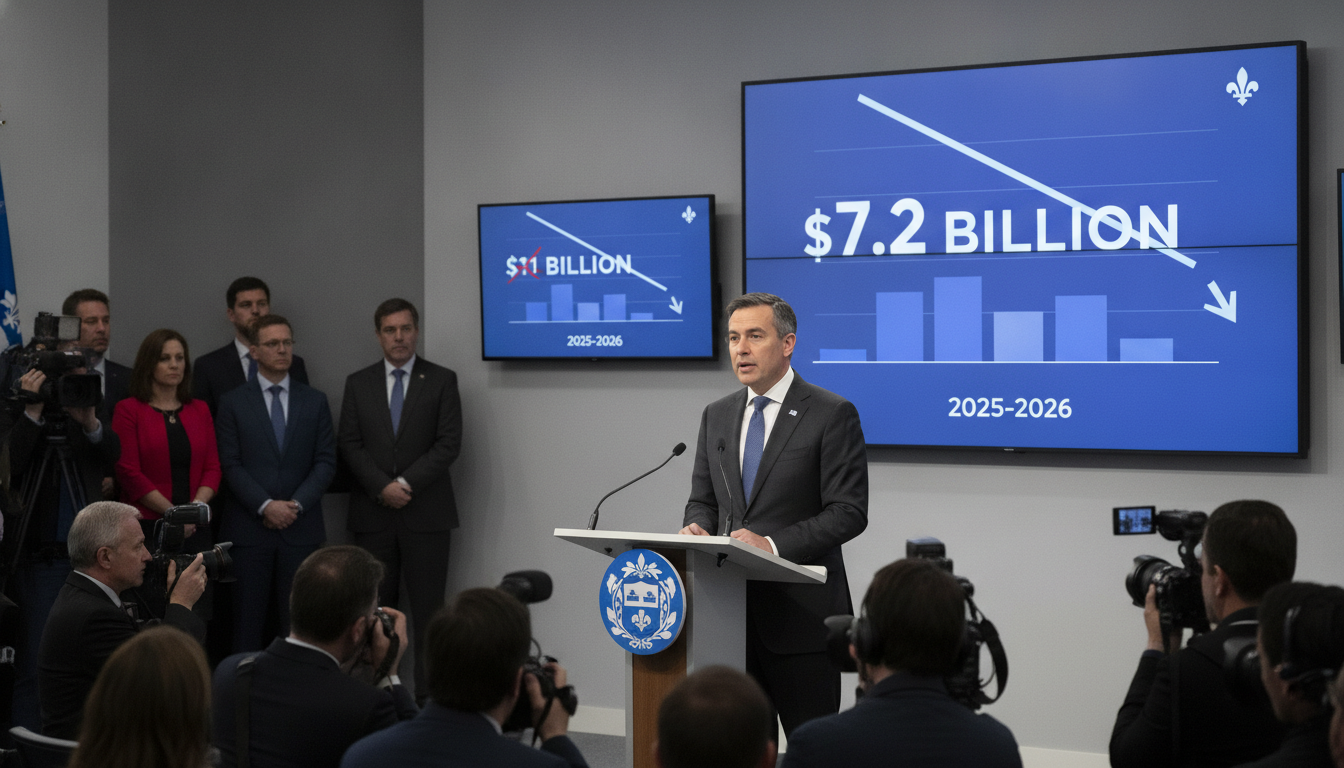
Quebec deficit revised to $7.2B for 2025-26, Finance Minister says
Quebec deficit revised to $7.2B for 2025-26 as Finance Minister Éric Girard cites stronger revenues and deferred spending; experts warn of lingering risks.
The Quebec deficit for 2025-26 has been revised down to $7.2 billion, the province’s finance minister announced after the release of the Report on the Financial Situation for 2025-2026. The revised figure, presented by Finance Minister Éric Girard, represents a $6.4 billion improvement from an earlier projection of $13.6 billion and marks a notable shift in the province’s fiscal outlook.
Deficit figure revised sharply
The government’s report shows the deficit shrinking from the previously forecast $13.6 billion to $7.2 billion for the fiscal year 2025-26. That reduction follows the latest fiscal tracking and adjustments reported Thursday afternoon by the provincial treasury.
When excluding transfers to the Generations Fund, the finance ministry estimates an underlying deficit closer to $5 billion, or roughly 0.8% of Quebec’s GDP. The minister stated that such a figure would be the smallest provincial deficit in Canada for 2025-26 if confirmed.
Government credits revenue growth and contingency decision
Officials attributed the revision primarily to stronger-than-expected revenues and a decision not to draw on a $2 billion contingency provision. The report points to an assumed 3% growth in revenues as a material factor in narrowing the gap between planned expenditures and receipts.
Finance Minister Girard highlighted that higher tax receipts and other income streams improved the fiscal picture, while the unspent contingency preserved budget flexibility. Those elements combined to reduce the headline deficit by approximately $6.4 billion, according to the ministry’s calculations.
Minister Girard frames the improvement as prudent management
In presenting the figures, Minister Girard described the adjustment as the result of cautious forecasting and tighter spending discipline. He emphasized that the revision reflects conservative assumptions in the budgetary projections and ongoing efforts to manage public expenditures efficiently.
Girard also reiterated the government’s intent to keep fiscal targets under review and defend the province’s credit profile. The minister framed the outcome as a positive development while acknowledging that work remains to bring the budget closer to balance.
Spending restraint and project deferrals explain much of the gain
Economists point out that much of the fiscal improvement stems from lower-than-expected spending rather than a structural boost to revenues. Louis Lévesque, president of the Public Policy Committee at the Association of Quebec Economists, said the bulk of the improvement comes from the postponement or rephasing of infrastructure projects and other deferred expenditures.
Lévesque warned that relying on temporary delays to reach short-term fiscal targets leaves the province vulnerable to future cost pressures. He noted that while the revision is “good news” for the near term, the composition of the gains matters for medium-term fiscal sustainability.
Economic uncertainty and policy risks persist
Analysts and stakeholders cautioned that uncertainties remain, including potential changes to trade arrangements with the United States and ongoing signals that may deter Canadian business investment. Those external factors could affect revenue trajectories and employment, complicating Quebec’s path back to a balanced budget.
Experts also pointed to long-standing infrastructure needs as an unresolved challenge. Lévesque said returning to equilibrium under a plan that assumes historically low growth in spending would be difficult without jeopardizing maintenance and capital renewal projects.
The finance ministry’s revised outlook follows earlier projections in March 2025 when Minister Girard anticipated a deficit exceeding $11 billion, part of a broader budget exercise titled Pour un Québec fort. That earlier projection had prepared the public for an elevated deficit for the 2025-26 fiscal year.
The government’s accounting choices — including the treatment of the Generations Fund and the decision not to use the $2 billion contingency — will be key points of scrutiny as stakeholders assess the sustainability of the improved headline result. Observers say transparent reporting of one-time measures and the timing of delayed projects is essential to evaluate the province’s true fiscal position.
Looking ahead, the province will monitor revenue trends and the status of postponed spending to determine whether the downward revision can be sustained. Quebec’s fiscal outlook will also depend on broader economic performance and any external shocks that could alter the revenue path.
The revised Quebec deficit provides immediate relief to the province’s finances but leaves open questions about how durable that improvement will be once deferred projects resume and economic conditions evolve.
