
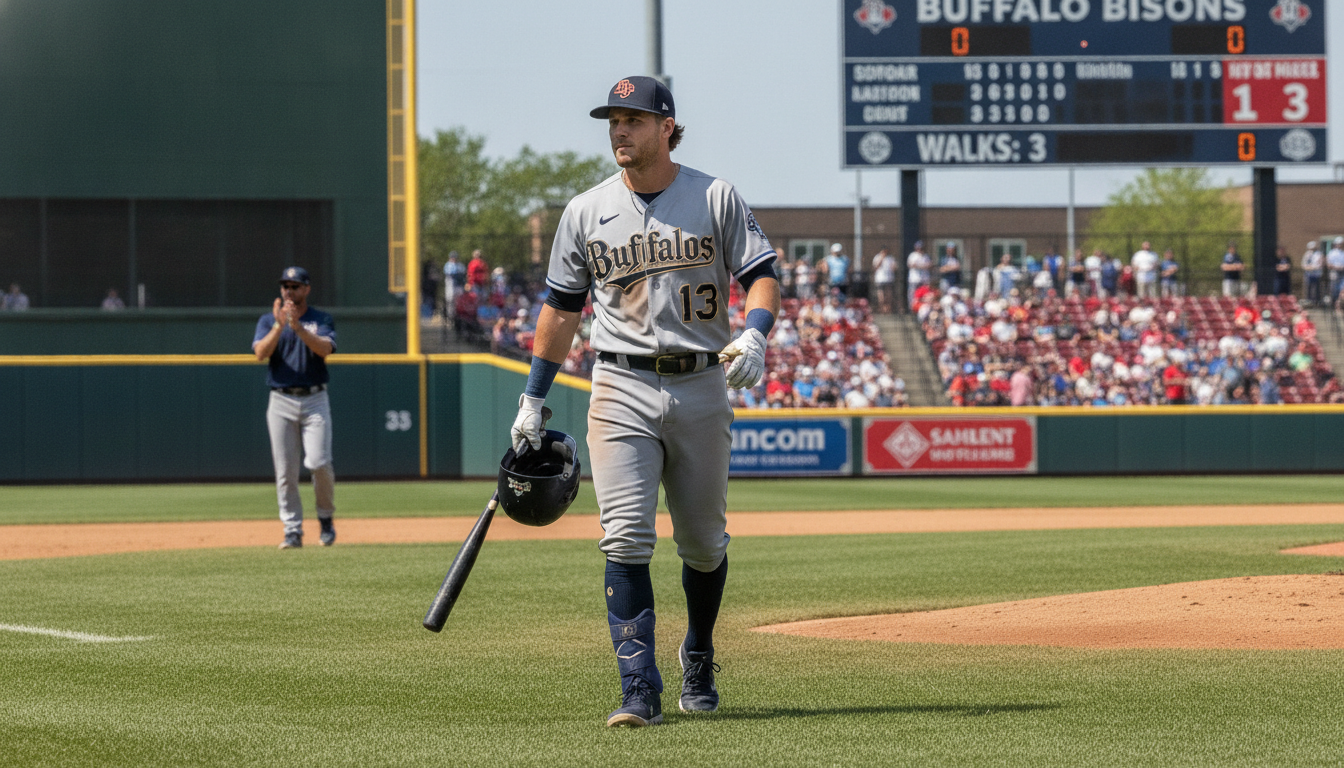
Davis Schneider Draws Walks but Struggles at Triple-A as Blue Jays Monitor Progress
Davis Schneider is drawing an unusually high number of walks in Triple-A Buffalo but continues to struggle at the plate as the Toronto Blue Jays assess when to bring him back to the majors.
Schneider Sent to Triple-A for a Reset
When Davis Schneider was optioned to Triple-A Buffalo in late May, the move was framed as a chance for the 27-year-old to see more hittable pitches and rebuild his swing confidence. Blue Jays manager John Schneider said the intention was development rather than a permanent demotion, emphasizing that Schneider remains part of the club’s plans. The assignment was intended to create a lower-pressure environment where Schneider could focus on repeating mechanical adjustments and facing pitchers he can time better.
The decision followed a difficult stretch at the major-league level that prompted the club to prioritize long-term growth over short-term roster necessity. Toronto opted for a reset in Buffalo with the expectation that regular at-bats and coaching attention would restore the form that helped Schneider earn a more prominent role earlier this season.
Early-Season Struggles in Toronto
Schneider’s major-league numbers through his 38 games and 89 plate appearances were stark: a .127 batting average and a .507 OPS with a lone home run. Those numbers stood in contrast to the postseason moments that raised expectations, including a leadoff home run in Game 5 of the World Series off Blake Snell. That spotlight coupled with increased opportunity this spring and early summer left the young infielder under pressure to produce.
Toronto had given Schneider a larger role to start the season after his memorable playoff performance, but the results failed to follow. As the club searched for consistency, the Triple-A assignment became the practical route to let him work through timing issues without occupying a major-league roster spot.
Plate Discipline Spikes in Buffalo
Statistically Schneider’s profile has shifted in Buffalo: through 14 games he is listed at roughly a .188 batting average but an eye-catching .550 on-base percentage, driven by 24 walks in 60 plate appearances. The walk rate indicates a pronounced selectivity at the plate, with Schneider choosing to take a pitch rather than expand his zone when he doesn’t see his preferred pitch shape.
Schneider acknowledged the tradeoff in interviews, saying he was trying to restrain from chasing pitches he couldn’t handle while also trying to rebuild more assertive swing mechanics. The result has been more opportunities on base but fewer balls put in play, a mixed signal for coaches who want both plate discipline and the ability to do damage when presented with a hitter’s pitch.
Swing Mechanics and Confidence Under Review
Coaching staff and Schneider have focused on swing consistency during his Buffalo stint. The player himself admitted he has been “all over the place” at times — getting underneath pitches, hitting a preponderance of ground balls, and missing offerings he believes he can handle. That combination of timing errors and mechanical variance is what the Blue Jays hope to correct in an environment where adjustments can be practiced over multiple games.
The reset in Buffalo is intended to calm the mental approach while allowing technical drills and live at-bats to reinforce a repeatable swing. Sources close to the organization say the emphasis is on balance and load timing rather than wholesale changes, with the goal of restoring Schneider’s ability to drive hittable pitches instead of simply drawing walks.
Roster Context and Organizational Moves
Schneider’s timeline for a return is dependent in part on broader roster circumstances. The Blue Jays have recently welcomed back starters Dylan Cease and Max Scherzer from the injured list, reducing immediate roster pressure on the infield. Meanwhile, Shane Bieber has been scheduled to make his second start with Buffalo, and All-Star catcher Alejandro Kirk was expected to appear for the Bisons before potentially rejoining Toronto for an upcoming series.
Those moves give Toronto more flexibility to leave Schneider in Triple-A while he works through issues. The presence of veterans back on the major-league staff also creates a clearer short-term picture for promotions, allowing the club to prioritize readiness over urgency when considering recalls.
What to Watch Before a Recall
Key metrics that will likely determine Schneider’s recall include an uptick in contact rate, better quality of contact on balls in play, and the conversion of walks into runs via multi-hit outings and extra-base power. Coaches will also monitor his plate-coverage on fastballs and breaking balls, along with strike-zone judgment in counts where he previously chased.
Performance milestones in Buffalo — a stretch of consecutive games showing improved contact and a reduction in weak grounders — would strengthen the case for a return. Equally important will be the mental signs: Schneider’s comfort level in the box, decisiveness on pitches to swing at, and ability to finish at-bats productively.
Schneider has described his time in Triple-A as a reset that allows him to “calm down a little bit and work on some things.” For Toronto, the priority is ensuring that a recall brings meaningful contribution rather than a short-term fix.
The Blue Jays have not set a firm timetable for his return, and the club appears willing to let development dictate the move. As Schneider continues to work in Buffalo, his combination of elite plate discipline and inconsistent contact will be the defining factors in when — and how — he rejoins the major-league roster.
