
AI in universities sparks boos, deals and fresh debate over automation
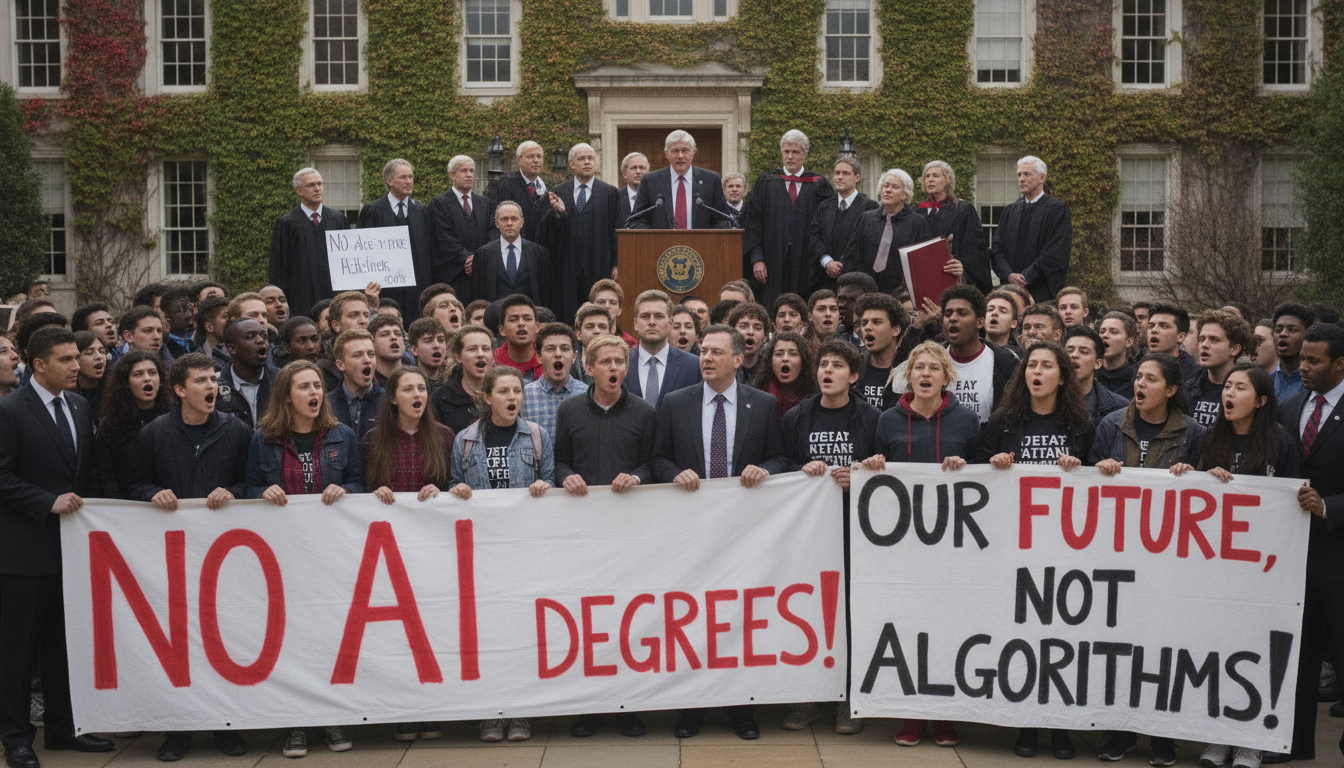
Universities face mounting debate as AI in universities becomes both a recruitment pitch and a cost-cutting prescription, prompting student backlash at commencement ceremonies. Graduates at multiple U.S. campuses voiced their unease — sometimes loudly — as speakers and administrators framed artificial intelligence as an essential skill and institutional solution. The dispute raises questions about pedagogy, governance and whether campuses should remodel themselves around technologies driven primarily by corporate incentives.
Graduation backlash over AI adoption
Graduation events this season have repeatedly featured protests against messages that cast AI as the answer to students’ futures. At several commencements, speakers who linked career success to rapid AI adoption were met with boos and jeers from graduates and relatives. Those reactions reflect broader anxiety about entering a labour market where AI is presented not merely as a tool but as a defining feature of work.
Large-scale contracts reshape campus priorities
A wave of agreements between universities and technology firms has accelerated the shift from pilot projects to systemwide adoption. Institutions including the University of Minnesota, Dartmouth College and Syracuse University have signed partnerships aimed at integrating vendor platforms into campus services and curricula. California State University drew particular attention in 2025 when it announced an initial $17-million arrangement with a major AI developer to roll out an education-focused chatbot across its campuses.
Those commercial ties can look attractive to cash-strapped institutions, offering branded services and promises of efficiency. But critics warn that such deals can reorient university priorities toward scalable, vendor-driven solutions at the expense of core academic commitments.
Budget choices deepen the debate
Money often drives technological decisions, with administrations arguing that AI can reduce administrative burdens and operating costs. Yet the financial calculus is not always straightforward. Despite facing substantial budget reductions, one large public system agreed to renew its AI contract on more expensive terms, committing millions annually even while cutting elsewhere. That choice has provoked scrutiny from faculty and students who question whether short-term savings or branding gains justify long-term contractual obligations.
The tension is especially acute when universities are expected to act as sources of talent for the companies that stand to profit most from widespread AI deployment. Critics say those dynamics create a conflict between institutional missions and market pressures.
Automation misfires at a commencement ceremony
A stark example of the risks of automating familiar campus tasks occurred when an AI-driven system used to display graduates’ names at a community-college commencement repeatedly misidentified students. The mismatches on the big screen prompted audible dismay and boos from the audience, and the campus president’s apology did little to tamp down frustration. For many attendees the incident crystallized a deeper worry: that adopting AI for routine functions can undermine the dignity and attention students expect on milestone occasions.
Such visible missteps feed a narrative that technology is being rushed into roles that require human judgment, local knowledge and simple attention to detail.
Assessment and academic standards under strain
Concerns intensify when AI moves from administration into teaching and evaluation. Recent academic testing of sophisticated assessment tools shows they can diverge significantly from human judgment, tending to reward surface features like length and vocabulary rather than the conceptual quality of an argument. Researchers caution that automated grading systems are often overly sensitive to linguistic style and may systematically undervalue work that human markers would recognize as excellent.
Scholars argue that assessment is integral to educational meaning: it signals standards, recognizes student effort and helps sustain trust in credentials. Replacing or heavily augmenting that process with opaque algorithms risks eroding the relationships, oversight and contextual judgement that give grades their significance.
Corporate incentives and the limits of efficiency narratives
Industry sponsors and consultants have been explicit about AI’s potential to streamline operations. Papers and promotional materials highlight automation of routine tasks, improved student services and the capacity to scale certain administrative functions. But observers warn that treating universities primarily as training grounds for a tech-driven labour market reduces them to parts of a supply chain — sources of employees and data — rather than independent centres of teaching, research and civic formation.
The rapid expansion of AI on campuses is therefore as much a business proposition as an educational reform. Where profitability depends on ubiquitous adoption, institutions risk being enlisted to validate technology before its pedagogical and ethical consequences are fully understood.
Universities must weigh efficiency against educational values, and faculty and trustees play a crucial role in shaping those decisions.
Many students say they do not want to be reduced to raw inputs for corporate algorithms, and faculty members voice concerns about privacy, bias and accountability. Evidence that AI use can sometimes blunt critical thinking and disrupt learning processes amplifies those worries.
For universities considering deeper AI integration, the debate is not only about capabilities but about purpose. Leaders must balance pragmatic needs with the responsibility to preserve mentorship, deliberative assessment and the cultivation of independent judgement. The choices made now will affect how future generations understand higher education’s role in public life.
The controversy unfolding on graduation stages is a public prompt: institutions should not adopt AI in ways that undermine teaching, trust or the many human interactions central to learning.
