
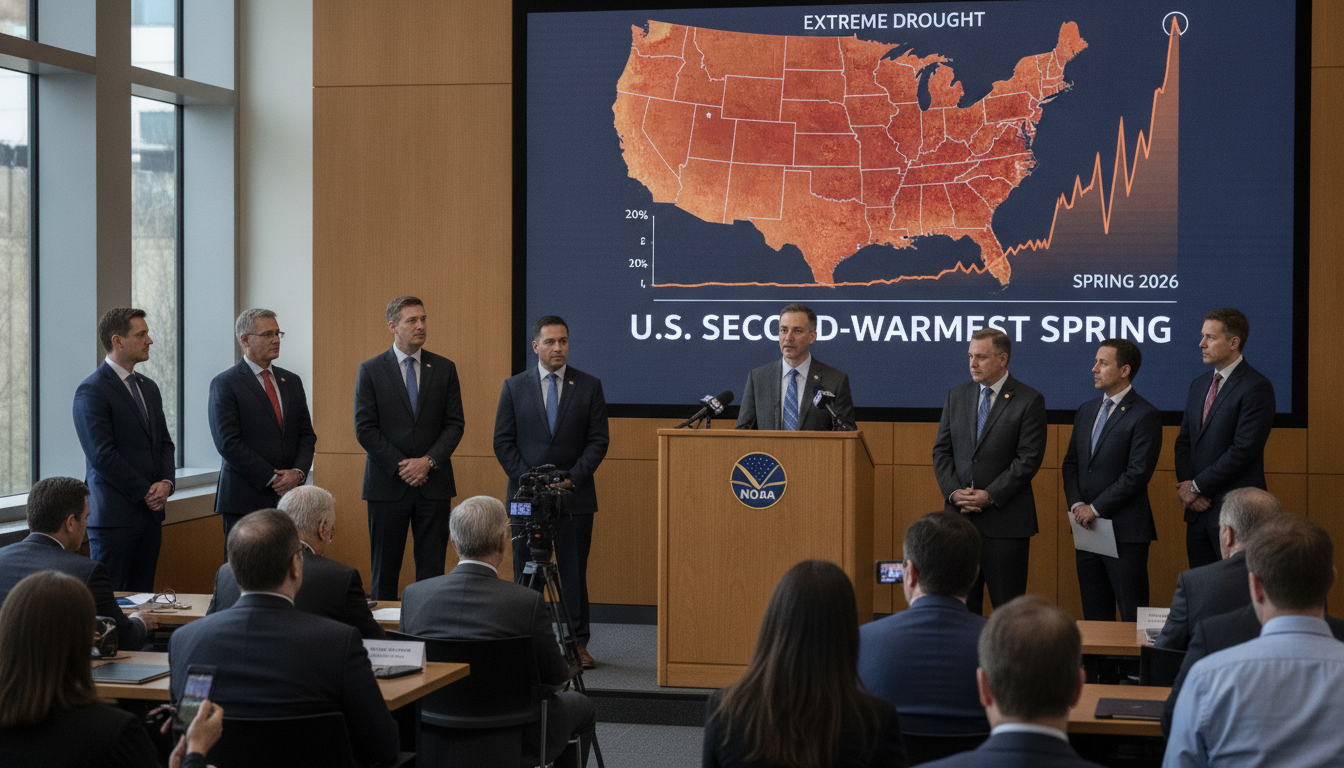
U.S. spring heat hits record levels as NOAA cites second-warmest spring in 2026
NOAA: The U.S. spring heat of 2026 was the nation’s second-warmest on record, with record March highs, widespread drought and mounting water supply risks.
The United States experienced an unusually intense period of warming this spring, with U.S. spring heat reaching the country’s second-highest seasonal average on record, officials said. The National Oceanic and Atmospheric Administration reported an average temperature of 13.2°C across the contiguous U.S. from March through May, marking a season of exceptional warmth and persistent dryness for large swaths of the country. Scientists and water managers warned that the combination of extreme March heat and depleted mountain snowpacks has intensified drought conditions and strained crucial water supplies.
NOAA declares second-warmest spring nationwide
The federal climate agency identified spring 2026 as the second-warmest in the contiguous United States’ 132-year observational record.
The seasonal average temperature of 13.2°C was surpassed only by the spring of 2012, NOAA said, underscoring a pattern of rising baseline temperatures across many regions.
Officials noted the seasonal ranking was driven by widespread warmth rather than isolated hot spots, affecting both the interior West and parts of the central United States.
Record March heat in the Southwest and border regions
March produced some of the most extreme early-season warmth, particularly across the western states and along the U.S.-Mexico border.
Temperatures in parts of the Southwest exceeded 44°C in late March, establishing a national high-temperature record for that month and occurring only days after sub-freezing conditions in some areas.
Arizona, Colorado, New Mexico and Texas each recorded their warmest spring in 132 years of records, intensifying wildfire risk and stressing electricity and water systems.
Scientific attribution links heat to human-driven climate change
A multi-institution study from the World Weather Attribution group found the March heatwave would have been nearly impossible without human-caused climate change.
Researchers say the accumulation of greenhouse gases from fossil fuel combustion has raised the probability and intensity of such early-season extremes, shifting historical baselines.
Climatologists warn that these events are likely to become more frequent, earlier in the year, and more severe unless greenhouse gas emissions are sharply reduced.
Drought deepens and Colorado River levels alarm authorities
NOAA reported that the start of 2026 brought the worst January-to-May drought in the contiguous U.S. since 1988, with more than half the country affected by some level of drought by early June.
The mountain snowpack that normally sustains summer water supplies fell to historic lows in many basins, leaving reservoirs and river systems vulnerable as temperatures rise.
Water managers have flagged the Colorado River’s low flows as a particularly urgent concern; the river supplies water to roughly 40 million people and supports agriculture across several states.
Sports events and public health face mounting heat risks
Forecasters expect above-normal temperatures to persist into June across much of the West and northern Plains, a trend that raises concerns for outdoor mass gatherings.
Several open-roof stadiums hosting high-profile soccer matches this summer will monitor conditions closely, with some climate experts warning that oppressive heat could affect a notable share of tournament games.
Public health officials emphasize the need for cooling strategies, hydration campaigns and heat-response plans to protect players, staff and spectators during prolonged warm spells.
Sharp regional contrasts highlight complexity of 2026 spring
While the contiguous U.S. saw exceptional warmth and dryness, other parts of the country experienced pronounced deviations from that pattern.
Hawaii recorded its wettest spring in 36 years, receiving more than twice the expected seasonal precipitation and elevating flood and landslide risks in some areas.
Alaska experienced a colder-than-average spring, marking its coolest spring since 2013 and illustrating the varied regional impacts that can accompany broader shifts in climate patterns.
The evolving mix of extreme heat, drought and localized heavy precipitation this spring underscores the increasingly complex challenges for water resource management and public safety.
As forecasts point toward continued above-normal temperatures in several regions, federal and state agencies say planning for heat-driven impacts on agriculture, infrastructure and public events will be essential.
Officials and scientists stress that while seasonal statistics illuminate recent extremes, long-term reductions in greenhouse gas emissions and investments in adaptation remain central to limiting future risk and protecting communities.
