
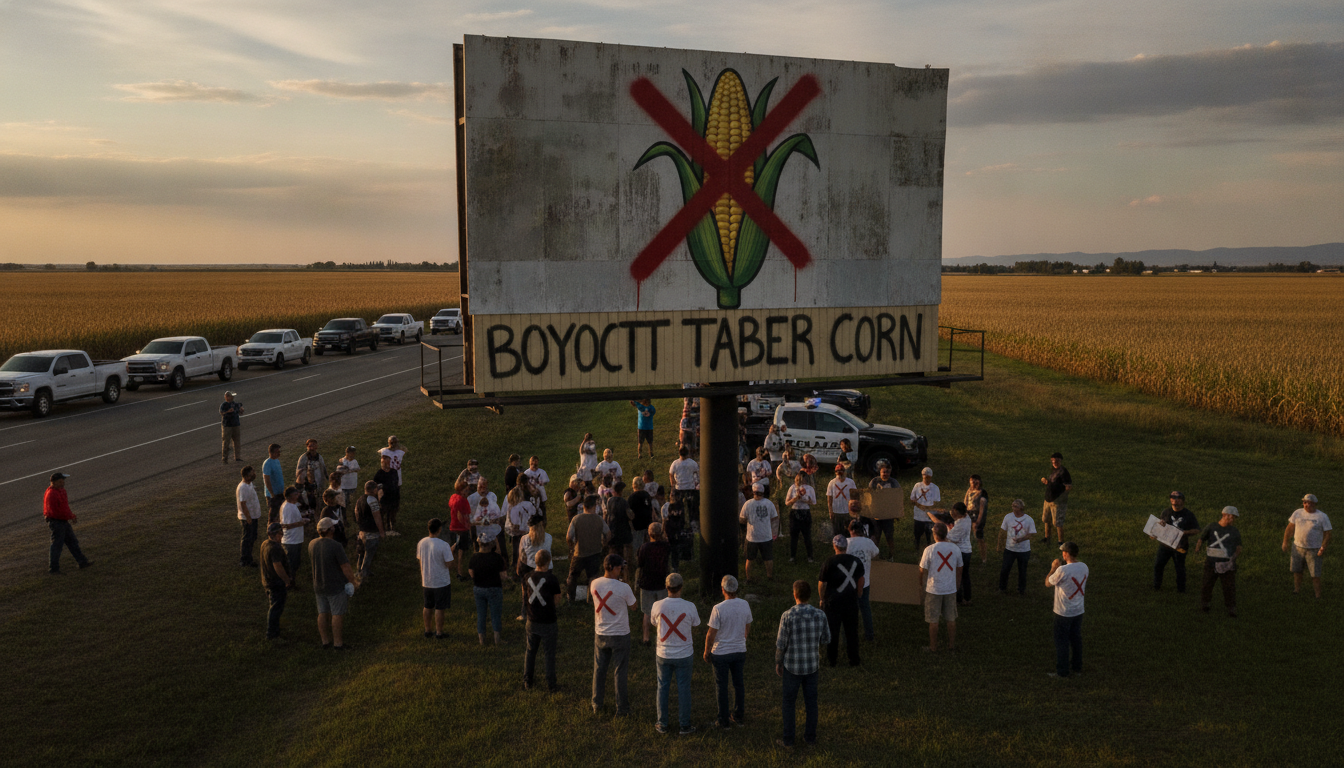
Taber billboard urging "Choose Alberta" divides town, prompts debate over political ads
Taber billboard reading "Send Ottawa a message! Choose Alberta" sparks debate, dividing residents and prompting concerns for local farmers and town officials.
A digital billboard visible from Highway 3 in Taber, Alta., has become the centre of a heated local debate after it began displaying a politically charged message urging viewers to "Choose Alberta."
The message, placed by third-party group Pathway to Independence on behalf of campaigner Cory Morgan, has been widely shared on social media and discussed in town meeting rooms and online comment threads.
Town officials and residents say the advertisement has forced a conversation about political advertising in public spaces and its potential effects on community cohesion.
Message on Highway 3 draws widespread attention
The electronic sign, located on a major route through southern Alberta, carried the plain text "Send Ottawa a message! Choose Alberta" for a series of rotations that quickly attracted notice.
Its placement near public areas and visible from the highway prompted passersby and local motorists to photograph and share the display across social platforms.
The advertisement was booked by Pathway to Independence and identified as supporting Cory Morgan, who has defended the placement as a legitimate form of political expression.
Public reaction escalated once images of the billboard circulated more broadly, pushing the local discussion into provincial online forums.
Some commentators applauded the ad’s blunt appeal to Alberta identity, while others criticised its confrontational tone and timing.
The mix of support and opposition reflects broader tensions over regional politics that have become more vocal in recent years.
Residents express discomfort with placement near community spaces
Several Taber residents told reporters they were surprised to see a politically charged advertisement in a location they consider close to everyday public life.
Bob Stewart, a long-time local, said he did not agree with the sign’s proximity to common areas and worried about its impact on the town’s public atmosphere.
Other residents voiced similar unease, describing the ad as an unwelcome intrusion into spaces they expected to be free from partisan messaging.
At the same time, some locals suggested that removing the advertisement would raise free-speech concerns.
Those in favour of letting the sign remain pointed out that public advertising spaces are often used for a variety of political and civic messages.
The debate highlighted a local divide between those prioritizing community harmony and those emphasizing robust political expression.
Local businesses reported mixed reactions from customers, with some saying they received questions and comments about the sign.
Retailers in the immediate vicinity said daily operations have not been disrupted, but they noted an uptick in conversations among patrons.
Several business owners expressed a desire for the town to clarify its role in managing, or at least responding to, contentious advertising.
Advertiser and candidate defend the notice as protected speech
Cory Morgan, associated with the message, told supporters and critics alike that political advertising is a strongly protected area of expression.
He warned that interfering with registered political advertising could set a dangerous precedent for future campaigns and civic discourse.
Morgan repeatedly asked that the debate not be used to target unrelated members of the community, particularly local farmers.
Pathway to Independence, the third-party advertising organization that leased the digital panel, said such platforms are available to a range of advertisers and that they do not curate political viewpoints.
The group’s involvement reflects a growing trend of third-party organizations using digital billboards to convey targeted messages during election cycles and political movements.
Both the advertiser and its representative emphasized that the placement complied with the terms of the sign lease and relevant advertising procedures in place at the time.
The defence of the message has not quelled criticism, but it has underscored the tension between regulatory oversight and private contractual arrangements that govern outdoor signage.
Critics argue that visibility on a major thoroughfare gives any political message an amplified reach that can strain small-town relations.
Supporters counter that public visibility is intrinsic to the purpose of political advertising and essential for stimulating democratic debate.
Town of Taber clarifies its limited role and responds to concerns
In an official statement, the Town of Taber said it does not approve, review, select or control the messages displayed on leased signs.
The municipality emphasized that the views expressed in the advertisement belong to the advertiser and do not represent the official positions of the town or council.
Town officials urged residents not to interpret the billboard as indicating community consensus or the stance of local businesses and organizations.
Nevertheless, the town acknowledged receiving inquiries and concerns from residents about the sign’s content and placement.
Officials said they are communicating those concerns to the leaseholder of the billboard and monitoring the situation for any developments that would require municipal attention.
The town’s response reflects a balancing act between respecting contractual arrangements with sign operators and addressing the community’s desire for consultation.
Municipal staff also noted the limits of their authority when it comes to editorial content on privately leased advertising panels.
While the town can regulate certain aspects of signage, such as size and location through bylaws, it does not typically exercise control over the messages that lessees choose to publish.
That distinction has left some residents calling for clearer local rules governing political advertising in public-facing spaces.
Economic concerns surface as calls to boycott Taber corn appear online
Shortly after the billboard gained traction, social media threads began referencing Taber’s agricultural profile, with some users suggesting boycotts of locally produced corn.
The town of Taber is well known in the region for its agricultural production, and the suggestion of a boycott alarmed several community members.
Cory Morgan publicly asked both supporters and opponents of his campaign to refrain from targeting Taber farmers, stressing that they had no involvement in the advertisement.
Farmers and agricultural groups in the area expressed frustration at being drawn into a political dispute unrelated to their industry.
Local producers emphasized that crop sales and farm incomes depend on regional and national market conditions, not municipal political messaging.
Several farm operators appealed to residents and outsiders to separate political disagreements from the livelihoods of those who work the land.
Economic stakeholders pointed out that a sustained boycott could harm independent operators and the broader supply chain in southern Alberta.
Chambers of commerce and local business associations contacted by reporters urged calm and dialogue rather than punitive actions directed at producers.
The emergence of boycott talk highlighted how quickly local economies can become entangled in political disputes when messages circulate widely online.
Leaseholder responsibilities and potential regulatory responses
The controversy has focused attention on the role of the sign’s leaseholder and what steps, if any, could be taken to address community concerns.
Lease agreements for digital signage typically set terms for content delivery, payment and technical operations, and they often include clauses about compliance with local regulations.
Town officials have indicated they will continue to liaise with the leaseholder to convey public concerns and explore any feasible responses under existing contracts and bylaws.
Observers said the episode could prompt a review of local sign bylaws or the adoption of clearer guidance around political advertising in public view.
Municipalities across Canada face similar dilemmas as digital panels become more common and political actors increasingly leverage them for rapid messaging.
Any regulatory adjustments would require council discussion, possible bylaw amendments and a public consultation process before changes take effect.
Legal experts and municipal lawyers note that changes aimed at restricting content must be carefully crafted to respect constitutional protections for political speech.
At the same time, measures that clarify placement, timing and disclosure requirements for paid political messages may offer a path for balancing free expression and community standards.
For Taber, the immediate practical step remains communication with the sign operator while long-term policy considerations are weighed by local leaders.
Community leaders call for respectful dialogue amid differing views
Local community leaders have urged residents to keep exchanges civil and to focus on constructive avenues for addressing disagreements.
Clergy, school officials and business representatives contacted in the wake of the billboard controversy recommended town forums or moderated discussions to air concerns without inflaming tensions further.
Those leaders emphasized that maintaining trust among neighbours is essential to small-town resilience, especially when divisive topics arise.
Some residents suggested convening a public meeting where municipal staff, the leaseholder and representatives of Pathway to Independence could answer questions and provide context.
Others proposed that community groups develop their own statements clarifying their values and distancing themselves from political messaging they did not endorse.
These suggestions reflect a common desire in Taber to restore a focus on local priorities while allowing space for lawful political expression.
The episode has also prompted conversations about media literacy and the importance of verifying who is behind public advertisements.
Citizens expressed interest in clearer labelling of paid political content and more accessible information about third-party advertisers and their funding sources.
Such steps, advocates argue, would help residents evaluate messages and make informed decisions without conflating advertisers with the communities where their signs are displayed.
The billboard remains visible while local debate continues, and municipal leaders say they will keep residents informed as any new developments arise.
The sign has succeeded in drawing attention, but it has also reopened longstanding conversations about the boundaries between private advertising, political messaging and community values.
For now, Taber residents continue to weigh the implications of a single message displayed on a digital panel and what it reveals about political expression in public spaces.
The advertisement has not been removed and the town continues to convey resident concerns to the sign’s leaseholder while urging calm and restraint from both critics and supporters.
