
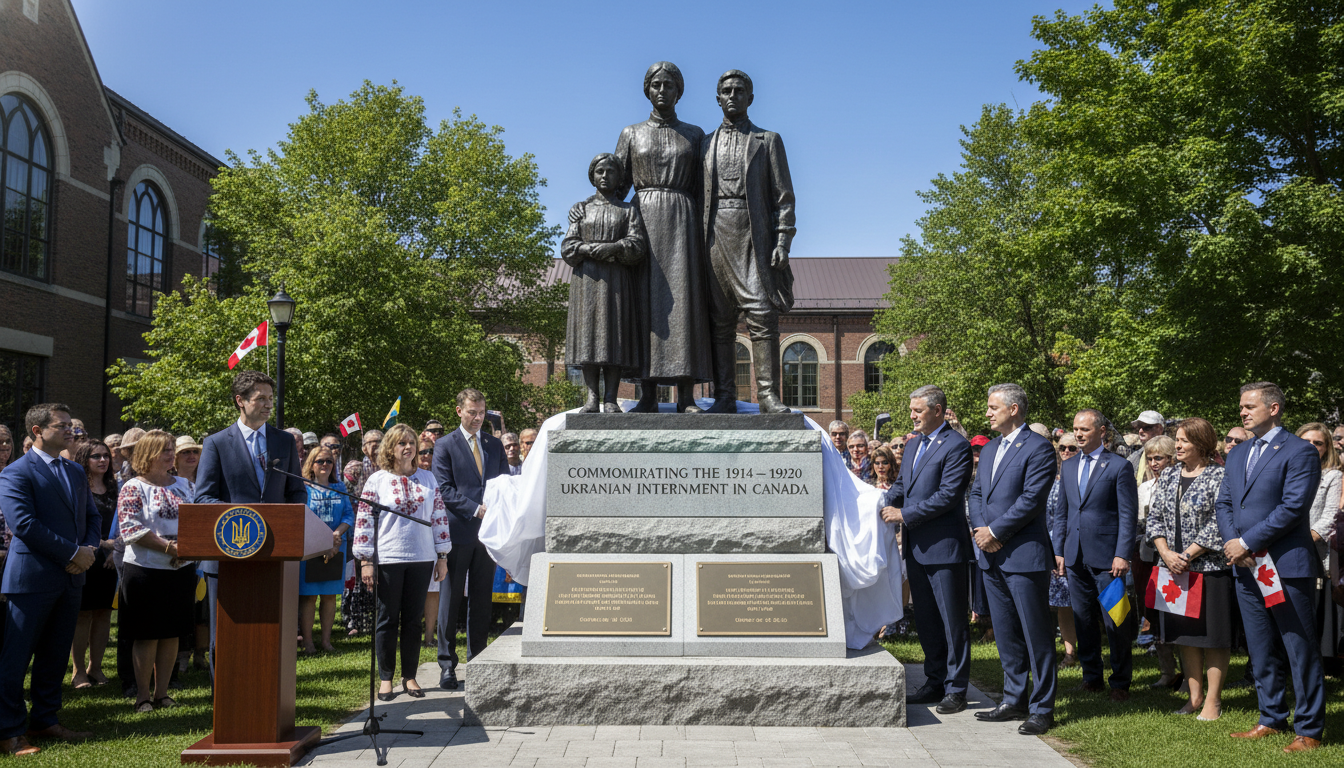
Statue and Plaques Unveiled in 1995 Recall Canada’s 1914–1920 Internment Operations
UCCLA’s 1995 monument commemorates thousands affected by Canada’s first national internment operations during 1914–1920 and aims to preserve that history in public memory.
Both a statue and accompanying bronze interpretive plaques were unveiled in August 1995 by the Ukrainian Canadian Civil Liberties Association (UCCLA). The installations were placed to mark the experiences of thousands of Ukrainians and other Europeans who were interned under Canada’s first national internment operations between 1914 and 1920. The memorials serve as a public acknowledgement of a wartime policy that removed civil liberties from many residents of Canadian communities.
Monument Unveiled in August 1995
The UCCLA organized the unveiling of a figurative statue alongside several bronze plaques in August 1995 to create a visible reminder of the internment era. The choice of bronze for the interpretive panels was intended to convey permanence and to withstand weathering over decades. Officials and community members present at the ceremony framed the installation as part of a broader effort to ensure the internment period was not omitted from Canada’s public narrative.
The plaques were designed to explain the historical context to passersby and to list, in broad terms, the groups affected by the policy. UCCLA representatives emphasized education and remembrance as central goals, arguing that visible markers in public spaces help keep difficult histories accessible to new generations. The memorials have since been referenced in local commemorations and educational programming.
Commemoration of the 1914–1920 National Internment Operations
Canada’s first national internment operations, carried out during and immediately after the First World War, detained individuals categorized as “enemy aliens” and others deemed security risks. Many of those interned were Ukrainian immigrants and other Europeans from territories then part of the Austro-Hungarian Empire. Families experienced disruption, forced labour, and economic losses that had long-term consequences for local communities.
Historical research and community testimony gathered in the decades after the war illuminated the scope of the internment and its human cost. The UCCLA’s memorialization effort in 1995 was part of a wider movement to document the policy’s effects and to bring the experiences of interned men, women and children into public view. Commemoration sought both to honor those affected and to prompt reflection on civil liberties during crisis.
Interpretive Plaques and Their Message
The bronze interpretive plaques installed alongside the statue provide concise historical summaries and contextual information for visitors. Their inscriptions explain why individuals were interned, describe conditions in some camps and labour projects, and note the lasting impacts on families and communities. The plaques are intended to be educational tools, readable to a general audience without requiring prior specialist knowledge.
Designers of the plaques aimed to balance factual description with empathetic language to acknowledge suffering while situating the events within wartime legal and administrative frameworks. As physical objects in public space, the plaques also perform a moral function: they assert that this chapter of Canadian history warrants public recognition. Over time, those panels have served as prompts for school groups, researchers, and community remembrance events.
UCCLA’s Role and Community Advocacy
The Ukrainian Canadian Civil Liberties Association played a central role in commissioning and unveiling the monument and plaques, reflecting long-standing community advocacy for recognition. UCCLA’s work in the 1990s built on research, survivor testimony and civic engagement aimed at ensuring the internment era was documented and commemorated. The organization framed the memorials as steps toward public awareness and historical justice.
Community groups and descendants of internees have continued to mark anniversaries and host events that refer back to the 1995 installation. Those local activities underscore the ongoing relationship between historical memory and contemporary civic life, as families pass stories across generations and as municipalities incorporate the history into cultural programming. The UCCLA’s initiative remains a focal point for such efforts.
Legacy in Education and Public Memory
Since their installation, the statue and plaques have been used in educational settings to teach about wartime civil liberties and the experiences of immigrant communities. Educators and historians frequently point to physical memorials as accessible entry points for students and members of the public to engage with complex pasts. The memorials reinforce that remembrance can be both local and national in scope.
The presence of the monument helps sustain discussions about how Canada acknowledges difficult episodes in its history. It contributes to a broader pattern of commemorative work that includes markers, exhibits and curricular materials addressing internment and displacement. For many community members, the 1995 installation remains an important symbol of acknowledgement and resilience.
The statue and its bronze interpretive plaques unveiled by the UCCLA in August 1995 continue to prompt reflection on Canada’s first national internment operations from 1914 to 1920, serving as a tangible reminder of lives disrupted and a resource for education and public memory.
