
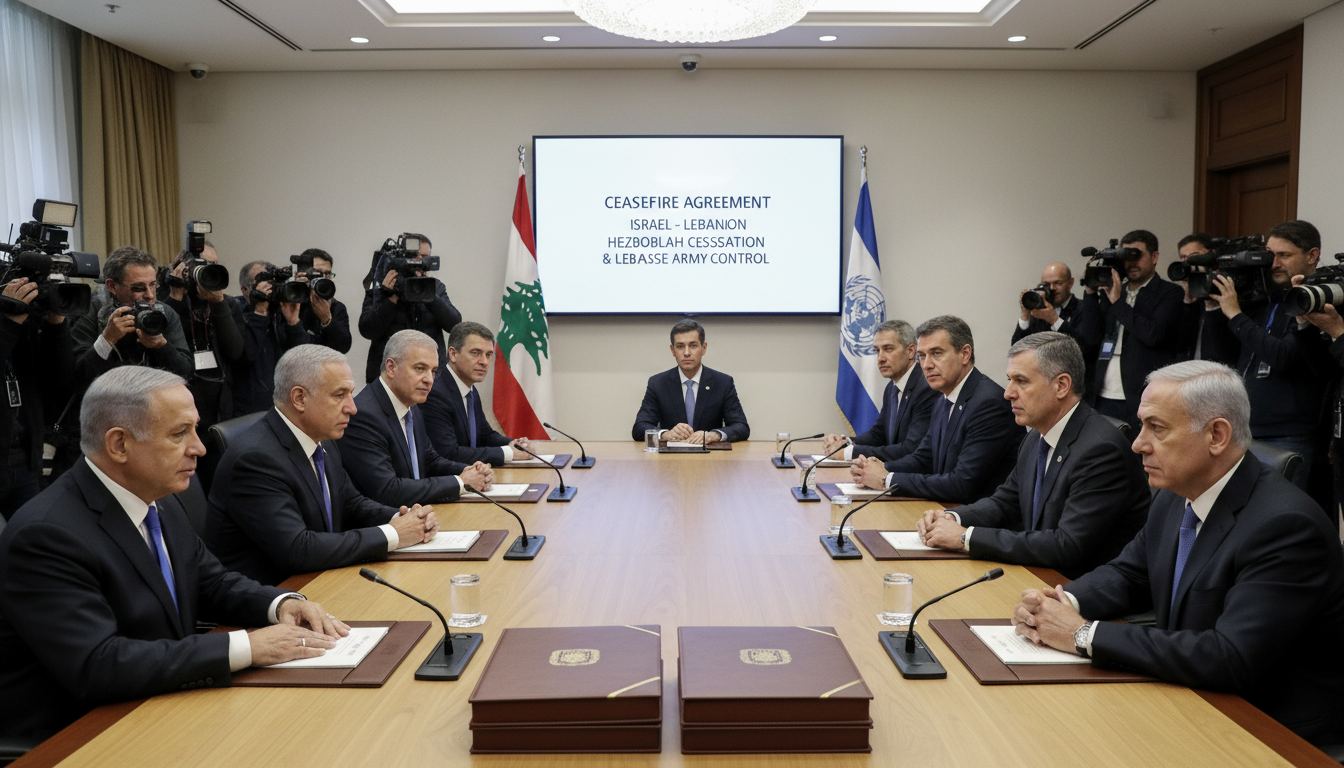
Israel-Lebanon ceasefire agreement contingent on Hezbollah halt, pilot zones proposed
A US-mediated Israel-Lebanon ceasefire agreement reached in Washington on June 3, 2026, ties a halt to hostilities to a complete cessation of Hezbollah fire and the creation of pilot zones under Lebanese Army control.
The conditional pact, negotiated over two days, commits both sides to further talks the week of June 22 as diplomats seek a broader, enforceable settlement.
Breakthrough in Washington talks
The agreement was announced after direct talks in Washington brokered by the United States, marking the fourth time Israeli and Lebanese delegations have met for face-to-face negotiations.
Officials described the accord as a framework rather than a final peace, intended to reduce immediate cross-border fighting while negotiating a more comprehensive deal.
Ceasefire conditioned on Hezbollah stopping fire
Under the terms released by the three parties, any ceasefire will be conditional on “an immediate and complete stop” to fire from Hezbollah against Israeli territory.
The text also requires the withdrawal or evacuation of Hezbollah elements from areas south of the Litani River, roughly 30 kilometres from the Israeli border, before a truce can take full effect.
Pilot zones to be controlled exclusively by Lebanese Armed Forces
The declaration calls for rapid establishment of pilot zones where the Lebanese Armed Forces (LAF) would exercise exclusive authority and exclude non-state actors.
These zones are explicitly intended to limit Hezbollah’s operational presence in sensitive southern districts and create secure buffer areas monitored by Lebanon’s military, according to negotiators.
Fighting and strikes continued during talks
Despite the negotiations, violence did not abate: Israeli strikes on June 3 killed civilians in southern Lebanon and were reported across other front-line areas.
The ceasefire that has been nominally in effect since April 17, 2026, has been repeatedly violated, and recent Israeli operations expanded in scope, raising concerns of wider regional escalation.
Hezbollah attacks and regional tensions
Hezbollah continued to carry out strikes against Israeli military targets, including rocket and drone attacks reported near the southern Lebanon-Israel frontier.
Iranian officials warned that any attack on Beirut’s southern suburbs could provoke a large-scale escalation, while Washington sought to separate the Lebanon talks from parallel negotiations with Tehran.
Humanitarian toll and medical personnel casualties
The fighting has inflicted a heavy humanitarian price: Lebanese authorities report thousands of deaths and more than a million people displaced since the conflict intensified in early March.
Health ministry figures and emergency responders said recent strikes directly hit ambulances and medical teams, with at least a hundred and thirty rescue and health personnel killed since the war’s start, compounding strain on already fragile services.
Diplomatic timeline and fragile prospects
Delegations agreed to reconvene the week of June 22, 2026, to pursue a comprehensive agreement building on the Washington framework.
Negotiators acknowledged the deal’s fragility, noting that its success depends on rapid steps to clear armed elements from the south and on robust monitoring to prevent renewed exchanges of fire.
The conditional Israel-Lebanon ceasefire framework offers a narrow pathway to reducing immediate violence, but its implementation hinges on rapid, verifiable action on the ground and continued diplomatic pressure; without those elements, negotiators warned, the risk of renewed and wider conflict will remain.
