
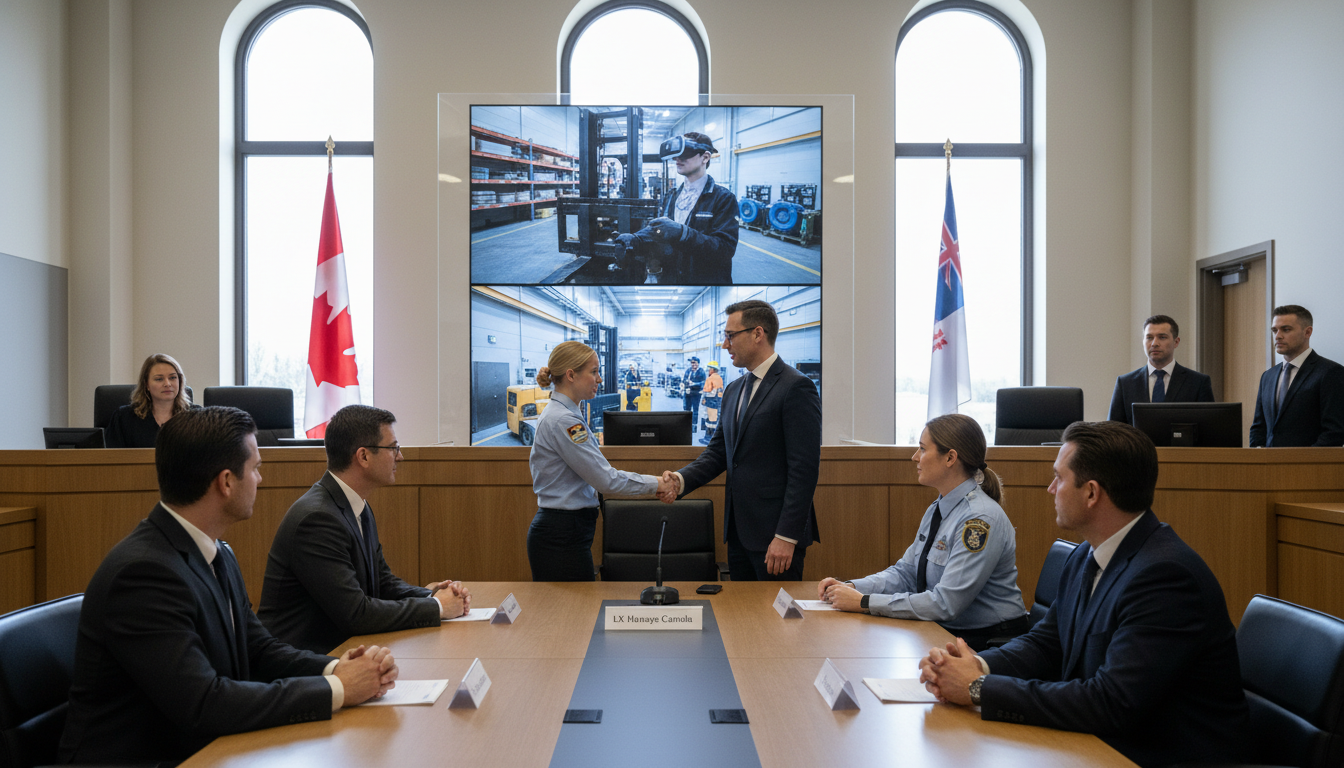
Calgary firm pleads guilty after fatal forklift incident; $350,000 ordered for forklift safety training
LX Hausys Canada pleaded guilty after a worker was fatally struck by marble slabs on Sept. 19, 2023, and the court ordered $350,000 for forklift safety training.
Calgary-based LX Hausys Canada Inc. has admitted guilt in provincial court in connection with the death of an employee crushed by dislodged marble slabs at its northeast Calgary warehouse. The company pleaded guilty on May 28, 2026, to a single charge under Alberta’s Occupational Health and Safety Act for failing to ensure the health and safety of a worker, authorities confirmed. The incident, which occurred on Sept. 19, 2023, prompted multiple charges initially, but Crown prosecutors withdrew 14 counts before sentencing. The court imposed a creative sentence directing the company’s $350,000 fine toward programs aimed at improving forklift safety and workplace training.
Calgary company enters guilty plea in fatal warehouse accident
LX Hausys Canada entered the plea in Calgary Court of Justice, acknowledging responsibility as the employer under the provincial Occupational Health and Safety Act. The plea followed an investigation into the circumstances surrounding the Sept. 19, 2023, incident that killed a worker who was helping to move heavy marble slabs with a forklift. Prosecutors initially filed multiple charges related to workplace safety, but those additional counts were withdrawn as part of the court proceeding. The conviction and sentence were announced at the May 28, 2026 hearing, and both the Crown and the company have up to 30 days to appeal the outcome.
Details of the September 19, 2023 incident and investigation
According to court records and statements released by investigators, employees were relocating large marble slabs in the warehouse when a slab became unstable and fell from the forklift. The slab struck and fatally injured a worker on site, prompting an immediate response from emergency services. The workplace incident triggered an investigation by provincial safety regulators into equipment, training, and handling procedures at the facility. Investigators examined whether proper rigging, securing methods, and operator controls were in place when the load dislodged.
Court orders fine redirected to safety programs under creative sentencing
Instead of remitting the $350,000 as a standard fine to the provincial coffers, the court ordered the amount to be paid to the Manufacturers’ Health & Safety Association to fund targeted safety initiatives. The sentence uses a provision in the Occupational Health and Safety Act that allows fines to be directed to projects or organizations that will advance workplace health and safety. Under the approved plan, the Manufacturers’ Health & Safety Association will develop portable virtual reality forklift simulators aimed at improving operator training. The arrangement is intended to convert punitive funds into practical safety improvements for the wider industry.
Virtual reality simulators and training for English language learners
The Manufacturers’ Health & Safety Association will collaborate with Alberta Workforce Essential Skills to build and deploy portable virtual reality (VR) forklift simulators. Those simulators will be designed to replicate realistic warehouse conditions, enabling hands-on operator practice without the risks of live equipment handling. In addition to VR technology, the program will include workplace safety training specifically tailored for English language learners, acknowledging language barriers as a factor in safe workplace communication. Organizers say the combined approach aims to make forklift training more accessible and effective across diverse workforces.
Legal context: withdrawn counts and appeal rights explained
Crown prosecutors withdrew 14 additional counts before the guilty plea was entered, leaving the single charge on which LX Hausys Canada pleaded guilty. The withdrawal of charges followed negotiations and review of the evidence, which is a common step in prosecutions of complex workplace incidents. Under Alberta law, both the Crown and the convicted employer have a statutory window to file an appeal of either the conviction or the sentence, and that window extends 30 days from the date of the court order. Until the appeal period lapses or an appeal is filed, the ordered payment and program development are expected to proceed.
Industry reaction and implications for workplace safety standards
Safety advocates and industry groups have emphasized that the case highlights ongoing challenges with heavy-load handling and the importance of operator training and equipment safeguards. The decision to invest in VR simulator technology has been framed by proponents as a positive step, offering a scalable training tool that reduces risk during skill development. Critics say that while program funding is welcome, enforcement of existing standards and supervisory accountability also require scrutiny to prevent future tragedies. Employers, unions, and regulatory bodies will be watching how the new training initiatives are implemented and whether they measurably reduce incidents.
What the ordered programs could mean for forklift training in Alberta
If delivered effectively, portable VR forklift simulators could allow employers across the province to train operators in a variety of scenarios without taking real forklifts out of service. Trainers can simulate load shifts, tight-space navigation, and emergency responses that are difficult or unsafe to reproduce with live equipment. For smaller companies and remote worksites, portable units could bring standardized training to workplaces that lack onsite training infrastructure. The programming for English language learners could also help reduce misunderstandings that contribute to accidents by providing bilingual instruction and simplified technical language.
The conviction marks a significant outcome in a case that began more than two and a half years earlier when the worker was killed in September 2023. The plea and the sentence reflect both the seriousness of the fatality and the court’s willingness to use restorative-style penalties that channel funds to safety initiatives. Legal observers note that creative sentencing is intended to create a tangible legacy from fines by investing in preventative measures rather than merely adding to government revenue. The approach has precedent in other jurisdictions where courts have sought to turn punitive funds into industry improvements.
Labour groups and occupational safety specialists have underscored ongoing concerns about the adequacy of training programs, supervision, and risk assessments in busy warehouse operations. Forklift operations are among the most hazardous tasks in many industrial workplaces, combining heavy machinery with human movement and variable loads. Regulators advise that employers must maintain safe load-securing practices, ensure operators are certified, and conduct regular equipment inspections to minimize hazards. The LX Hausys case will likely prompt renewed internal reviews among similar businesses.
The agreement to fund training and language-access programs does not replace corporate responsibility or the need for systemic changes within workplaces. Employers remain obliged under the OHS Act to take every reasonable precaution to protect workers, including appropriate scheduling of tasks, clear communication, and the use of engineered controls where necessary. Families and colleagues of the deceased have expressed that meaningful, sustained changes are necessary to honour the worker’s memory and prevent similar losses. The company’s obligation to participate in the program development forms part of the court-ordered response.
Officials from the Manufacturers’ Health & Safety Association and Alberta Workforce Essential Skills have signaled intent to consult with frontline workers, trainers, and industry stakeholders during program design. Engagement with the people who will use the simulators and training modules is considered critical to ensure relevance and uptake. The organizations have experience delivering workplace safety training and see the funding as an opportunity to pilot portable technology that could be scaled across sectors. Their plans include evaluation metrics to measure training outcomes and operator competency improvements over time.
As implementation moves forward, employers will need to consider how VR training integrates with existing certification requirements and whether regulatory bodies will accept simulator-based components as part of formal operator credentialing. While VR is increasingly used as a supplement to physical training, regulators usually require hands-on competency assessments with actual equipment. Program designers intend for VR to be an adjunct that enhances theoretical knowledge and hazard recognition before supervised live practice. Clear guidelines on the role of simulation in formal certification will help employers adopt the technology responsibly.
The LX Hausys case also raises questions about workplace language barriers and how they contribute to safety risks. English language learners often make up a significant portion of the workforce in warehouses and manufacturing facilities, and communication challenges can affect task understanding and hazard reporting. Training materials that reflect multiple languages and culturally appropriate learning methods can reduce miscommunication. The planned partnership with Alberta Workforce Essential Skills aims to create resources that acknowledge literacy and language diversity when delivering safety instruction.
Regulators and policy-makers may view the outcome as an example of how legal sanctions can be paired with investments in prevention. The creative sentencing provision in the OHS Act provides a pathway for courts to require offenders to fund programs that address underlying safety issues. Observers caution that such measures should complement—not substitute for—robust enforcement, inspections, and penalties that deter negligent practices. The effectiveness of this approach will depend on transparent program governance, measurable goals, and ongoing oversight.
Employers operating material-handling operations across Alberta should take the LX Hausys case as a prompt to review their own practices and training programs. Practical steps include verifying operator certification, conducting load-stability risk assessments, ensuring proper use of attachments and restraints, and improving supervision during high-risk tasks. Regular maintenance and inspection of forklifts and storage racks are also essential to prevent equipment failures and load shifts. Clear, documented procedures and worker involvement in safety planning can strengthen workplace resilience against similar incidents.
The conviction and the court’s directive to fund training also highlight the human cost behind regulatory breaches. Families and co-workers who lose loved ones in workplace accidents often seek assurance that systemic changes will reduce the likelihood of repeat tragedies. The funding for VR simulators and language-access training aims to provide a constructive response, translating penalty dollars into concrete skills and resources. The next steps will be judged not only on program rollout but on evidence that these measures lead to safer daily practices in warehouses and manufacturing sites.
Both the Crown and LX Hausys Canada retain the right to appeal the conviction or the sentence within the 30-day statutory period following the May 28, 2026 ruling. If an appeal is filed, it could delay aspects of the ordered payment and program development, depending on the terms set by the appellate court. If no appeal is launched, the Manufacturers’ Health & Safety Association and Alberta Workforce Essential Skills can proceed with detailed project planning and outreach to employers and training providers. The unfolding implementation will be closely watched by regulators, industry groups, and labour organizations alike.
Workplace safety advocates emphasize that advances in training technology are most effective when paired with strong safety cultures at the workplace level. That includes fostering worker empowerment to report hazards, conducting timely incident investigations, and using lessons learned to update procedures and training. The LX Hausys sentence is part of a wider conversation about how to prevent workplace deaths and serious injuries through a combination of enforcement, education, and technological innovation. The new training pilots will provide a test case for how targeted investments can change operator behaviour and decision-making under pressure.
The ordered investment in simulator technology and language-focused instruction represents a targeted attempt to address specific vulnerabilities revealed in the Calgary incident. Portable VR forklift training could reduce the steep learning curve for new operators while providing experienced operators with scenario-based refreshers. Language-accessible safety training can close communication gaps that contribute to misunderstandings on job tasks. Together, these measures aim to reduce the frequency and severity of material-handling incidents in workplaces across the region.
The case stands as a reminder that workplace fatalities often stem from multiple interacting factors, including equipment, procedures, supervision, training, and communication. Legal outcomes such as this one seek to assign responsibility and, where possible, to generate improvements that protect other workers in the future. As the Manufacturers’ Health & Safety Association and Alberta Workforce Essential Skills begin program development, stakeholders will be looking for timely implementation, clear accountability, and measurable safety improvements. The ultimate measure of success will be a reduction in incidents and safer workplaces for all.
The court’s decision to redirect a fine into preventive tools for forklift safety reflects a growing interest in pairing punishment with practical prevention efforts, and the coming months will show whether those investments produce measurable safety gains.
