
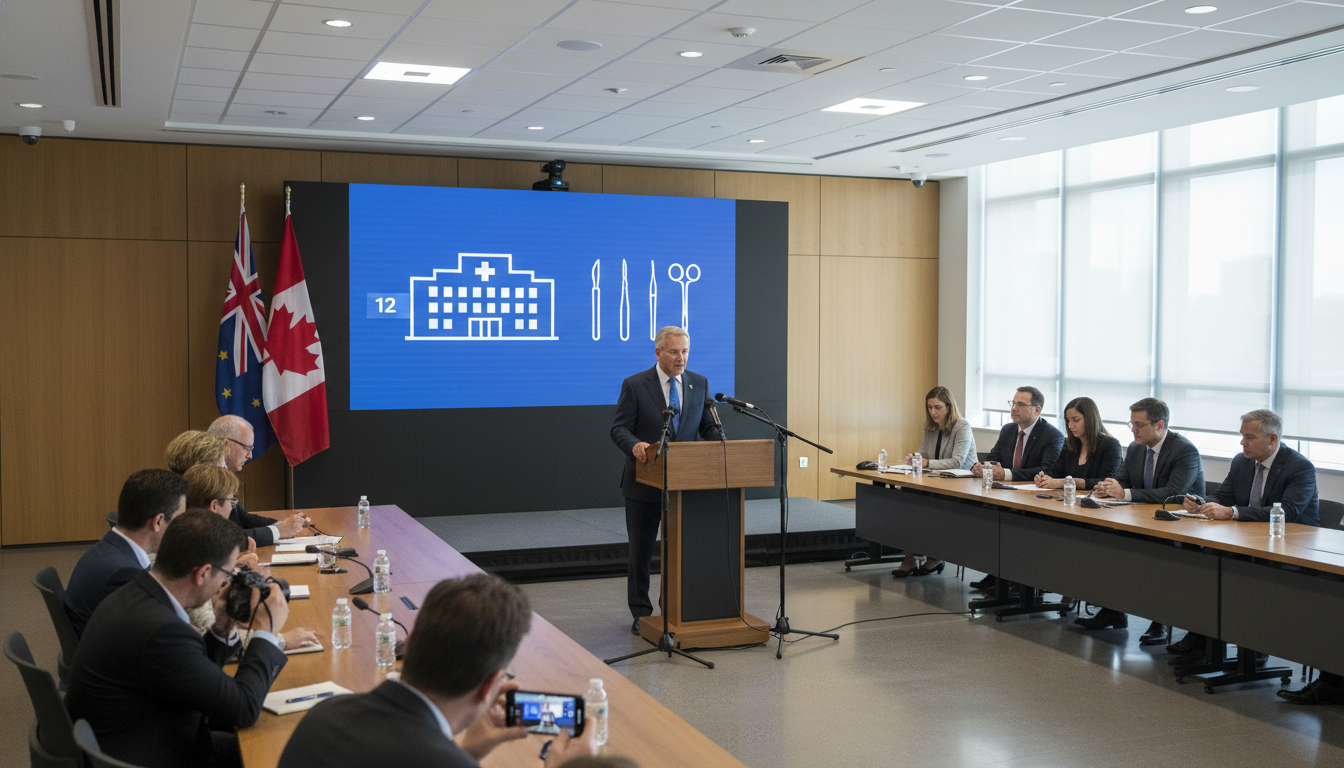
Province announces patient-focused funding model for 12 hospitals, starting with four surgeries
Province unveils phase one of a patient-focused funding model for 12 hospitals, tying payments to activity for hip, knee, cataract and rotator cuff surgeries.
The provincial government announced on Monday, June 1, 2026, that 12 hospitals have entered phase one of a new patient-focused funding model. The model, described by officials as an activity-based approach, will initially cover hip replacements, knee replacements, cataract surgery and shoulder rotator cuff repair. Health system leaders say the change is intended to align funding with the volume and type of care delivered, rather than historical budgets.
Twelve hospitals move into phase one
Twelve hospitals across the province were named as participants in the initial rollout, the government said at the June 1 news conference. Officials did not disclose a full list of the participating facilities at the event, but confirmed the sites represent a mix of urban and regional centres.
Staff at the enrolled hospitals will be required to adopt new billing and reporting practices to qualify for activity-based funding, hospital administrators say. Hospital leaders also noted they will monitor service volumes and patient outcomes closely during the early months of implementation.
Surgeries targeted in the initial rollout
Phase one applies specifically to four common elective procedures: hip replacements, knee replacements, cataract surgery and rotator cuff repair. These procedures were selected because they are high-volume, have well-established clinical pathways, and account for a significant portion of surgical wait lists.
Targeting these operations is intended to create measurable baselines and testing ground for the model before a broader expansion. Officials said the early focus will allow the ministry and providers to evaluate administrative processes, costing accuracy and potential impacts on wait times.
Activity-based funding ties payments to episodes of care
Under the patient-focused funding model, hospitals will receive funding based on the care provided rather than fixed annual allotments. The approach typically assigns a standardized price or weight to an episode of care, adjusted for complexity and patient needs, so that funding follows the service delivered.
Proponents argue activity-based funding can incentivize efficiency, clearer reporting and better alignment between services and resources. Implementation requires robust coding, case-mix adjustment and data systems to ensure payments reflect clinical reality and do not inadvertently penalize complex cases.
Hospital operational changes and data reporting
Hospitals participating in phase one must upgrade administrative and information systems to capture procedure volumes, patient characteristics and outcomes. That will likely involve investments in electronic medical records, coding training for clinical staff and regular submission of activity and outcome data to the health ministry.
Operational changes may also include redefining care pathways for the targeted surgeries to improve throughput and standardize quality. Hospital managers caution that short-term administrative burdens could temporarily divert staff time from clinical duties as new processes are embedded.
Potential effects on wait times and surgical capacity
Supporters of the model say linking funding to activity could reduce surgical backlogs by making resources more responsive to demand. If hospitals receive funding proportional to the number and complexity of procedures performed, there is an incentive to increase capacity for high-demand surgeries.
Critics warn, however, that activity-based funding can create perverse incentives if not carefully designed, such as favoring easier cases or concentrating resources on funded procedures at the expense of non-funded care. Observers say rigorous monitoring and safeguards will be needed to ensure equity and continuity of services across the system.
Next phases and provincial oversight remain to be detailed
The announcement confirmed only the scope of phase one and the participating hospitals, leaving the timeline and criteria for later phases unspecified. The provincial government did not provide a detailed schedule at the press conference for when additional procedures or hospitals might be added.
Stakeholders say the success of the pilot will hinge on transparent reporting, independent evaluation and clear benchmarks for expansion. Health system advocates are calling for public release of performance data from the phase-one sites so progress can be assessed against wait-time and quality objectives.
The patient-focused funding model marks a significant shift in how provincial health dollars flow to hospitals, emphasizing activity and outcomes over historical allocations. As the 12 hospitals begin phase one for hip, knee, cataract and rotator cuff surgeries, officials, providers and patient groups will be watching closely for evidence that the change improves access, maintains quality and preserves equity across the health system.
