
PEI oyster industry pursues disease‑resistant hybrids as MSX and Dermo devastate stocks
PEI oysters face widespread die-offs from MSX and Dermo; scientists pursue disease-resistant hybrids as $4.2M federal funding supports imports of resistant spat.
The PEI oyster industry is confronting an unprecedented biological crisis as outbreaks of MSX and Dermo parasites have killed large numbers of local oysters. Researchers on Prince Edward Island are racing to breed disease‑resistant stock and deploy emergency measures to prevent a major shortage within five years. The hybrid breeding strategy and a parallel import plan form the backbone of a two‑pronged effort to stabilise supply.
Hybrid breeding trial underway in Souris lab
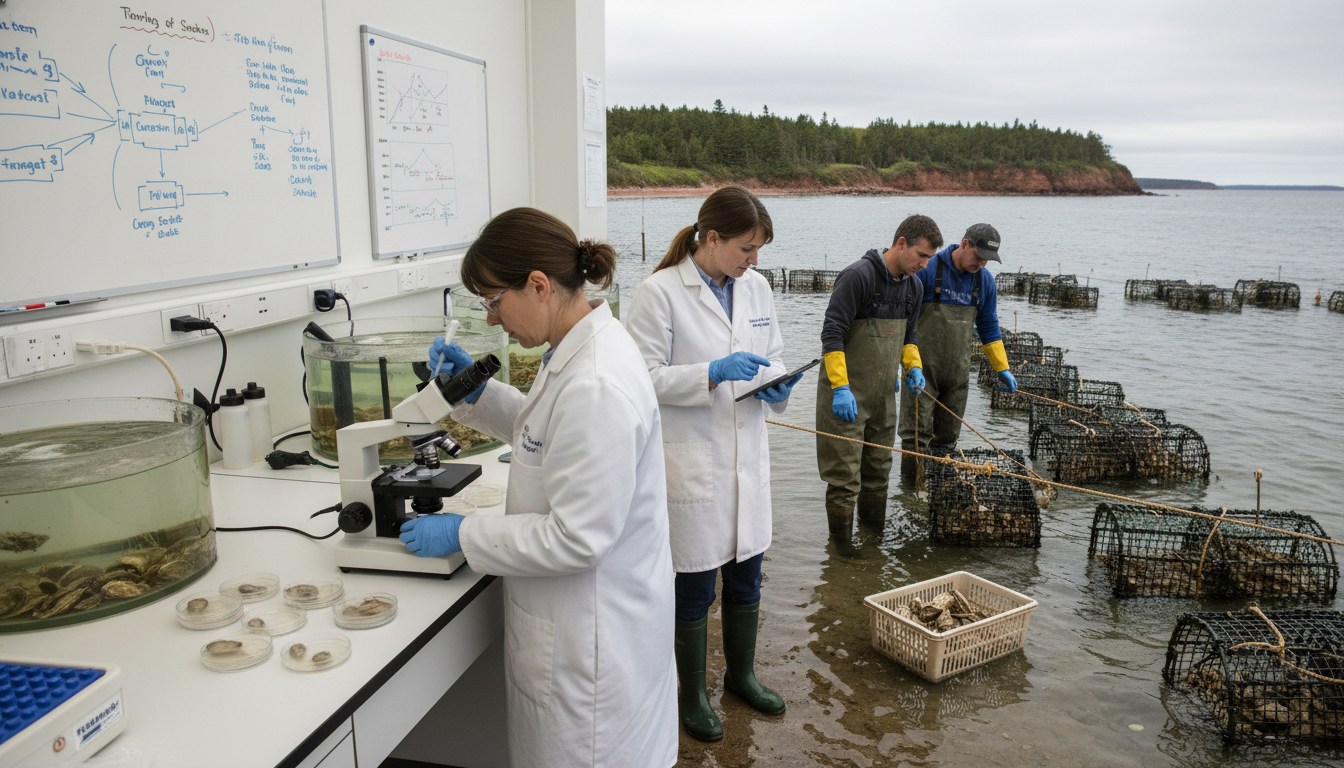
In a quarantined laboratory in Souris run by Onda Aquaculture, researchers led by Tirosh Shapira are using frozen sperm from American oysters to fertilize eggs from local females. The aim is to combine disease resistance observed in some U.S. strains with traits that allow offspring to thrive in PEI waters. The work is being conducted under strict biosecurity to limit the risk of introducing new pathogens while testing whether hybrid progeny inherit the sought‑after resistance.
Frozen American sperm stored for controlled crosses
More than 20 samples of sperm from different American males have been cryopreserved at the Souris facility to create multiple cross combinations. Laboratory staff thaw and use the samples selectively, hoping to maximize genetic diversity and resistance alleles in the resulting larvae. The samples will be paired with carefully chosen local eggs to produce naissains that can be reared in hatcheries and later outplanted to oyster parks.
Genetic transmission and survival present major uncertainties
Experts warn the breeding pathway carries biological uncertainties, particularly around sperm survival after thawing and whether resistance genes will be effectively passed on. Memorial University aquaculture researcher Cyr Couturier notes survival rates of thawed sperm can be low, meaning only a fraction of attempted crosses may succeed. Couturier also recommends prioritizing females that have already survived MSX outbreaks in the field, as their offspring may have a higher probability of inheriting adaptive traits.
Hatchery scale‑up slated for Borden‑Carleton
If crosses in Souris produce viable fertilized eggs, those larvae will be transferred to Onda Aquaculture’s main hatchery in Borden‑Carleton. There they will be nurtured into juvenile oysters—naissains—before distribution to commercial growers for restocking. The hatchery phase is critical: surviving and fast‑growing juveniles will determine whether hybrid lines can be produced at the scale needed to replenish depleted oyster parks.
Short‑term measures include imports and diagnostics
Because breeding programs take years to validate, industry and government are pursuing immediate relief through imports and rapid testing. A plan to bring in millions of disease‑resistant American naissains is underway, backed by a federal allocation of $4.2 million to help producers purchase resistant stock. Onda has also developed a rapid diagnostic test since the MSX emergence in 2024, and researchers are investigating whether a secondary host in the ecosystem may carry the parasite without showing symptoms.
Monitoring, field trials and a multi‑year timeline
Even if hybrid lines or imported spat appear promising, they must be monitored closely once placed in marine environments. Couturier and other scientists say it will take three to four years of field observation to determine whether cohorts remain resistant under natural exposure. That timeline means growers and regulators must balance short‑term import and containment strategies with longer‑term breeding and monitoring programs.
The crisis has prompted cross‑sector cooperation between industry, academic researchers and federal authorities to protect Prince Edward Island oysters and the communities that depend on them. With both genetic trials and emergency imports moving forward, officials say the success of recovery efforts will hinge on rigorous testing, careful selection of broodstock, and sustained monitoring over the next several years.
