
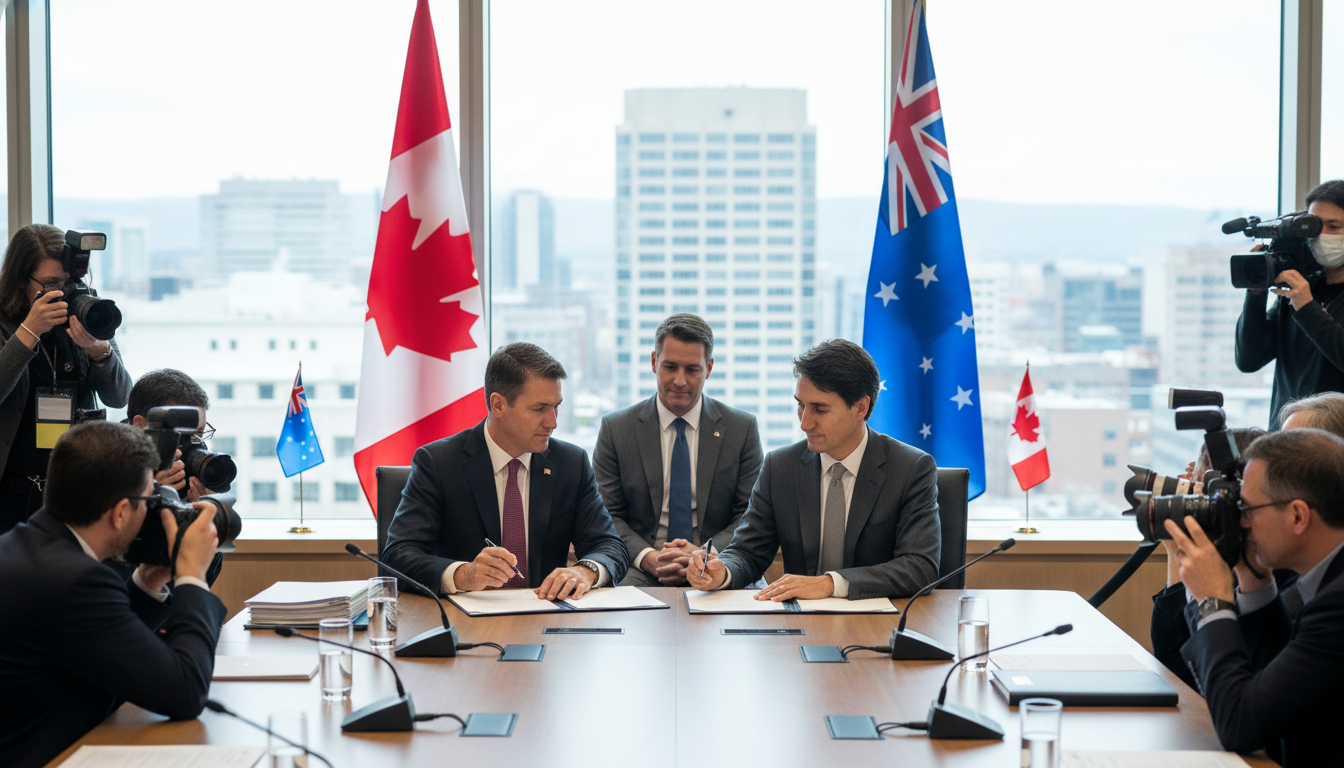
Alberta pipeline timeline set as Ottawa and Edmonton agree to national-interest review and possible construction by Sept. 1, 2027
Federal and Alberta governments agree timelines for an Alberta pipeline proposal, national-interest decision and potential construction start by Sept. 1, 2027.
The federal and Alberta governments signed a formal agreement Friday that sets a concrete timetable for advancing an Alberta pipeline to the West Coast, with a province-led proposal due to Ottawa by July 1, 2026 and a federal national-interest declaration sought before Oct. 1, 2026.
Under the deal, final approval to begin construction is targeted before Sept. 1, 2027, marking the most detailed joint timeline on the project to date.
Both premiers framed the arrangement as a step toward making Canada a global supplier of lower-emission energy while balancing economic and regulatory conditions.
Federal-provincial timeline and next steps
The agreement requires Alberta to file its application with the federal Major Projects Management Office by July 1, 2026, after which Ottawa will move to assess whether the project meets the national-interest test by Oct. 1, 2026.
If Ottawa declares the project in the national interest, the governments expect to complete required approvals so construction could start before Sept. 1, 2027, pending regulatory and legal conditions.
Officials said the timeline builds on a memorandum of understanding signed last November and is intended to provide clarity to industry and investors on major deadlines.
Regulatory conditions and environmental commitments
Both governments tied the pipeline timetable to a package of regulatory and environmental measures reached earlier in 2026, including agreements on methane equivalency and shared approaches to environmental impact assessment.
Ottawa also reiterated that federal clean electricity regulations remain subject to judicial review; the two governments agreed that if courts overturn the rules they will be stood down, and if the regulations are upheld they will seek an equivalence arrangement.
Federal officials emphasized that the pipeline expansion would be contingent on demonstrated emissions-reduction measures, including large-scale carbon capture projects.
Carbon pricing changes and industry impact
The deal revises the industrial carbon-price trajectory that had been set under previous federal policy, reducing the ultimate target from $170 per tonne by 2030 to $130 per tonne by 2035.
The current price of $95 per tonne will remain for the remainder of 2026 before rising to $100 per tonne from 2027 through 2030, according to the agreement.
Alberta’s government estimates the new schedule could reduce compliance costs for the energy sector by as much as $250 billion through 2050, a projection industry groups welcomed as improving competitiveness.
Carbon capture and electricity commitments
A central condition for future pipeline growth remains the success of large-scale carbon capture and storage projects promoted by industry collaborations such as the Oil Sands Alliance, formerly known as Pathways.
Federal officials told reporters the carbon capture megaproject is a necessary element for any later expansion of export capacity and for meeting emissions benchmarks tied to approvals.
The day before the agreement, the prime minister outlined a separate federal objective to roughly double the country’s electricity grid capacity by 2050 as part of a push toward a net-zero electricity system.
Outstanding hurdles: financing, routing and Indigenous consultations
Despite the timeline, significant hurdles remain: no private sector proponent has formally committed to build the pipeline, the final route has not been chosen, and consultations with Indigenous communities are still underway.
British Columbia has signalled continued opposition to any new oil export line to its coast, meaning interprovincial disagreement could affect project logistics and political support.
Government officials said those issues will require parallel workstreams, including economic underwriting, route approvals and sustained, meaningful engagement with First Nations and Métis communities.
Political stakes and regional dynamics
The agreement was presented by both leaders as proof that cooperative federalism can advance major energy projects, and it came amid heightened political debate in Alberta over provincial autonomy and separatist sentiment.
Alberta’s premier suggested the pact strengthens the province’s position within Canada and could undercut arguments for separation, pointing to recent court setbacks for separatist initiatives.
The prime minister described the move as building trust between levels of government and stressed the broader economic and national implications of a coordinated approach.
Federal and provincial ministers will meet in the coming weeks to begin drafting the formal submission requirements and to identify timelines for consultations and technical studies.
