
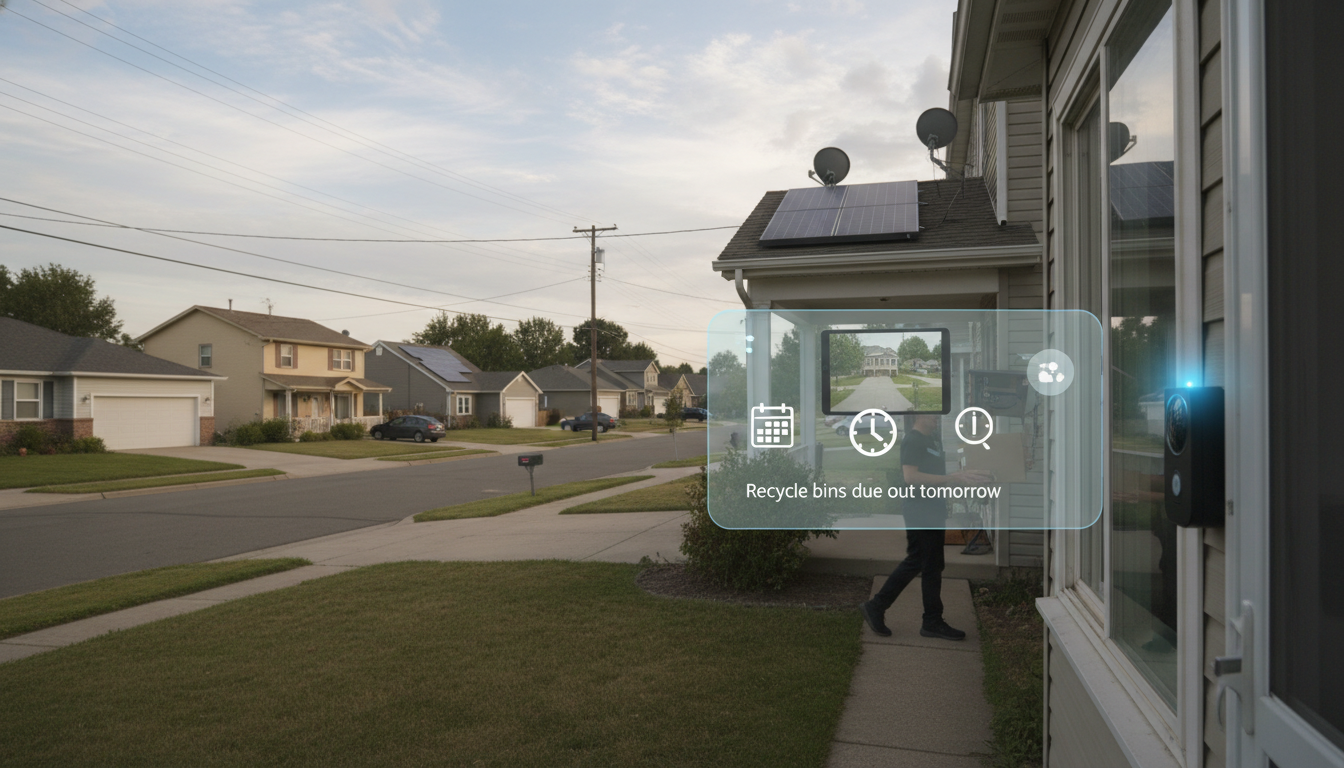
Amazon Ring cameras to monitor household routines, power automated reminders and raise privacy concerns
Amazon to use Ring cameras to analyze household activity for smart-home features, prompting privacy concerns as automated reminders and data-sharing expand.
Amazon is developing ways for Ring cameras to gather and analyze household activity to power context-aware smart‑home features, according to company examples of the technology in action. The system is described as detecting everyday routines — such as whether a pet has been fed — and issuing automated reminders or actions based on what the camera observes. The proposed approach would rely on continuous sensing and on-device or cloud analysis to turn visual cues into contextual services inside connected homes.
Ring cameras to monitor household routines
A central aim of the initiative is to make home systems more proactive by using visual data to infer routine events and prompt users when something deviates from normal patterns. For example, a camera pointed at a pet’s feeding bowl could detect whether food is present and trigger a reminder if the bowl remains empty during a typical feeding window. Amazon frames these features as convenience enhancements that reduce the cognitive load of managing recurring tasks in busy households.
The demonstrations emphasize frictionless automation, where the camera’s observation becomes the basis for a notification or an automated task. That model depends on accurate object detection, reliable activity recognition and a rules engine that translates observations into contextual prompts or actions. The result, proponents say, would be a more helpful, anticipatory smart home that nudges users at the right moment.
Example use case with pet feeding reminders
One of the most tangible examples presented involves pet care: a Ring camera aimed at a pet bowl registers whether food has been placed there and alerts the owner if the pet has not been fed within a customary timeframe. The reminder can arrive as a push notification or a voice prompt through a connected speaker, and may be configurable to reduce false alarms. The company suggests this type of scene-specific automation could extend to other routine checks, such as medication timers, appliance status or refuse collection.
These practical scenarios illustrate how household cameras could do more than security monitoring by supporting daily living tasks. They also demonstrate how a single visual sensor can serve multiple purposes when paired with machine learning models that interpret context rather than only capturing motion or faces.
How data will be collected and analyzed
The proposed system uses visual inputs from Ring cameras combined with algorithms that detect objects and routines in the frame. Detected events would then be translated into structured signals — for instance, “bowl empty” or “no movement at usual feeding time” — which trigger predefined responses. Processing could occur on-device to preserve bandwidth and privacy or be sent to cloud services for more sophisticated analysis and cross-device coordination.
Device manufacturers typically balance on-device intelligence with cloud processing to enable complex learning across households, update models, and deliver personalized experiences. The architecture chosen will determine what raw or derived data leaves the home and what remains local, a technical distinction with strong privacy and security implications.
Privacy and legal questions emerge
Using Ring cameras for non-security functions resurfaces longstanding debates about in-home data collection and consent. Privacy advocates warn that repurposing always-on cameras for broader behavioral analysis increases the scope of personal information that companies can infer about daily life. Questions center on how long data are stored, whether derived labels (like “pet fed”) are retained, and what third parties may gain access to those signals.
Legal frameworks in various jurisdictions require clear notice and, in some cases, explicit consent for certain types of data processing. Observers note regulators are increasingly scrutinizing smart-home products that blur the line between security, convenience and surveillance, especially when sensitive inferences about occupants’ habits are possible.
Consumer controls and company safeguards described
Amazon has portrayed configurable settings and opt-in choices as part of the product experience, allowing users to enable specific scene-detection features and manage how notifications are delivered. Proposed safeguards include options to process data locally, to anonymize or delete derived signals, and to provide transparency reports about what types of inferences are being made. The effectiveness of these measures will depend on how clearly they are communicated and how granular controls are in practice.
Industry analysts emphasize that user trust hinges on straightforward privacy controls, easy-to-understand explanations about what cameras can infer, and robust default protections that minimize data exposure. Without these elements, convenience features risk provoking consumer pushback or regulatory action.
Industry reaction and wider implications
The expansion of Ring cameras into everyday automation underscores a broader trend in consumer technology toward context-aware services that anticipate user needs. Competitors and platform partners will likely watch closely to see whether consumers embrace such features and how regulators respond. The balance struck between utility and privacy will shape product design choices across the smart-home market.
Experts say the technology could deliver measurable convenience for households while also setting precedents for how visual data are used beyond security. That duality makes the coming months important for policy, consumer education and the technical implementation of privacy-preserving measures.
As Amazon moves to integrate Ring cameras more deeply into smart‑home routines, users and policymakers will need clear information about what is being detected, how data are processed, and what options exist to limit or delete inferences. The debate that follows will determine whether these camera-driven conveniences become accepted fixtures of connected living or a catalyst for tighter rules on in-home sensing.
