
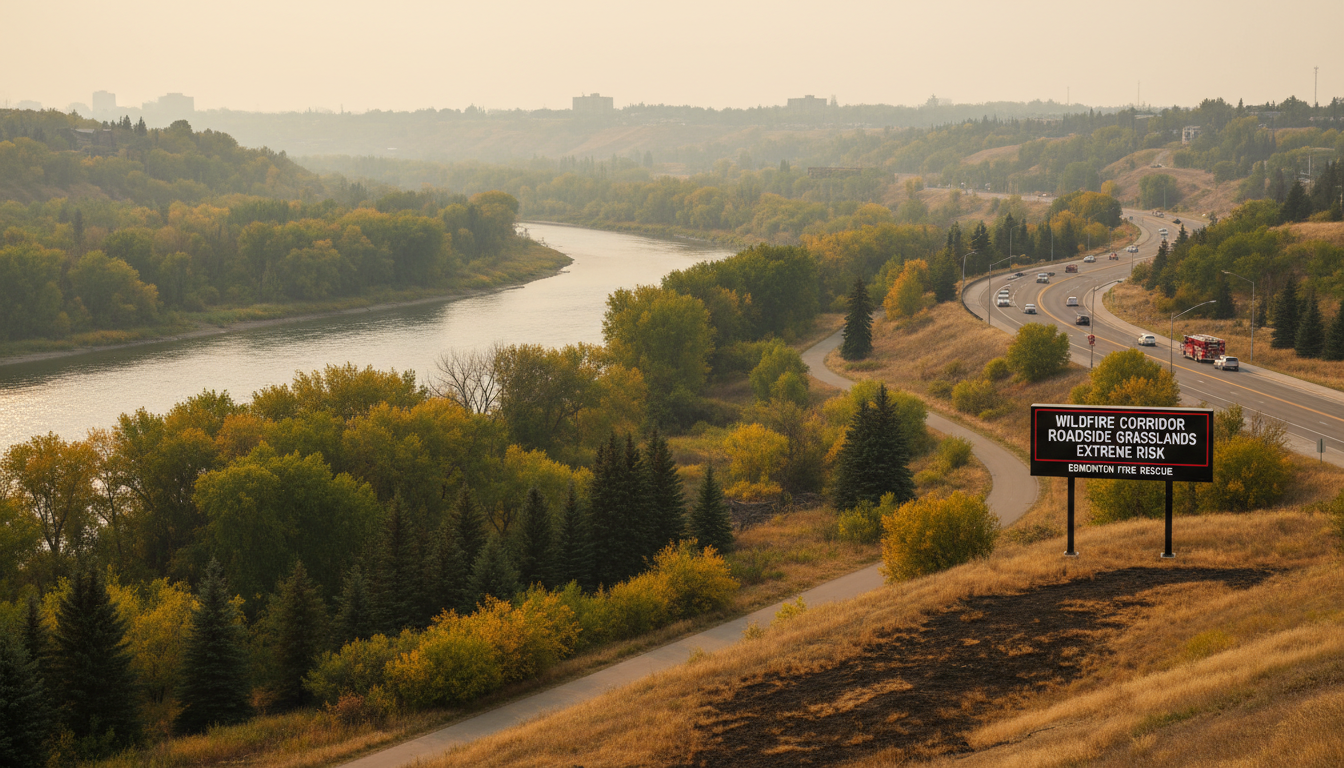
Edmonton grassfires rise as river valley identified as main wildfire corridor
Edmonton warns river valley is the main wildfire corridor amid 7,400+ hectares of wildland-urban interface and more than 2,000 grassfires in six years.
River valley identified as main wildfire corridor
The city has identified Edmonton’s river valley as the primary wildfire corridor where vegetation and topography concentrate risk. Officials say the continuous stretch of natural areas creates a pathway that can carry flame and smoke toward adjacent neighbourhoods. That corridor includes slopes and ravines that can accelerate fire spread and complicate firefighting access. City planners are stressing the need to consider the valley in long term mitigation and land use decisions.
The designation of the river valley follows municipal mapping and risk assessments carried out over recent seasons. Officials note the corridor is not a single ignition point but a channel that links multiple fuel sources across the urban landscape. Because the valley runs through many wards, the risk is dispersed and requires coordinated responses across departments. Neighbourhoods bordering the valley are being advised to review their own property-level fire readiness.
Wildland urban interface covers more than 7,400 hectares
Municipal data show the city contains more than 7,400 hectares of wildland urban interface, the zone where natural vegetation meets homes and infrastructure. That footprint creates a complex management challenge because protection of private property, public parks and critical infrastructure overlaps in relatively small areas. The scale of the interface makes conventional firebreaks and single interventions less effective on their own. City officials say a mix of vegetation management, building standards and public education is required to reduce vulnerability.
The large acreage also means seasonal conditions can shift the level of risk quickly, from damp to highly flammable in days during warm dry spells. The city is monitoring moisture, temperature and vegetation growth as part of its seasonal preparedness planning. Officials stress the importance of early detection and rapid response to prevent small fires from exploiting the continuous interface. Residents living near these zones are being encouraged to keep vegetation trimmed and create defensible space where possible.
City reports over 2,000 grassfires in six years
Edmonton has recorded more than 2,000 grassfires in the past six years, according to city figures released with the assessment. That frequency underscores how common smaller vegetation fires have become and how they can strain suppression resources during peak periods. Many of these incidents are extinguished quickly, but clusters of simultaneous calls can overwhelm frontline crews and delay containment. The city says tracking and analysing these events is informing where to focus prevention and patrol efforts.
The pattern of repeated grassfires has prompted municipal managers to prioritize high risk corridors and ignition hotspots. Data analysis is being used to target roadside mowing, public messaging and enforcement activities where necessary. Officials also point to the seasonal cycle of grass curing and spring green-up as a driver of the spike in incidents. In response, operational plans include surge staffing and mutual aid arrangements for periods of elevated activity.
Grasslands along major roadways pose ongoing ignition risk
City staff warn that grasslands along major roadways are frequent ignition sources for grassfires, especially when debris, discarded cigarettes or vehicle faults interact with dry vegetation. Linear fuel beds created by roadside grasses can carry fire rapidly and allow flames to jump containment lines if weather conditions favour spread. These strip environments present a particular hazard because they run alongside highways and arterial roads that provide access to many parts of the city. Management of roadside vegetation and public compliance with vehicle safety and littering laws are highlighted as practical prevention steps.
Roadside fires can also produce dense smoke that reduces visibility and threatens traffic safety, creating a secondary hazard for motorists. Emergency responders often have to coordinate with traffic services to secure scenes, which can compound response times and resource needs. The city is assessing where targeted clearing and buffering can reduce exposure while still preserving ecological function. Residents and commuters are being asked to report any roadside flames immediately rather than attempting to extinguish fires themselves.
Municipal prevention and response measures under review
City officials say a combination of prevention, preparedness and response measures forms their current strategy for managing Edmonton grassfires. Prevention work includes vegetation management, public education campaigns and inspections in high risk areas to reduce human-caused ignitions. Preparedness covers training, equipment staging and inter-agency coordination so that resources can be mobilized rapidly when incidents occur. Response priorities aim to protect life, critical infrastructure and property while working to keep fires small and localized.
The municipal review is also examining zoning and land use practices that influence where development interfaces with natural areas. Officials indicate that future planning decisions will need to factor in wildfire corridor dynamics and the cumulative effect of small, repeated fires. Funding and resource allocation remain central discussion points as the city balances competing infrastructure and environmental objectives. The outcome of this review will inform the city’s operational plans for upcoming seasons.
Residents urged to take property level precautions
City officials are asking Edmontonians who live near the river valley and other interface areas to take manageable steps to reduce risk around their homes. Simple actions such as clearing dry vegetation away from structures, keeping grass short near roads and removing loose combustible materials can reduce the chance that a passing spark results in a larger incident. The city also encourages residents to stay informed about seasonal burn restrictions and to report any unattended flames or suspicious activity. Neighbourhood-level planning and communication can multiply the effect of individual precautions.
Volunteer groups and community associations are being invited to partner with municipal staff on local mitigation efforts and public outreach. These partnerships can help tailor messaging to specific neighbourhood conditions and improve local preparedness. Officials stress that while the river valley is a major corridor, many fires still start in everyday places such as ditches, vacant lots and road edges. Collective action and timely reporting remain essential tools for preventing small fires from becoming community threats.
The city’s assessment places Edmonton grassfires in a broader context of urban growth, seasonal weather patterns and everyday human activity, and it highlights the need for coordinated action from municipal authorities and residents alike.
