
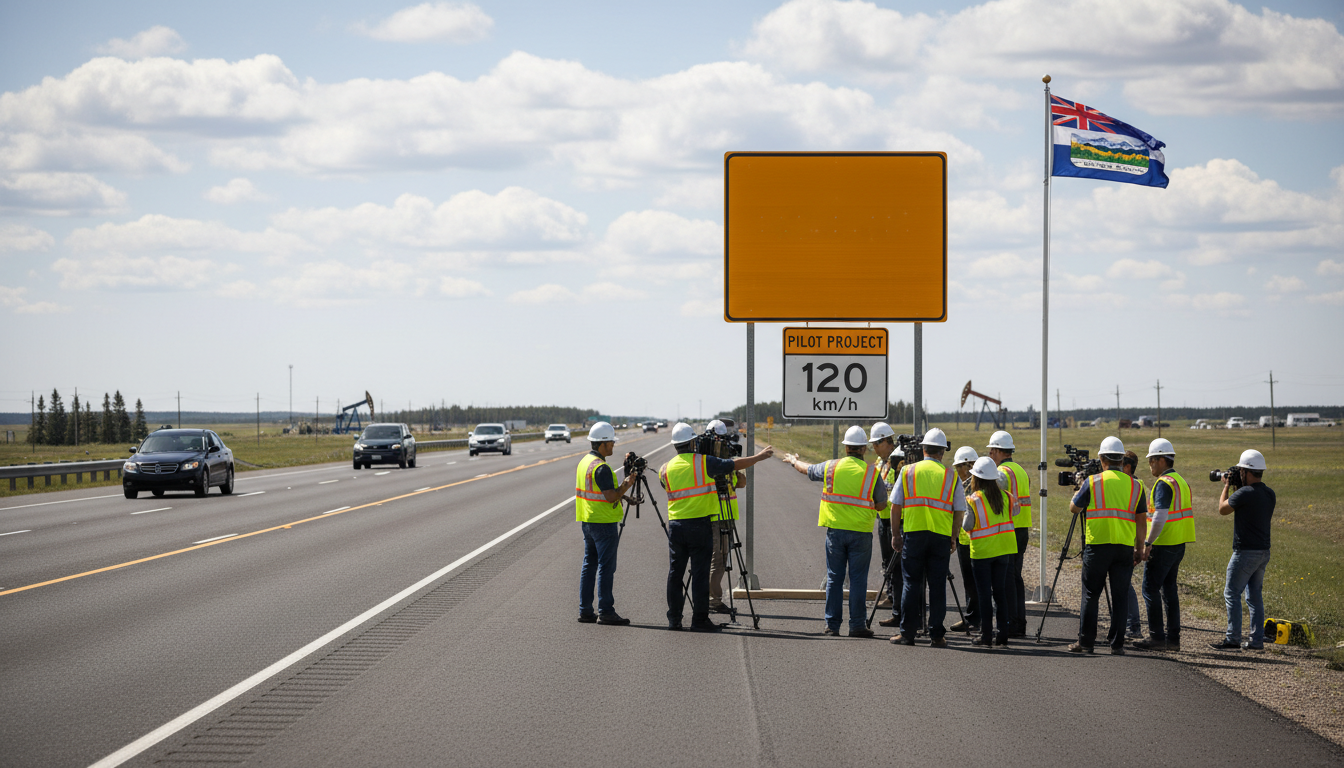
Alberta launches pilot for 120 km/h speed limit on Highway 2 south of Leduc
Alberta launches a summer pilot testing a 120 km/h speed limit on a 22-km stretch of Highway 2 south of Leduc to measure driver behaviour and safety outcomes.
The provincial government has begun a pilot project to test a 120 km/h speed limit on a 22-kilometre section of Highway 2 just south of Leduc, part of a wider plan to consider raising posted limits on divided highways.
Transport Minister Devin Dreeshen said the trial, starting in early March 2026 and running through the summer, will collect data to determine whether posted speeds should be aligned with the design speed of major rural routes.
Pilot test to start on Highway 2 south of Leduc
The trial will take place on a 22-kilometre segment of Highway 2, selected for its pattern of overpasses and monitoring points that make it suitable for automated speed measurements.
Officials say the layout allows sensors and traffic monitoring equipment to capture a large number of discrete speed readings without disrupting normal traffic flow.
The province aims to run the pilot through the summer months to gather seasonal driving behaviour and account for varying traffic volumes.
Dreeshen has framed the test as a data-driven step rather than an immediate provincewide change.
Data collection and sample size
Alberta officials point to the volume of traffic on the selected stretch — roughly one million vehicle trips per month — as offering a robust sample for analysis.
The placement of overpasses and existing infrastructure will enable authorities to record speed distribution, lane usage and how faster posted limits affect interactions between vehicles.
Sensors will track both instantaneous speeds and aggregate patterns over time to identify shifts in compliance and potential safety impacts.
The government has said it will analyze how drivers who currently travel below posted limits adapt if the legal limit rises to 120 km/h.
Highways already built for higher speeds
Transportation officials note that many of Alberta’s divided highways are engineered for higher travel speeds, and the pilot tests whether posted limits should reflect those design standards.
Routes identified as having design features consistent with 120 km/h include Highway 2, Highway 1 (the Trans-Canada), Highway 16 (the Yellowhead), Highway 43, Highway 63 and Highway 4.
The government clarified that urban expressways such as Calgary’s Deerfoot Trail and the Calgary and Edmonton ring roads are not included in the trial.
Planners say the characteristics of rural divided highways — separation of opposing traffic, long sightlines and controlled access — differentiate them from urban freeway environments.
Public sentiment and observed driving habits
A recent government survey cited by officials indicated that close to seven in 10 respondents supported increasing the posted limit to 120 km/h on divided highways.
Provincial sources also note that roughly 40 per cent of drivers already travel at or above 120 km/h in areas where the design speed is higher than the posted 110 km/h, suggesting posted limits lag behaviour in some corridors.
Transport spokespeople say rural drivers in particular tend to favour aligning posted limits with design speed, while acknowledging that views vary across regions and driving populations.
Officials plan to weigh public sentiment alongside the empirical safety data collected during the pilot.
Safety concerns and stakeholder reactions
Road safety advocates and law enforcement voices have warned that higher limits could increase crash severity and fatalities on certain corridors, and some road-safety groups have urged caution.
Calgary police have expressed concern that raising posted limits could send the wrong signal to motorists about safe driving speeds in varied conditions.
Dreeshen has countered that the objective is a safer, smoother flow of traffic and that the trial is intended to test that premise empirically rather than rely on assumptions.
He emphasized measures to limit potential conflicts, including rules proposed for multi-lane sections that would restrict heavy trucks from the far left lane where there are three or more lanes in one direction.
Possible policy pathway after the trial
The government has said it will review the pilot’s findings before deciding whether to extend a 120 km/h posted limit to additional divided highways across Alberta.
Officials will examine both aggregate crash statistics and behavioural metrics, including whether slower-moving vehicles adjust and how lane discipline evolves with the changed limit.
If the data supports a broader rollout, policymakers will still need to determine implementation details, signage changes and enforcement strategies to manage the transition.
Dreeshen has cautioned against making provincial changes without the evidence the pilot is designed to produce, saying the government does not want to “put the cart before the horse.”
The outcome of the Highway 2 pilot will shape whether Alberta aligns posted limits with the design speed on other divided corridors, and it will form the basis for any wider policy decisions on speed and lane restrictions.
