
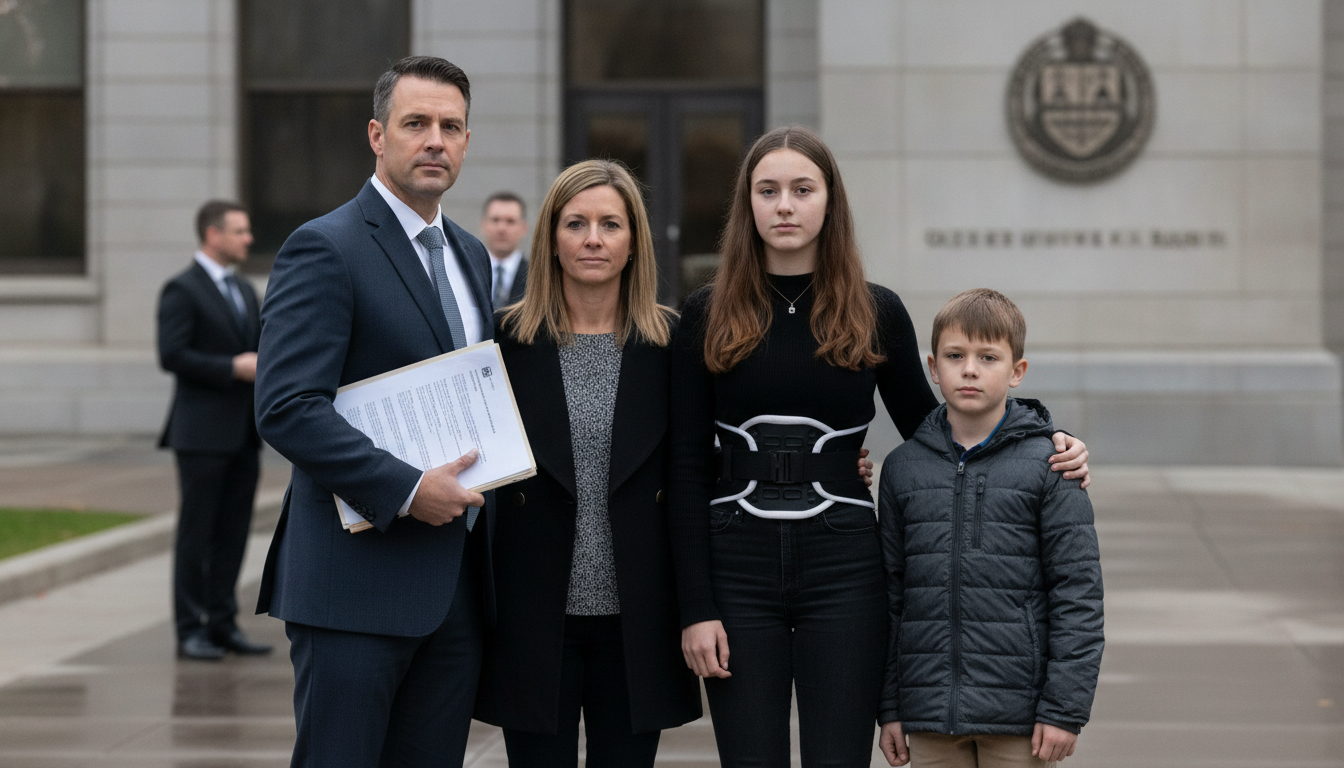
Alberta teen out-of-country surgery prompts court fight to recover $199,074
An Alberta teen out-of-country surgery and a more-than-two-year wait for care have led her family to seek $199,074 in reimbursement, saying provincial delays violated her constitutional rights.
Vienna Pedatella, who was diagnosed with idiopathic scoliosis at 13, underwent anterior scoliosis correction in the United States after her curve progressed while she waited in the provincial system.
Her family paid the hospital bill themselves and has now launched a judicial review with the Canadian Constitution Foundation, contending that the province’s decision to deny out-of-country funding effectively forced them to pay for medically necessary care abroad.
Family pays $199,074 after provincial funding denied
The Pedatella family opted to pay $199,074 for Vienna’s surgery in August 2025 after an Alberta committee declined their request for out-of-country coverage in July of that year.
Faced with a projected wait of more than two years for the alternative fusion surgery in Canada, the parents say they had little choice as their daughter’s curvature advanced and her symptoms became increasingly severe.
They exhausted the internal appeal route before filing for a judicial review in early 2026, seeking to have the province reimburse the full cost and to challenge the denial as a breach of constitutional protections.
Medical timeline: diagnosis, progression and surgical options
Vienna was first diagnosed with idiopathic scoliosis in 2021 at age 13 and was initially offered bracing and physiotherapy rather than surgery.
Her curve progressed despite conservative measures, increasing from roughly 40 degrees to nearly 70 degrees by May 2025, according to the family’s account of repeat imaging.
Local specialists later informed the family that she had missed the window for a less-invasive tethering procedure and that spinal fusion — in Vienna’s case a fusion spanning 14 vertebral levels from the base of the neck to the lower back — would be the expected treatment if the curve worsened.
Out-of-country option and clinical rationale for ASC
After learning that tethering was no longer considered viable for Vienna locally, the family consulted a surgeon at St. Peter’s University Hospital in New Brunswick, N.J., who recommended anterior scoliosis correction (ASC).
Their Canadian family physician and the U.S. surgeon both advised that ASC offered a path to correct the deformity while preserving motion and function, particularly important for Vienna’s active lifestyle and plans beyond high school.
The Pedatellas say the ASC procedure was presented to them as an established surgical option that could address Vienna’s severe curve without the extensive fusion that would limit spinal mobility.
Committee denial and internal appeal process
Alberta’s Out-of-Country Health Services Committee reviewed the family’s application in July 2025 and denied funding, concluding that the requested treatment did not meet the criteria for out-of-province coverage.
The family appealed to an internal review panel but that appeal was dismissed in February 2026 on the basis that Vienna could have continued to wait in Canada for the fusion surgery already offered by provincial providers.
Faced with the committee’s and panel’s decisions, the Pedatellas chose to proceed with ASC in the United States to avoid further deterioration and persistent pain.
Family’s legal challenge and constitutional arguments
With legal support from the Canadian Constitution Foundation, the family has filed for a judicial review asserting that the denial of funding engaged Vienna’s rights to life, liberty and security under the Charter.
The CCF argues that when delays in publicly funded care force patients to endure pain or irreversible deterioration, those delays may cross a constitutional threshold that obliges governments to act or fund alternatives.
CCF interim executive director Christine Van Geyn has said the case is intended not only to seek reimbursement for this family, but also to set a precedent ensuring provincial responsibilities are enforced when system failures cause harm.
Provincial response and policy context
The Ministry of Primary and Preventative Health Services declined to comment on the particulars of the case because it is before the courts and involves personal health information.
The ministry noted that decisions on out-of-country funding are made by the Out-of-Country Health Services Committee, which it described as an independent panel of physicians and medical experts, and said treatments deemed experimental or still being evaluated are not eligible.
Officials also said the ministry is reviewing the out-of-country program to ensure it evolves alongside patient needs and medical advances and to determine changes that could better support Albertans while maintaining independent expert-led decision-making.
Clinical debate over ASC and eligibility for coverage
Court filings supplied by the family state Vienna’s treating surgeon provided evidence that ASC is not experimental and is an accepted approach to certain spinal deformities.
Provincial officials, in describing their eligibility criteria, emphasized that novel or trial procedures remain ineligible until safety and effectiveness are established, a standard the committee applied in reviewing the Pedatellas’ case.
The dispute thus centers on whether ASC in Vienna’s specific clinical circumstance met the threshold of an accepted standard of care and whether the lengthy wait for fusion in Canada constituted a de facto denial of timely and effective treatment.
Patient impact: pain, mobility and life plans
The family reported that by the time they decided on surgery, Vienna was experiencing daily pain, sleep disruption, and activity limitations that affected school and quality of life.
Following the ASC operation in August 2025, Vienna recovered quickly and returned to weight training, skiing and other pursuits she had previously limited because of pain.
She has since completed high school with honours and expressed a desire to pursue nursing, a choice influenced in part by the care she received during her treatment.
Precedent and potential implications for other patients
The judicial review, expected to reach court in 2027, could have ripple effects across Canada if a judge finds that excessive waits for established treatments engage constitutional protections.
A successful ruling for the family might require provinces to reimburse out-of-country care in cases where waiting times pose a real risk of harm or where a recommended standard of care cannot be provided in a timely fashion.
Such an outcome could also prompt provinces to reassess triage, specialist training and capacity for procedures that are available elsewhere but limited locally.
Safety-valve program and questions about access
The family describes the out-of-country funding regime as a “safety valve” designed for situations where patients have waited too long or when a particular surgical option is recognized as standard but not accessible locally.
They say their case raises concerns about other young patients on wait lists who may not be able to secure timely care that preserves function and prevents deterioration.
Provincial officials have indicated they are conducting a program review to align policy with evolving treatments and patient expectations, suggesting potential administrative adjustments may be forthcoming.
What the court will consider and next steps
In judicial review proceedings, the court will assess whether the Out-of-Country Health Services Committee acted within its mandate, followed fair procedures and applied policy criteria reasonably when it denied funding.
The court will also consider the factual record about Vienna’s clinical need, the nature of ASC, the anticipated wait for fusion, and whether the denial infringed constitutional protections in practical terms.
Both parties will have the opportunity to present medical evidence and expert opinion as the judge determines whether to overturn the committee’s decision or leave it intact.
The Pedatella family says the case is about more than reimbursement; it is intended to shine a light on the consequences of prolonged waits and the limits of the safety-net process when specialist procedures are unavailable locally.
They acknowledge they may never recover the $199,074 they paid, but they are pursuing the review to press for clearer obligations from the government and to protect other patients facing similar delays.
As the province reviews its out-of-country program and the judicial process unfolds, patients, clinicians and policymakers will be watching to see whether this case alters how governments respond when access, timing and standard-of-care disputes intersect.
