
De Havilland revives Canadair water bombers as global wildfire demand mounts
De Havilland restarts Canadair water bomber production; first planes due 2028 as governments press for federal bulk orders amid global wildfire strains.
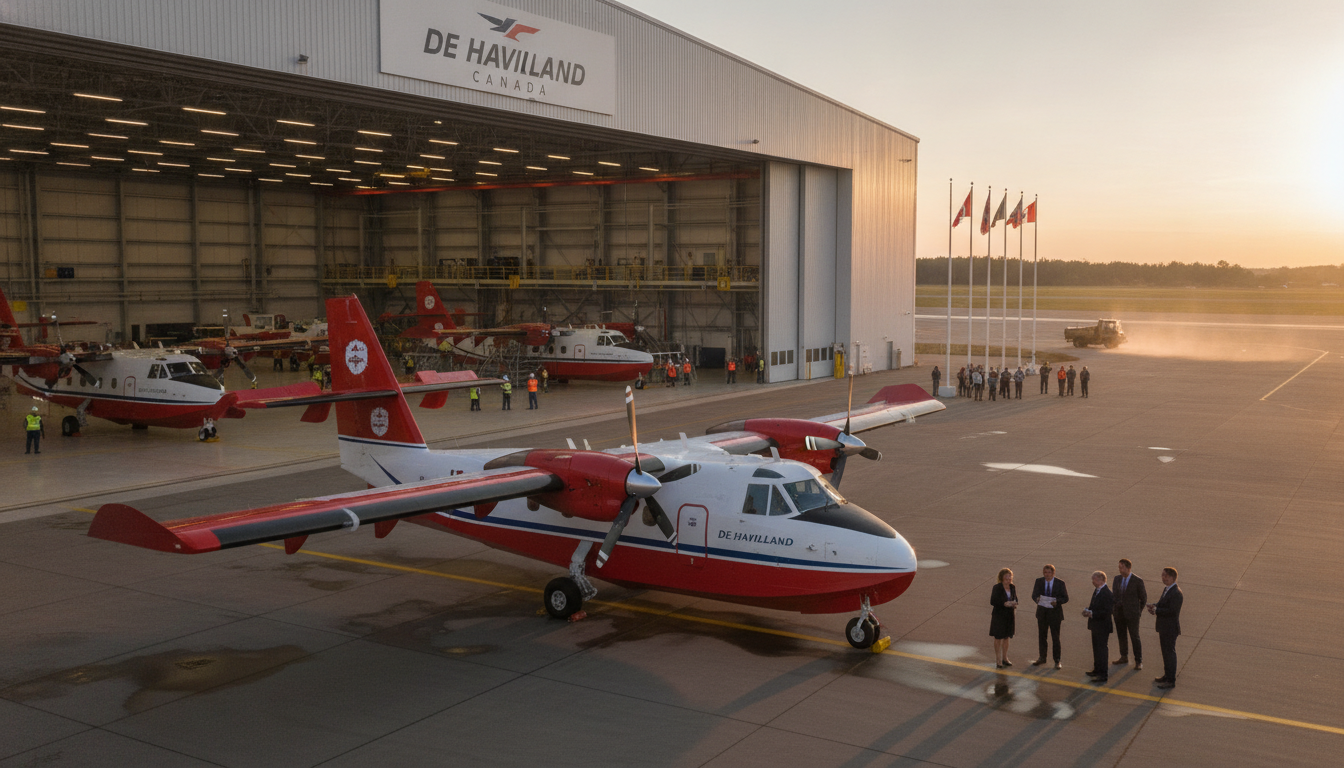
The Canadair water bombers are being rebuilt in Calgary as demand for aerial firefighting surges across Canada, Europe and beyond. De Havilland has restarted hand-assembled production of the amphibious scooping aircraft, a move officials and provincial leaders say is critical amid shrinking global firefighting capacity. The company says its first two aircraft are on schedule for delivery in early 2028, with a limited annual output until production expands. This restart has intensified calls for Ottawa to place a large, coordinated order to secure aircraft for Canadian and allied needs.
De Havilland restarts Canadair water bomber production
De Havilland Aerospace announced in 2022 that it would revive the Canadair program after acquiring the water bomber line previously produced by Bombardier through 2015. The aircraft, known for their amphibious design and rapid lake- or river-based refills, are assembled largely by hand in Calgary with parts sourced across Canada. Company officials say the revived production leverages both legacy tooling and modern manufacturing techniques to recreate a proven platform. Neil Sweeney, De Havilland’s vice-president of corporate affairs, has emphasized the company’s commitment to meeting the urgent global need for the planes.
The revived assembly line has produced visible progress, with the first two airframes taking shape inside the Calgary facility. De Havilland reports that those initial aircraft remain on schedule for completion and delivery in early 2028. At current facilities, the company estimates it can produce about 10 Canadair water bombers per year when operating at full capacity. Those production limits—and the long lead times for new orders—have prompted discussions about expanding output with additional production lines.
Delivery timeline, capacity and existing orders
De Havilland currently holds orders for 38 water bombers, and officials say the backlog means new orders would face multi-year waits. The company has indicated that delivery of additional ordered aircraft could occur in the early 2030s, with estimated delivery windows for fresh orders stretching to 2032–2033. At roughly 10 aircraft per year from the single line, timelines lengthen rapidly as demand grows. De Havilland has stated that a second production line would double output to about 20 aircraft annually, shortening wait times substantially.
Industry sources and government briefings provided to provincial leaders suggest the per-aircraft cost is in the tens of millions of dollars, with public announcements indicating figures near $80 million per plane. De Havilland itself has not published a retail price, citing commercial sensitivities, but has pointed to long-term service and parts support as part of broader procurement discussions. Delivery timelines are also influenced by supply-chain constraints: a Canadair requires tens of thousands of parts, many of which are specialty components produced by Canadian suppliers and legacy subcontractors.
Political pressure and calls for a federal bulk order
Political leaders from several provinces and European countries have publicly urged quicker access to new Canadair water bombers as wildfire seasons intensify. Manitoba Premier Wab Kinew said provincial firefighting operations "could use every water bomber we can get our hands on," reflecting growing frustration over aging fleets. Alberta Premier Danielle Smith has pushed the federal government to consider a firm, large-scale order that she and fellow premiers say would give De Havilland the certainty to expand production. Sweeney told officials that an order of roughly 50 aircraft would justify immediate construction of a second line.
Federal officials have responded cautiously, pointing to existing emergency leases and interprovincial coordination as short-term measures while national procurement options are evaluated. The federal government did lease 10 aircraft and helicopters this year to support provincial crews, according to statements from emergency management officials. A spokesperson for the minister responsible for emergency management said the minister remains in close contact with provincial and territorial counterparts to coordinate responses and identify how best to strengthen capacity. The debate now centers on whether Ottawa should move from short-term leasing toward a strategic, bulk purchase that would secure production capacity and the domestic industrial base.
Global demand, competition and climate drivers
Wildfire seasons in North America, Europe, South America and Australia have driven international demand for purpose-built scooping aircraft. Aviation experts warn that demand could far outstrip available supply if multiple countries attempt to order large fleets simultaneously. John Gradek, an aviation specialist at McGill University, says the world would likely snap up hundreds of these aircraft if production could meet the need. He cautions that while designing a new firefighting aircraft is possible, the lead time is long and the cost of developing a competing platform would be significant.
The Canadair water bomber’s enduring reputation stems from its amphibious capability, which enables it to refill quickly from lakes, rivers and coastal waters and return to fire lines in minutes. That operational profile makes the aircraft exceptionally useful in remote and rugged terrain where ground access is limited. As a warming climate lengthens fire seasons and increases the frequency of large blazes, governments are reassessing aerial assets needed for suppression, perimeter control and support of ground crews. The prospect that foreign manufacturers or governments might develop competing scooping aircraft has heightened urgency among Canadian policymakers and industry officials who want to protect domestic manufacturing jobs and technological advantage.
Manufacturing, supply chain and workforce challenges
The Canadair production effort is heavily rooted in Canadian suppliers, with roughly 80 percent of parts and components manufactured domestically, according to company briefings. Much of the assembly remains hands-on work at the Calgary facility, where legacy jigs and tooling from earlier production eras have been refurbished and integrated with modern systems. Workers assemble wings, fuselage sections and amphibious hulls using both traditional techniques and updated quality-control processes. Company sources say some of the equipment on the line dates back decades, underscoring the continuity between past and present production.
Scaling up to a second production line presents a host of operational challenges beyond physical space and tooling. De Havilland would need to secure increased supplies of specialty components, expand its qualified supplier base, and recruit or train hundreds more technicians and skilled assemblers. The company currently employs about 4,000 people across Calgary, Ontario and Victoria in a mix of manufacturing, engineering and support roles, and officials say any expansion would be phased to preserve quality and safety standards. Supply-chain bottlenecks for aerospace-grade parts and the interdependence of Canadian suppliers mean that government procurement could serve as a stabilizing signal to downstream manufacturers.
Senate recommendations and the case for a national fleet
A Senate report released in June recommended the federal government consider establishing a national fleet of modern firefighting aircraft to improve readiness for intensifying wildfire seasons. The report argued that a coordinated federal approach could reduce duplication, ensure equitable access across provinces and territories, and support domestic manufacturing. Federal officials note that the leased aircraft this year have been deployed to support provincial crews, but that a permanent national capacity would provide more predictable, long-term availability during peak seasons.
Representatives of the Canadian Interagency Forest Fire Centre say federally funded aircraft are consistently in high demand and that requests sometimes require triaging. Alexandria Jones, a spokesperson for the centre, emphasized that aircraft complement ground crews by slowing fire spread and creating safer operating conditions, but do not replace the work of firefighters on the ground. Emergency-management officials say the federal government is committed to strengthening national capacity, while also recognizing that aircraft are part of a broader strategy including prevention, mitigation and community preparedness. Debate continues on procurement models, cost-sharing arrangements with provinces, and how to balance domestic industrial benefits with operational needs.
De Havilland and provincial officials argue that a substantial federal purchase would deliver both operational advantages and economic benefits by anchoring a multi-year production program. The company’s public statements suggest that a firm, long-term order would reduce uncertainty and allow rapid scaling of domestic manufacturing. Political leaders who have observed the assembly line in Calgary describe the planes as a tangible national capability that carries economic and strategic value beyond any single wildfire season.
The broader policy question revolves around investment priorities, procurement timelines and international cooperation as wildfire risks increase. Some experts urge a mix of investments: new aircraft, improved detection and prevention, strengthened ground firefighting capacity, and community-level mitigation. Others stress the need for interoperable agreements so aircraft can be deployed across borders during extreme events, reducing duplication and strengthening collective responses.
The reintroduction of Canadair water bombers to active production is a decisive step in addressing an acute operational gap, but it is not a near-term panacea. With the first deliveries slated for early 2028 and existing backlogs extending into the early 2030s for new orders, policymakers face immediate choices about leases, interim measures and strategic procurement. How Ottawa responds—whether through a coordinated bulk purchase, investment in the supply chain, or multinational procurement partnerships—will shape Canada’s aerial firefighting capability for the coming decades.
As wildfire seasons intensify, the fate of the Canadair program will be watched closely by firefighters and officials around the world. Decision-makers must weigh the operational benefits of a modernized national fleet against the costs and complexities of scaling production, while ensuring that investments also drive prevention, mitigation and the resilience of communities at risk.
