
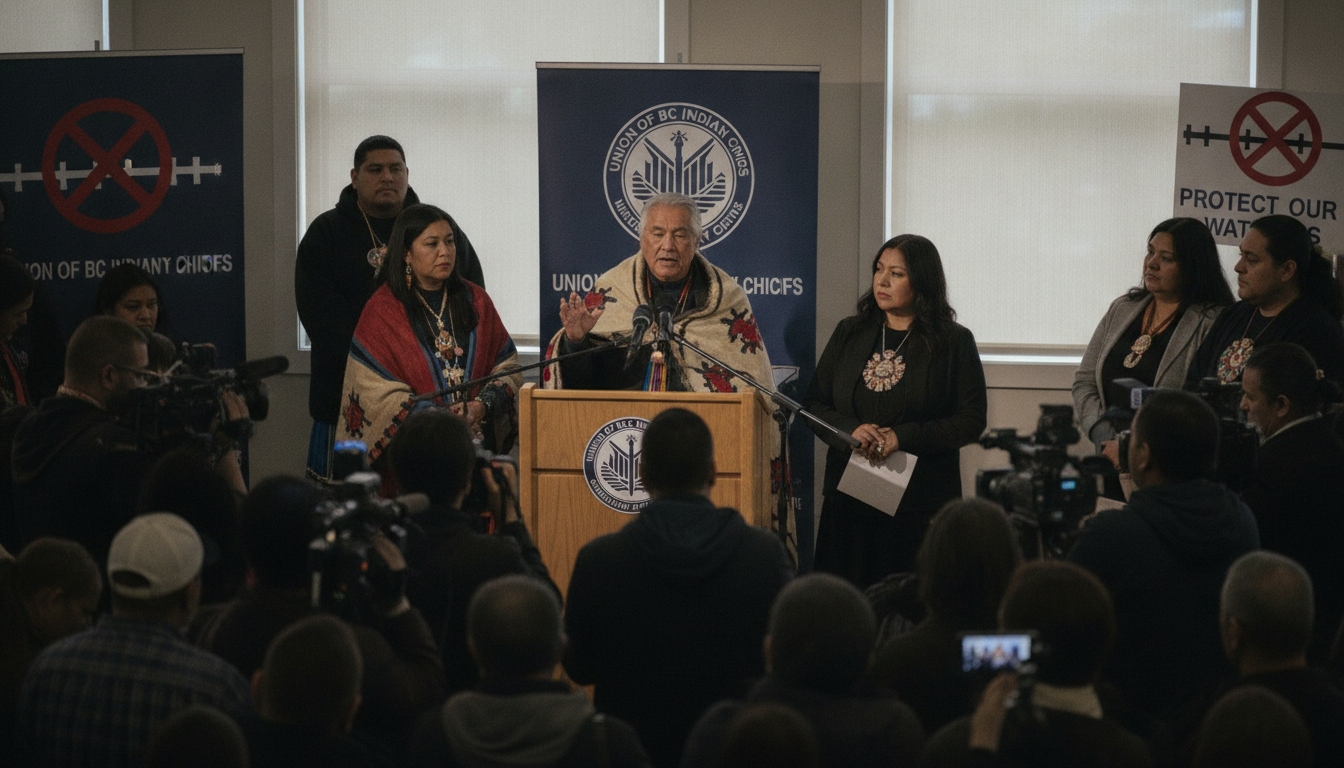
West Coast oil pipeline draws urgent Indigenous demand to pause as B.C. battles wildfires
Union of BC Indian Chiefs urges Ottawa and Alberta to halt the West Coast oil pipeline, citing climate impacts amid sweeping wildfire emergency.
The Union of British Columbia Indian Chiefs has formally called on the federal and Alberta governments to halt the proposed West Coast oil pipeline, saying advancing the project would worsen climate impacts already driving extreme weather and disasters.
The letter, addressed to Prime Minister Mark Carney and Alberta Premier Danielle Smith and published on the International Day of the World’s Indigenous Peoples, asserts that expanding fossil fuel production will deepen a national crisis of fires, floods and rising seas.
Indigenous leadership demands an immediate pause
The letter, signed by the union’s chiefs including Grand Chief Stewart Phillip, asks Ottawa and Alberta to stop work toward advancing the pipeline while concerns remain unaddressed.
It frames the issue as one of urgent public safety and long-term stewardship, arguing that new fossil fuel infrastructure increases the scale and frequency of climate-driven disasters affecting communities across British Columbia and the country.
The union said it shared the letter with B.C. Premier David Eby and published it to coincide with the international day recognizing Indigenous peoples.
That timing, the group said, was intended to underscore the intersection of Indigenous rights, environmental risk and broader public interest in decisions about major energy projects.
State of emergency and wildfire impacts underscore warnings
The union’s appeal arrived as British Columbia issued a provincial state of emergency in response to a severe wildfire season.
More than 100 wildfires were active in the province at the time of the letter, with nearly half described as burning out of control and one blaze forcing almost 25,000 people to evacuate from two communities east of Vancouver.
Provincial officials and first responders have linked the intensity and scale of recent fires to hotter, drier conditions that scientists and local leaders tie to climate change.
Indigenous leaders argue those same changing conditions strengthen the case for re-evaluating proposals that would expand fossil fuel production and transport.
Concerns over consultation and the meaning of consent
A central contention in the union’s letter is that governments have not engaged in meaningful consultation or cooperation with First Nations on the pipeline’s development.
The group contends consultation cannot be limited to discussions about how a project will proceed once elements are already predetermined, and it warns that promises of equity ownership or revenue-sharing cannot substitute for free, prior and informed consent.
The union pointed to steps already taken by government — including naming a corridor, identifying prospective development partners and publicly promoting the project’s economic rationale — as evidence that key decisions are moving forward without full Indigenous agreement.
That, the group says, undermines trust and legal obligations and risks legal and social conflict if the project advances without broad Indigenous support.
Ottawa and Alberta reiterate review process and potential benefits
Federal officials had not publicly responded to the union’s letter at the time it was released, while Alberta’s Ministry of Indigenous Relations said the project could deliver long-term benefits for Indigenous communities.
A ministry spokesperson said the submission for the West Coast pipeline is under review by the federal Major Projects Office and that Indigenous consultation will form part of determining whether the project is in the national interest.
Alberta’s statement emphasized job creation, energy security and economic opportunities tied to the pipeline, reiterating the provincial government’s role as the project proponent.
Officials also said the provincial schedule anticipates specific regulatory milestones, while noting that consultations and approvals remain conditions for construction.
Route, ownership and scope of the project
The proposed West Coast pipeline would extend roughly 1,250 kilometres from Bruderheim, Alberta, to a marine terminal near Delta, British Columbia, and is designed to carry more than one million barrels of crude oil per day for export.
Alberta’s government is listed as the project proponent, and ownership would be shared among Trans Mountain, the Alberta Petroleum Marketing Commission and Pembina Pipeline Corporation under the proposal.
Project proponents argue the route would connect landlocked supply to international markets and bolster Canada’s export capacity, while critics point to the scale of new production such a corridor would enable.
Those opposing voices highlight the potential for increased tanker traffic, coastal and marine risks, and wider climate impacts tied to higher production volumes.
Regulatory pathway under the Building Canada Act
Ottawa took a step to consider designating the pipeline as a project of national interest under the Building Canada Act, a move that can streamline approvals and alter the regulatory review process.
The government opened a public comment period on the designation, accepting submissions until mid-September, and Alberta’s materials indicate the province expects a national interest designation by October 1.
The Building Canada Act framework has been used to advance other large projects, and federal officials say the designation is intended to weigh national benefits such as autonomy, economic returns and advancing Indigenous interests.
Critics argue the mechanism can reduce environmental safeguards and limit the scope of standard impact assessments when projects are moved into that pathway.
Timeline expectations and conditional construction dates
Alberta’s public-facing timeline states that, following Indigenous consultation and once all approvals and permits are in place, construction could begin as early as September 1, 2027.
That schedule assumes the project secures a national interest designation and other regulatory clearances, and it positions the pipeline’s start date contingent on outcomes of consultation and permitting processes.
Federal officials have said the Major Projects Office will consult Indigenous communities as part of its national interest determination, while the province has set public engagement and milestone expectations on its project website.
Stakeholders on all sides have noted the timeline is subject to legal challenges, regulatory findings, and the outcome of ongoing consultations.
Carbon capture condition and the Pathways project
Ottawa and Alberta have stated the West Coast pipeline would be conditional on the deployment of the Pathways carbon capture and storage project, a separate initiative intended to capture emissions from expanded oil production.
Pathways envisions a pipeline network to move captured carbon from multiple sites in northern Alberta to an underground storage hub near Cold Lake, with ownership and operations involving several industry partners.
However, recent analysis from the Canadian Climate Institute suggested that the emissions enabled by increased oil production tied to a new export corridor would far exceed what Pathways could prevent from entering the atmosphere.
That assessment raises questions about whether conditional carbon capture commitments can offset the lifecycle emissions associated with larger flows of exported crude.
Major Projects Office role and other national-interest moves
The West Coast pipeline is among several projects the federal Major Projects Office has advanced for national interest consideration under the Building Canada Act.
The office, based in Calgary, has signaled that certain large infrastructure files are being prioritized as projects of national significance, with implications for timelines and regulatory review pathways.
Other projects moved toward national interest designation include the Grays Bay road and port project in Nunavut, the Mackenzie Valley Highway in the Northwest Territories and the Nuclear Waste Management Organization’s proposed deep geological repository in northern Ontario.
Each file has raised its own questions about Indigenous consultation, environmental protection and the balance between regional priorities and national objectives.
Public feedback window and legal, political stakes
The federal comment period on the West Coast pipeline designation remains open through the mid-September deadline set by the government, and submissions from Indigenous groups, municipalities, environmental organizations and private citizens will be reviewed.
Advocates for the pipeline and its opponents alike have signalled they will use the public engagement window to press their cases, and some observers expect legal challenges at various stages of the process.
Political dynamics are also in play, with the federal government defending a policy that seeks to pair resource development with emissions mitigation, while provincial leaders and industry proponents emphasize economic and energy-security rationales.
Indigenous leaders and climate-focused organizations argue the balance of evidence and rights-based obligations point toward pausing projects that expand fossil fuel production.
The coming weeks are set to shape a contentious public and regulatory debate, as the Major Projects Office reviews submissions and the province continues to prepare for potential project milestones.
Key dates flagged by government communications include the public comment deadline in mid-September and Alberta’s projection of an October 1 designation decision, though stakeholders caution those timelines could shift.
In the meantime, the Union of British Columbia Indian Chiefs has urged Ottawa and Alberta to place a formal hold on work that would further lock in a project corridor and commitments until concerns over consultation, consent and climate impacts are resolved.
The union maintains that meaningful engagement and genuine accommodation of Indigenous rights must precede decisions that affect territories, livelihoods and long-term community safety.
The West Coast oil pipeline proposal remains at the center of competing imperatives: economic opportunity and energy access on one side, and climate risk, Indigenous rights, and environmental protection on the other.
As public comment continues and government offices complete their reviews, the final regulatory and political path will be informed by submissions, consultations, and the evolving public response to the risk landscape highlighted by recent wildfires.
