
Meta data centre plan north of Edmonton draws protests over water, energy and jobs
Meta data centre in Sturgeon County prompts local protests and debate over water use, grid capacity, jobs and a gas-fired power plant due to supply the hub.
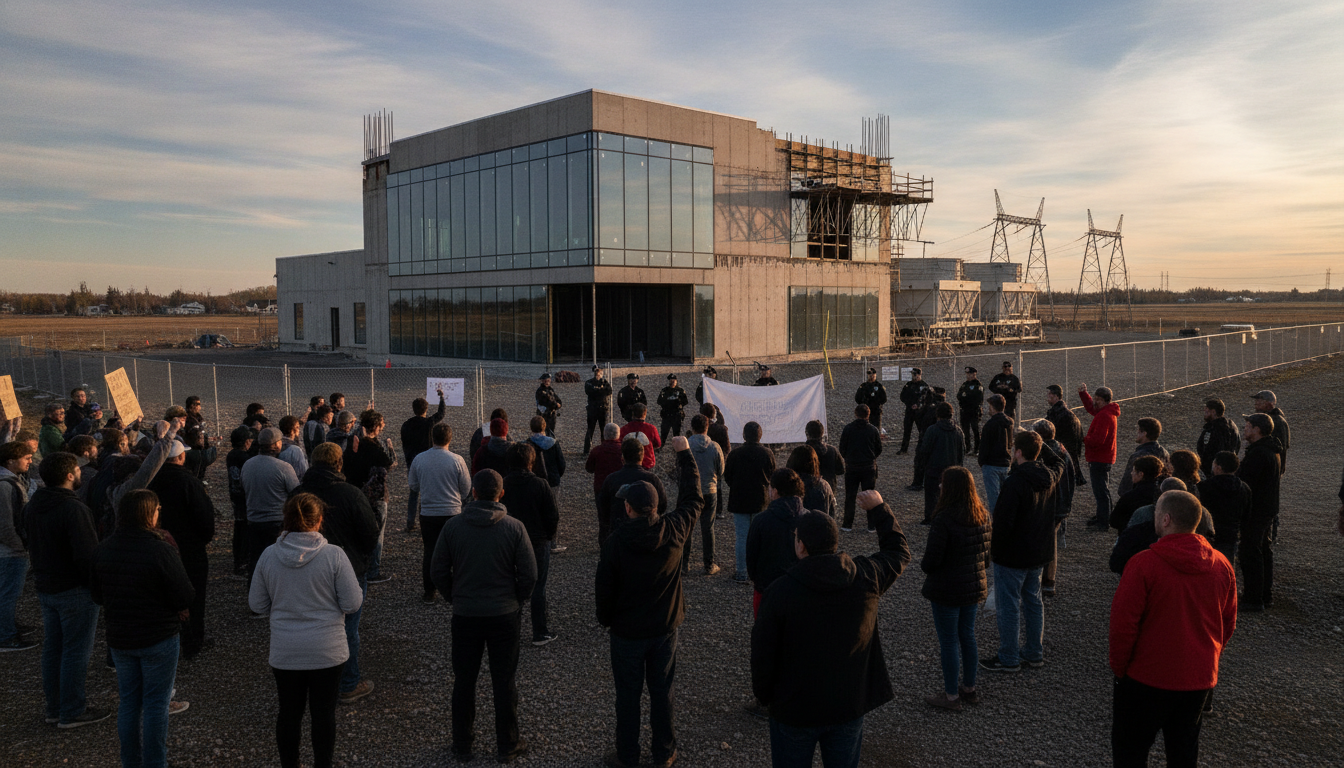
Dozens of residents gathered in Morinville this week to protest Meta’s plan to build its first Canadian data centre in Sturgeon County, arguing the massive project will strain local water and electricity resources and threaten jobs as artificial intelligence expands.
Organizers, including a 20-year-old protest leader from the community, said the proposed one‑gigawatt facility and its associated infrastructure raise questions about long-term environmental impacts and the pace of AI-driven change.
Meta has said the data centre will be operational within two to three years, while provincial leaders and private investors have outlined an energy plan that includes a new natural gas-fired plant scheduled for 2030.
Local protest draws attention in Morinville
Residents and activists gathered at a local park in Morinville to voice opposition to the Meta data centre, saying the project was moving too quickly and without adequate community consultation.
The protest was organized by a group led by a 20-year-old local resident who has framed the demonstration around concerns about water availability, the capacity of the provincial electrical grid, and climate impacts from large fossil-fuel projects.
Speakers at the rally argued the scale of the proposed facility, described by developers as a one‑gigawatt campus, makes it fundamentally different from typical industrial developments and warrants a higher level of scrutiny.
Organizers also raised economic concerns, saying rapid expansion of data-intensive operations and artificial intelligence could displace local jobs and shift employment patterns without clear transition plans.
Several participants told reporters they were troubled by the prospect of a sizeable, long-term corporate footprint adjacent to a small town and the municipal services it relies upon.
Local officials in Sturgeon County and Morinville have acknowledged the public interest and indicated they will monitor permitting and consultation processes as the project proceeds.
Project scale, timeline and corporate statements
Meta has described the Alberta site as its first full-scale Canadian data centre, with company statements indicating the facility will be substantial in both power demand and physical footprint.
Public communications from the company say the campus could be online in the next two to three years, a timeline that has sharpened local debate about readiness and impact.
Project cost estimates cited publicly place the development in the multi‑billion‑dollar range, a figure that has prompted questions about regional economic benefits versus environmental and social costs.
Local planners and provincial regulators face a sequence of approvals before full construction can begin, including municipal permits, environmental reviews and utility connection agreements.
Meta and its partners have said they will work with authorities on required studies and infrastructure plans, though details about specific mitigation measures and community benefits remain sparse in public materials.
Opponents have asked for more concrete commitments on water conservation, local hiring, and visible timelines for environmental assessments before irreversible construction work begins.
Energy strategy and the Greenlight Electricity Centre
Provincial officials have signalled that Alberta’s grid operator will route surplus electricity to the Meta data centre in the near term while a new generation facility is developed to meet longer-term demand.
That new facility, referred to by provincial leaders as the Greenlight Electricity Centre, is expected to be a natural gas-fired plant with major private-sector partners listed as backers of the project.
The provincial timeline puts initial reliance on surplus grid capacity now and a switch to the Greenlight plant by about 2030, a date that has become a focal point in discussions about emissions and fuel choice.
Pembina Pipeline Corp., Morgan Stanley Infrastructure Partners and Kineticor Asset Management have been identified publicly as financial backers connected to the planned power plant, a constellation of partners that highlights the investment scale.
Energy analysts note that meeting the continuous power demands of a one‑gigawatt data centre typically requires dedicated generation capacity or long-term supply contracts to ensure reliability and resiliency.
Community critics argue that relying on a new gas-fired facility to serve a large corporate data centre conflicts with provincial and national climate objectives and represents a substantial long-term environmental commitment.
Water use, cooling needs and environmental questions
Data centres of the scale proposed for Sturgeon County require significant cooling and, in many designs, substantial water resources to maintain operational temperatures for servers and support infrastructure.
Local residents and environmental advocates have pointed to the potential for increased industrial water withdrawals in a region where municipal and agricultural water needs already compete for supply.
Officials have said detailed engineering and environmental studies will determine final water sourcing and cooling technologies, but opponents argue studies should be completed and released publicly before construction advances.
Industry representatives and some engineers note that modern data centres can employ a range of cooling solutions, from air-based systems to water-efficient closed-loop designs, which can substantially reduce potable water use.
Still, the size and continuous operation of a one‑gigawatt campus can magnify even modest per-unit water consumption into a significant local demand, intensifying community concerns.
Environmental groups have called for transparent independent reviews of the site’s hydrology, water rights implications and potential impacts on neighbouring wells and surface water features.
Economic arguments and labour-market concerns
Proponents of the project emphasize the potential for large-scale investment, property tax revenues, and the indirect economic activity that major data centres typically generate in local supply chains.
Supporters also point to opportunities for infrastructure upgrades, including electrical transmission and broadband capacity, that can benefit broader economic development in the region.
However, opponents have framed the issue around labour-market disruption, arguing that automation and artificial intelligence systems supported by large data centres can displace jobs and alter local employment structures without guaranteed replacements.
Local business leaders remain divided, with some anticipating contracts for construction and maintenance and others worried the bulk of specialised jobs will be filled by external firms and technical specialists rather than local workers.
Community activists have called for binding agreements on local hiring targets, apprenticeship programs and supply-chain commitments to ensure that economic benefits accrue within the region.
Municipal and provincial authorities have acknowledged those requests and said workforce planning and procurement expectations are topics for further negotiation as approvals proceed.
Regulatory pathway and next administrative steps
Before shovels can break ground, the project must move through a sequence of municipal and provincial processes that include land-use approvals, environmental studies and utility interconnection agreements.
Sturgeon County and Morinville councils have the authority to shape local permitting conditions and can request additional studies or community benefit agreements as part of their review.
Provincial regulators will also examine energy planning implications, water-use permits and any environmental impact assessments required under Alberta rules.
Public meetings and written submissions are likely to be a part of the approvals process, providing formal avenues for residents and stakeholder groups to voice support, concerns or demand changes.
Advocacy groups have signalled they will pursue both regulatory interventions and public campaigning to press for stricter conditions or, if necessary, legal review of approvals.
Meta and its partners have said they will comply with required processes and will present technical studies to demonstrate how the development can meet regulatory and environmental standards.
Local voices and the broader debate over data centres
The protests in Morinville underscore a growing national conversation in Canada over where and how to site large data‑processing hubs as demand for cloud computing and AI accelerates.
Municipalities across the country have seen a mix of excitement for investment and anxiety over resource impacts, giving rise to moratoriums or stricter local rules in some jurisdictions.
Community groups argue that decisions about major infrastructure must balance economic opportunities with clear plans for environmental protection and equitable labour outcomes.
Industry groups counter that data centres are essential digital infrastructure supporting everything from healthcare to work-from-home operations, and that investment attracts skilled jobs and technology training opportunities.
The policy question for provincial and federal governments is how to reconcile ambitions for a digital economy with commitments to emissions reductions and water stewardship.
Stakeholders in Sturgeon County say the outcome of the Meta proposal will be watched closely by other communities facing similar proposals across Canada.
The coming months will test how quickly developers, provincial planners and local communities can reconcile competing priorities on water use, electricity supply and employment as construction plans for a major data centre in Alberta move from proposal toward reality.
Public consultations, regulatory reviews and technical studies remain the primary mechanisms through which details will be refined, and local residents say they will remain engaged until those documents are completed and decisions are finalized.
For now, the scene in Morinville is emblematic of a wider reckoning in Canada over the rapid expansion of data-intensive infrastructure and the governance choices that will shape its social and environmental footprint.
