
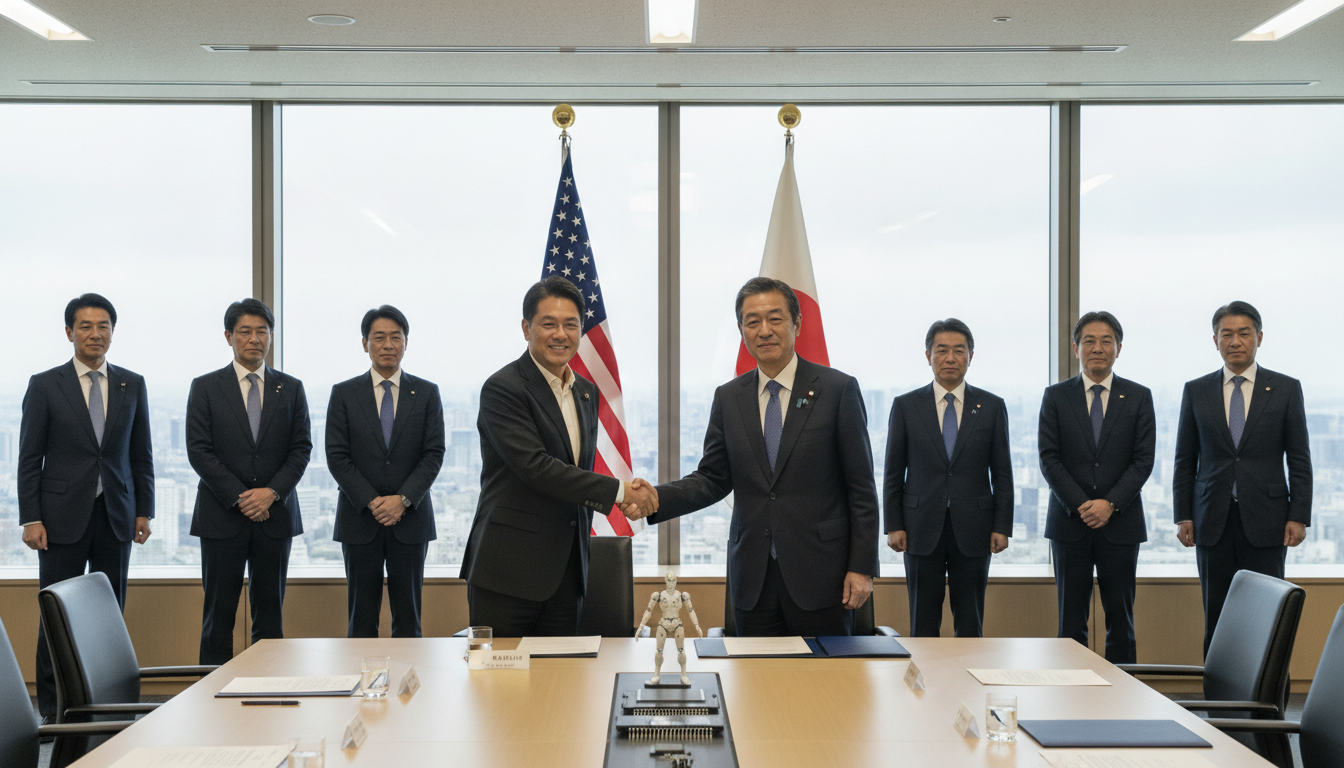
Nvidia in Japan: Huang secures national AI factory, robotics coalition and auto ties during Tokyo visit
Japan-backed Noetra factory, Cosmos robotics deals and expanded Toyota partnership mark Nvidia in Japan push for “physical AI” on factory floors.
Jensen Huang, Nvidia’s chief executive, spent July 15–16 in Tokyo and left with a sweeping set of agreements tying the company to Japan’s industrial and chip-supply leaders. The visits cemented Nvidia in Japan as the provider of the high-performance hardware that will underpin Tokyo’s newly announced national AI effort and a broad robotics coalition. Huang framed the deals as the start of a “physical AI” era that moves advanced models from data centers into robots, vehicles and production lines.
Deals sealed over two days
Huang met senior executives from Japan’s major manufacturers and semiconductor suppliers during a two-day program that combined formal announcements with private meetings. Attendees included leaders from Toyota, Fanuc, Yaskawa and several chip-material companies, signaling cross-industry alignment behind Nvidia’s platforms. The meetings produced agreements spanning a national AI training facility, shared robotics models, and deeper automotive collaborations.
Noetra and the national AI factory
Japan launched Noetra, a government-backed consortium led by roughly 44 domestic firms, to build a sovereign AI stack for robots, vehicles and factory operations. The state and private partners have pledged as much as 1 trillion yen (about $6.2 billion) over five years to develop foundation models optimized for machine control and Japanese-language reasoning. Nvidia will supply the compute backbone for a Vera Rubin AI factory — a data center planned to host thousands of Vera CPUs and Rubin GPUs and roughly 140 megawatts of power when it begins operating toward 2028.
Noetra’s roadmap calls for staged model releases: an initial reasoning model tuned for Japanese contexts, followed by a multimodal system and ultimately “real-world native” models designed to run on robots and other machines by 2030. The facility will train models at scale while Tokyo retains domestic control over data and model stewardship.
Robotics coalition adopts Cosmos 3 Edge
Japan’s top robotics and manufacturing firms committed to building on Nvidia’s Cosmos initiative, an open-model effort for physical AI. Companies including Fanuc, Yaskawa, Kawasaki Heavy, Fujitsu, Hitachi, NEC, Sony, SoftBank, Kubota and robotics group AIRoA say they will use Cosmos-derived models to accelerate factory automation. Nvidia introduced Cosmos 3 Edge in Tokyo, a variant engineered to run on Jetson Thor-class chips inside robots and industrial controllers.
Some members are already testing shared control frameworks, while others plan to integrate Cosmos-based software across production lines. The coalition’s aim is to create interoperable model stacks that allow robots from different makers to share perception, motion planning and control.
Toyota broadens Nvidia collaboration
Toyota extended its existing Nvidia relationship beyond in-vehicle platforms into factory simulation and production software. The automaker, which already uses Nvidia technology in advanced driver-assistance systems and in parts of its DRIVE stack, committed next-generation vehicle development and manufacturing simulations to Nvidia’s tools. The agreement covers systems that analyze traffic and inform vehicle software, along with simulation environments used to design and optimize production lines.
Toyota’s approach remains cautious on autonomy, prioritizing driver-assistance systems that augment rather than replace human drivers while leveraging Nvidia compute to bolster safety and manufacturing efficiency.
Sovereignty, workforce and industrial strategy
Tokyo’s moves reflect a dual industrial and sovereign objective: to capture the economic upside of AI-powered robotics while reducing dependence on foreign-run AI services. The Japanese government has tied the physical-AI push to wider economic goals, targeting 10 million AI-equipped robots across 18 sectors by 2040 and mobilizing tens of billions in public-private investment. The strategy positions model training and sensitive factory data under domestic control even as much of the hardware and chip technology remains U.S.-sourced.
Policymakers view domestic foundation models and a national training infrastructure as essential to securing Japan’s manufacturing edge as the country responds to demographic pressures and labor shortages.
Supply-chain commitments and next-generation chips
Beyond models and software, Huang’s itinerary addressed the semiconductor and materials supply chain that will support next-generation AI chips. Nvidia’s planned Vera Rubin factory depends on a large installed base of specialized CPUs and GPUs and a steady flow of chip materials and components from Japanese suppliers. Executives from firms that produce chip substrates, chemicals and manufacturing equipment attended discussions aimed at scaling production to meet the projected compute demand.
Those supply-chain alignments seek to ensure that Japan’s industrial base can both host large AI deployments and benefit economically from component production and systems integration.
In Tokyo, Huang combined formal briefings with informal talks — from CEO lunches to supply-chain dinners — to convey a simple message: the next phase of AI will be built into the physical world, and Japan’s manufacturing expertise is central to that transition. The agreements announced on July 15–16 lay out a multi-year program that ties Nvidia’s compute platforms to Japan’s ambitions for industrial automation, national model development and a more autonomous AI infrastructure.
Japan’s wager is now visible in plans, funding pledges and corporate commitments, but its success will depend on integrating large-scale compute, secure data governance and interoperable robotics software. The coming years will test whether the partnership between Nvidia and Japan’s industrial conglomerates can translate headline deals into deployed factory systems and mass-market robotic applications.
