
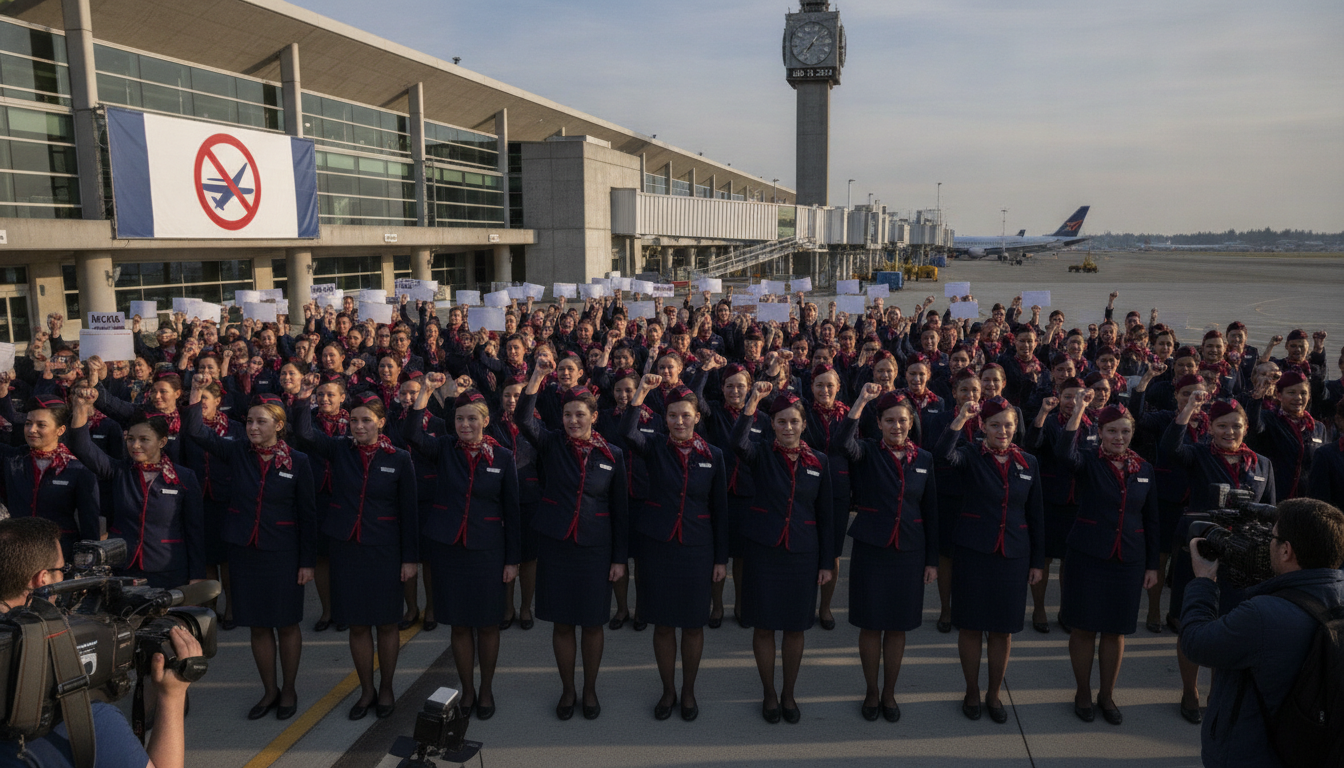
WestJet flight attendants strike mandate approved; walkout possible August 2
WestJet flight attendants strike mandate won near-unanimous support, raising prospect of major travel disruption starting August 2 if negotiations fail during the 21-day reflection period.
WestJet cabin crew vote paves way for potential strike
The roughly 4,400 WestJet flight attendants represented by Local 8125 of the Canadian Union of Public Employees (CUPE) voted overwhelmingly to authorize a strike mandate. Union officials said turnout reached 97.3 percent and 99.4 percent of those voting endorsed the strike mandate.
Local 8125 president Alia Hussain said members were united behind their bargaining priorities, particularly over compensation for all hours worked. The vote clears the legal path for a strike after the mandatory 21-day reflection period unless a deal is struck.
Legal timing and notice requirements
Under current labour rules, the parties are in a 21-day cooling-off period following the mandate vote, after which employees would be able to commence job action. Both the union and WestJet would be required to provide 72 hours’ notice before a strike or a lockout could begin.
If no agreement is reached, the earliest possible date for an authorised walkout would be August 2, coinciding with a busy summer long weekend. Company management also has the option to impose a lockout, placing pressure on timetables and contingency planning on both sides.
Scope of operational disruption forecast
A McGill University aviation management instructor, John Gradek, estimated a WestJet stoppage could affect roughly 60,000 to 70,000 passengers each day the airline is grounded. That figure underscores the potential scale of disruption at major airports and regional gateways across Canada.
By comparison, last year’s strike at another carrier disrupted about 500,000 travellers over three days, illustrating how brief job actions can ripple rapidly through the travel system. With summer schedules typically near capacity, passengers could face limited rebooking options on alternate carriers.
Passengers and ticketing implications
Travel experts warn that travellers without comprehensive travel insurance may struggle to recover full costs if flights are cancelled amid a strike or lockout. Passengers who purchased all-risk insurance at the time of ticketing are the most likely to secure full refunds or reimbursements.
Airlines generally prioritize rebooking on their own networks before seeking space on other carriers, which leaves little capacity for displaced travellers during high-demand periods. Airport and tourism stakeholders are monitoring the labour situation closely given the potential local economic impact.
Core grievance: unpaid pre- and post-flight hours
Flight attendants say they perform up to 35 hours of unpaid work per month, including aircraft preparation and extended waits during delays, because pay clocks often start only when aircraft doors are closed. The union is pressing for a contractual change to ensure compensation for all hours of required work.
Crew members also seek a wage adjustment to close what they describe as a pay gap, arguing that WestJet cabin crew ranks among the lowest paid in the country despite the airline’s position as Canada’s second-largest carrier. The union frames the demands as a correction for long-standing scheduling and compensation practices.
WestJet response and bargaining posture
WestJet’s chief executive, Alexis von Hoensbroech, has said the airline complies with Canadian labour law while signalling willingness to explore adjustments to pay structure to address employee concerns. Company statements have emphasized a preference for reaching an agreement at the bargaining table rather than through job action.
Executives and union negotiators are expected to continue talks during the reflection period, with both sides under public scrutiny to avoid large-scale travel disruption. Operational planning by WestJet will likely involve contingency schedules and communications to customers about possible cancellations or changes.
Comparisons to prior airline labour disputes
Analysts point to past airline labour disputes as indicators of how quickly cancellations and rebookings can cascade through networks. Even short stoppages have previously forced mass rebooking, created long lines at airport counters, and imposed economic costs on communities dependent on summer travel.
The concentration of flights during peak holiday weekends amplifies the risk that a strike or lockout would have disproportionate effects on travellers and airports compared with a similar action taken in lower-demand periods.
The coming days will test whether negotiators can narrow differences over unpaid hours and compensation, or whether the union will move toward authorised job action that could reshape travel plans for tens of thousands of Canadians this summer.
