
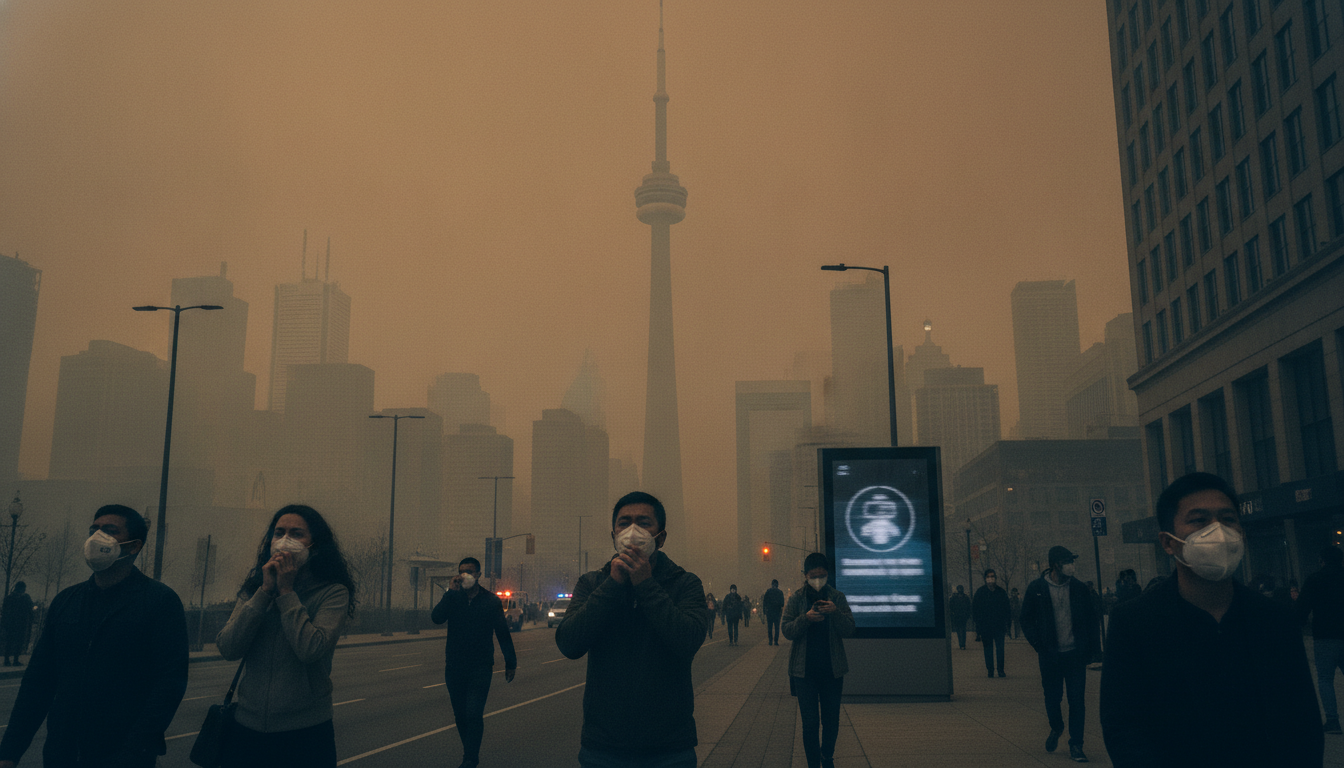
Toronto air quality ranks worst globally as wildfire smoke and urban pollution combine
Toronto air quality hit the worst level in the world on Wednesday, July 15, 2026, according to IQAir, driven by a mix of urban emissions and wildfire smoke that pushed the city’s Air Quality Health Index to 10+.
Toronto tops global AQI list
Toronto was recorded with the poorest air quality worldwide on Wednesday morning, placing ahead of Kinshasa and Delhi on IQAir’s real-time ranking. The platform aggregates data from more than 33,000 monitoring stations to produce an instant snapshot of particulate pollution in cities around the globe.
The abrupt spike followed several days of persistent haze and visible smoke that settled over the region, reducing visibility and prompting concern among public health officials. Local authorities said the combination of fine particulate matter from nearby wildfires and routine urban emissions contributed to the rapid deterioration.
Health advisory and symptoms
Public health officials warned that the Air Quality Health Index (AQHI) reached 10+, the scale’s highest category, signaling a very high risk to the general population. Symptoms associated with exposure to fine particulate smoke include eye, nose and throat irritation, shortness of breath, chest pain and severe coughing.
Vulnerable populations — including young children, older adults, pregnant people and anyone with respiratory or cardiovascular conditions — were advised to avoid outdoor exertion. The general public was also urged to limit time outside and to reduce or reschedule outdoor physical activity until conditions improve.
Environment Canada issues alert
Environment Canada issued an official air quality alert on Wednesday, linking the degraded conditions to smoke from wildfires in northwestern Ontario. The agency reported that smoke plumes had drifted southeastward, affecting a large portion of southern Ontario and concentrating fine particles in the urban atmosphere.
Forecasters noted that improvements were possible by Friday morning, though they cautioned that shifts in wind direction or fire activity could prolong poor conditions. The alert included specific recommendations for residents and reiterated that local air quality could change rapidly.
Protective measures for residents
Officials recommended practical steps to reduce exposure to smoke both outdoors and indoors. For those outside, wearing a properly fitted N95 respirator was advised to lower intake of fine particles, while people indoors were told to keep doors and windows shut and to use portable air cleaners or HVAC systems with high-efficiency filters when available.
Public guidance also stressed the importance of balancing air quality precautions with heat safety during periods of elevated temperature. In situations of extreme heat combined with poor air quality, staying cool and hydrated was emphasized as a priority, and seeking shelter in air-conditioned locations was advised when possible.
Evacuations and displaced communities
The wildfire situation in northwestern Ontario has prompted mandatory evacuations in several communities, with some residents being flown to Toronto for safety. Members of the Gull Bay First Nation were evacuated by air from Thunder Bay and arrived in Toronto on Wednesday, where they were provided with immediate assistance, including meal support.
Other affected communities under evacuation orders include Armstrong, Whitesand First Nation, Collins, Lac des Mille Lacs and Lac La Croix. Emergency managers are coordinating reception services for evacuees and monitoring transportation and sheltering needs as the situation evolves.
How the AQI ranking is determined
IQAir’s global ranking relies on the U.S. Environmental Protection Agency’s Air Quality Index (AQI) methodology, focusing primarily on PM2.5 — airborne particles 2.5 micrometres in diameter or smaller. These fine particles are roughly 30 times smaller than the width of a human hair and penetrate deep into the lungs, posing significant health risks.
The platform synthesizes readings from thousands of official and community monitoring stations to deliver near real-time comparisons between cities. Because PM2.5 can originate from both natural sources like wildfires and human activities such as traffic and industry, urban air quality can deteriorate rapidly when these sources coincide.
Public and private organizations in Toronto are monitoring conditions and coordinating responses, including advisories for outdoor events and guidance for schools and vulnerable facilities. Health units and municipal officials urged residents to check local updates and to follow advice from Environment Canada and health authorities.
Residents should remain alert to changing conditions and prepared to take protective actions if air quality warnings are extended or if new evacuation directives are issued.
Air quality may begin to improve by Friday morning, but officials cautioned that forecasts can change and urged continued vigilance until readings return to safer levels.
