
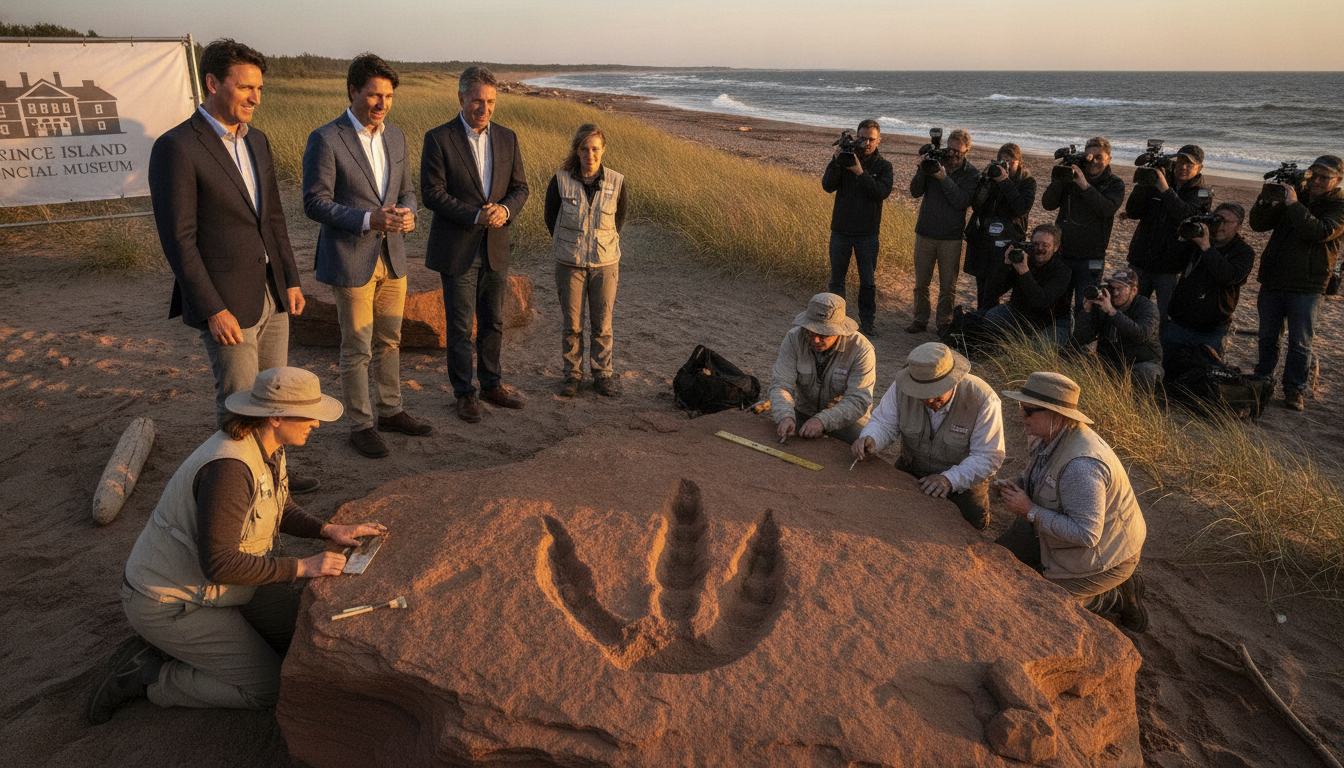
Dimetrodon footprint on Prince Edward Island prompts push for provincial museum
Dimetrodon footprint on Prince Edward Island discovery by a local paleontologist has spurred calls for a dedicated museum, conservation centre and expanded community programs.
Laura MacNeil felt certain she had found something extraordinary after a short walk along the island’s north shore revealed a clear five-toed impression with claw marks etched into Permian sandstone. The dimetrodon footprint on Prince Edward Island, later confirmed by provincial officials, is the first of its kind recorded on the island and immediately drew scientific and public attention. The find has accelerated plans to secure and conserve the province’s growing fossil collection while galvanizing grassroots efforts to bring paleontology to local communities.
Site discovery and initial confirmation
A trained paleontologist who leads Prehistoric Island Tours, Laura MacNeil made the find after several weeks of fieldwork on coastal outcrops. The print shows distinct toes and terminal claw impressions consistent with a large synapsid, prompting authorities to inspect the location quickly. Provincial staff and local experts, including conservation officers, were notified and subsequently confirmed the identification as a dimetrodon trace.
Officials say the footprint likely dates to the Permian period and represents an uncommon coastal preservation of vertebrate activity. Because the rock is exposed at low tide and vulnerable to weathering, crews have documented the site and removed detailed molds and photographs for study. The discovery provides a new data point for researchers piecing together the island’s deep-time ecosystems.
Scientific importance of the dimetrodon print
Dimetrodon, a prominent Permian-era synapsid, is important to scientists because features of its skull foreshadow mammal evolution. The presence of a dimetrodon footprint on Prince Edward Island expands the known geographic range of such animals and raises questions about regional environments during the Permian. Researchers note the print can inform models of behaviour, locomotion and habitat use among early terrestrial vertebrates.
Paleontologists emphasize that a single trace is not a complete picture but can prompt targeted surveys that yield more material. Footprints can capture moments of life activity that bones alone do not show, and their orientation, depth and distribution add to interpretations of ancient shorelines. The new trace therefore opens research avenues that provincial teams and visiting specialists plan to pursue in coming seasons.
Conservation arrangements and collection care
Provincial authorities currently oversee the island’s fossil collections through facilities in Charlottetown, while park staff manage finds from federal lands. Matthew McRae, director of the museum and heritage foundation, said the province is prioritizing secure storage and climate-controlled conservation for specimens identified as museum-quality. Recent investments include a $3-million provincial grant targeted to create a conservation centre to house and stabilize the growing collection.
Officials describe a modular approach to preservation, starting with safe storage and traveling exhibits while planning permanent gallery space. That strategy aims to protect fragile material against coastal erosion and to ensure long-term scientific access. Coordination between provincial and park teams will be key to cataloguing finds and making them available to researchers and the public.
Plans for a provincial natural history museum
Community leaders and heritage managers are increasingly vocal about establishing a provincial museum focused on the island’s paleontological record. Advocates say a museum would serve research, education and tourism goals while anchoring conservation work. Matthew McRae and other stakeholders argue a phased project — beginning with conservation infrastructure and a rotating exhibition program — is financially realistic for a small province.
Proponents propose multi-use spaces that support school programming, temporary exhibits and community events as an interim measure before galleries are built. The approach is pitched as “modular and intelligent,” allowing expansions aligned with new discoveries and funding windows. Local officials stress that public engagement and donor partnerships will shape the museum’s final form.
Community outreach and the annual Fossil Day
Since 2024, an annual Fossil Day held in Charlottetown has become a central venue for public engagement, drawing families, students and amateur collectors. The event transforms library halls and community centres into temporary cabinets of curiosities, where fragile items are secured in vitrines and more robust specimens are available for hands-on viewing. Organizers report growing attendance and a steady stream of inquiries from residents who suddenly see their coastline in a new light.
Local volunteers and trained staff lead demonstrations and fieldwork talks, encouraging safe and legal collecting practices while cultivating interest in science careers. Small exhibits featuring a recently displayed dimetrodon fragment and other Permian specimens have proven particularly popular with children. Organizers say the festival reinforces the argument for a permanent facility to showcase and interpret the island’s deep-time heritage.
Mentorship and the next generation of fossil hunters
The discovery has already inspired local youth, including a 10-year-old enthusiast who spent Fossil Day studying specimens and planning his next beach search. Mentorship ties between experienced collectors, artists and young people were visible throughout the event, with volunteers sharing contacts and offering to review photos of new finds. Such grassroots mentorship helps channel curiosity into scientifically valuable reporting and conservation.
Those involved stress that community observers often provide the earliest leads to significant discoveries and that training can improve data quality. As the province moves to formalize conservation and exhibition plans, organizers hope to expand school partnerships and field programs that guide responsible exploration. The combination of professional stewardship and local engagement aims to turn this single dimetrodon footprint on Prince Edward Island into a sustained program of research and education.
The dimetrodon footprint has shifted the conversation about the island’s geological heritage from a niche interest to a public priority, and officials now face the twin tasks of protecting fragile sites and making their stories accessible to residents and visitors alike.
