
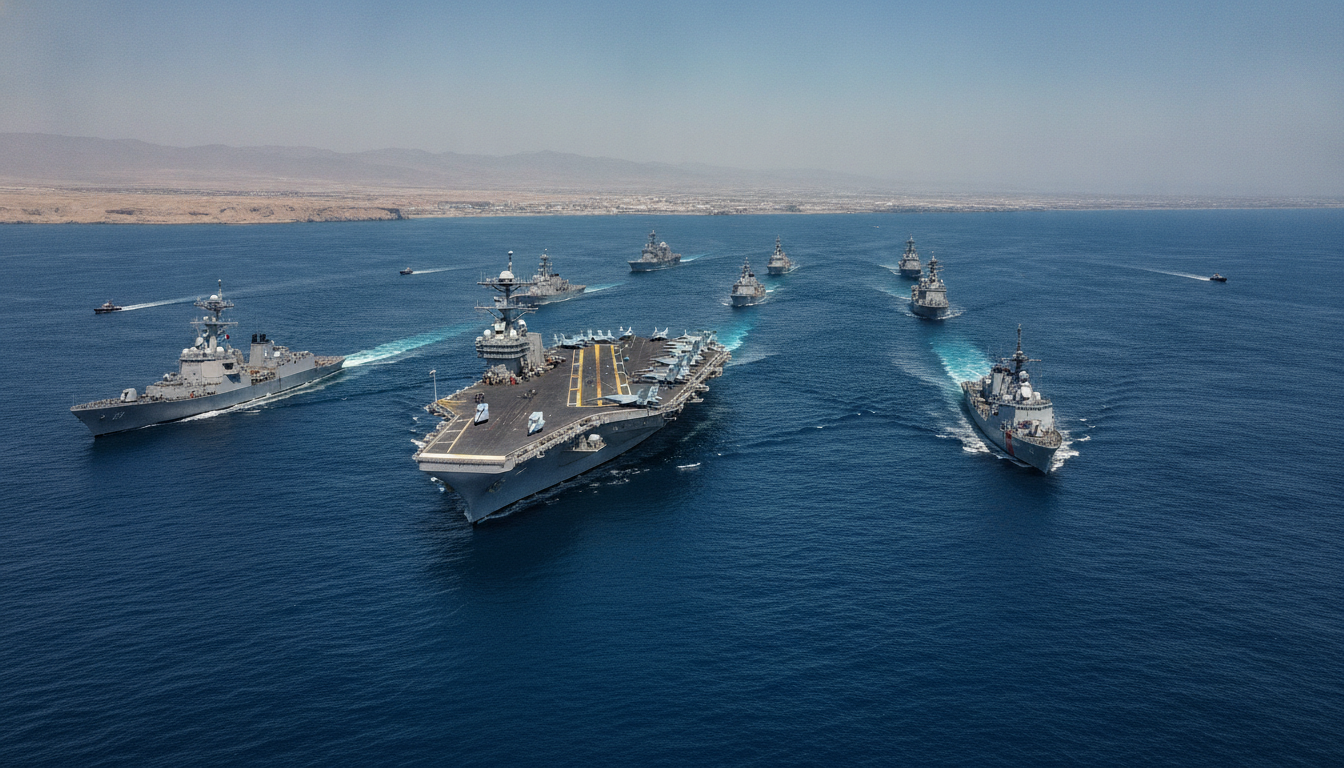
US reimposes naval blockade on Iranian ports after fresh strikes
U.S. naval blockade on Iranian ports reinstated as CENTCOM says it launched a seven-hour wave of strikes; Iran reports casualties and retaliatory attacks across the Gulf.
The United States has reinstated a US naval blockade on Iranian ports, less than a month after a memorandum of understanding meant to ease hostilities. CENTCOM said its latest operation targeted dozens of Iranian military sites near the Strait of Hormuz and along coastal areas. Iran has reported dozens of civilian casualties and said it launched missile and drone attacks on U.S. assets and regional partners in response.
CENTCOM says strikes hit missile, drone and coastal defences
CENTCOM reported that the latest round of strikes began at about 02:00 GMT and continued for roughly seven hours, employing fighter aircraft, unmanned systems and naval firepower. The U.S. military described the campaign as a precision effort aimed at Iranian missile and drone locations, naval capabilities and coastal defence systems near the Strait of Hormuz.
Iranian outlets and officials reported damage and casualties after the strikes, including that a naval watchtower in Chabahar—a facility used for maritime security and fishermen rescue operations—was struck. Iran’s health ministry spokesman said more than 260 people were injured and Tehran reported that over 30 civilians were killed in the attacks, figures that have not been independently verified.
Iranian forces strike U.S. targets and Gulf states overnight
Iran’s Islamic Revolutionary Guard Corps said it retaliated with coordinated drone and missile strikes against U.S. military assets in Bahrain, Kuwait and Jordan. Regional militaries reported a mix of direct hits and interceptions as air defences were activated across the Gulf.
Kuwait’s defence authorities said an attack damaged a Kuwaiti naval vessel and wounded four personnel, while Bahrain’s interior ministry urged residents to seek shelter as air-raid alerts were sounded. Jordanian military statements said air defences intercepted and downed four ballistic missiles that breached Jordanian airspace, underscoring how the escalation spread beyond Iran and the United States.
Maritime traffic halted and coastal areas placed under control
Following the strikes, U.S. forces moved to block sea traffic destined for or departing from Iranian ports and coastal zones, effectively reinstating the naval blockade. Shipping movements in the immediate area around the Strait of Hormuz were disrupted, with authorities warning of heightened risks to commercial and local maritime operations.
Iran has publicly rejected any erosion of its control over the Strait of Hormuz, a strategic chokepoint for global energy shipments, and warned that its ability to operate there will not be compromised. The targeting of a civilian maritime watchtower has raised immediate concerns about the effects on search-and-rescue services and fishing communities that rely on coastal infrastructure.
Diplomatic fallout accelerates after recent MoU
The blockade and subsequent strikes came barely weeks after Washington and Tehran signed a memorandum of understanding that was portrayed as a potential step toward reducing hostilities. Iranian Deputy Foreign Minister Kazem Gharibabadi declared the MoU void following the latest U.S. actions, saying Tehran no longer regarded the agreement as valid.
Iran’s permanent representative to the United Nations also wrote to Secretary-General António Guterres accusing the United States of aggression and arguing that Washington had failed to implement its commitments. On the U.S. side, senior defence officials have continued high-level diplomatic engagement; the U.S. defence secretary met with Iraq’s prime minister to press for a firmer stance against Iran-aligned militias seen as a threat to U.S. forces.
Sanctions, frozen assets and threats to energy exports
In parallel with military measures, the U.S. Department of the Treasury announced sanctions that it said froze in excess of $130 million by targeting cryptocurrency wallets linked to Iran’s central bank. The move was presented as part of Washington’s effort to cut off financial channels that could support Tehran’s military activities.
Iranian commanders responded to the blockade and sanctions with economic warnings, with the IRGC threatening to halt energy exports from the Middle East if Tehran’s access is constrained. Such statements underscore the potential for disruption to global energy markets should the conflict broaden or choke regional export routes.
Regional security posture and risks of wider confrontation
The latest exchanges have sharpened regional security concerns, with Gulf states scrambling to reinforce defences and allies reassessing force dispositions. U.S. officials have urged partner states to deny sanctuary to militias it blames for recent attacks, while Tehran has framed its strikes as legitimate retaliation for what it calls American aggression.
Analysts warn that a tit-for-tat pattern of strikes, blockades and sanctions could entrench a protracted standoff, increasing the likelihood of miscalculation. International institutions have been asked to monitor developments, but concrete steps toward de-escalation have not been publicly announced as both sides maintain firm postures.
The situation remains fluid, with casualty figures, damage assessments and the wider economic impact still subject to confirmation by independent observers. Observers will be watching for further statements from CENTCOM, Iran’s foreign ministry and regional capitals, as well as any moves at the United Nations to address the renewed maritime blockade and attacks.
