
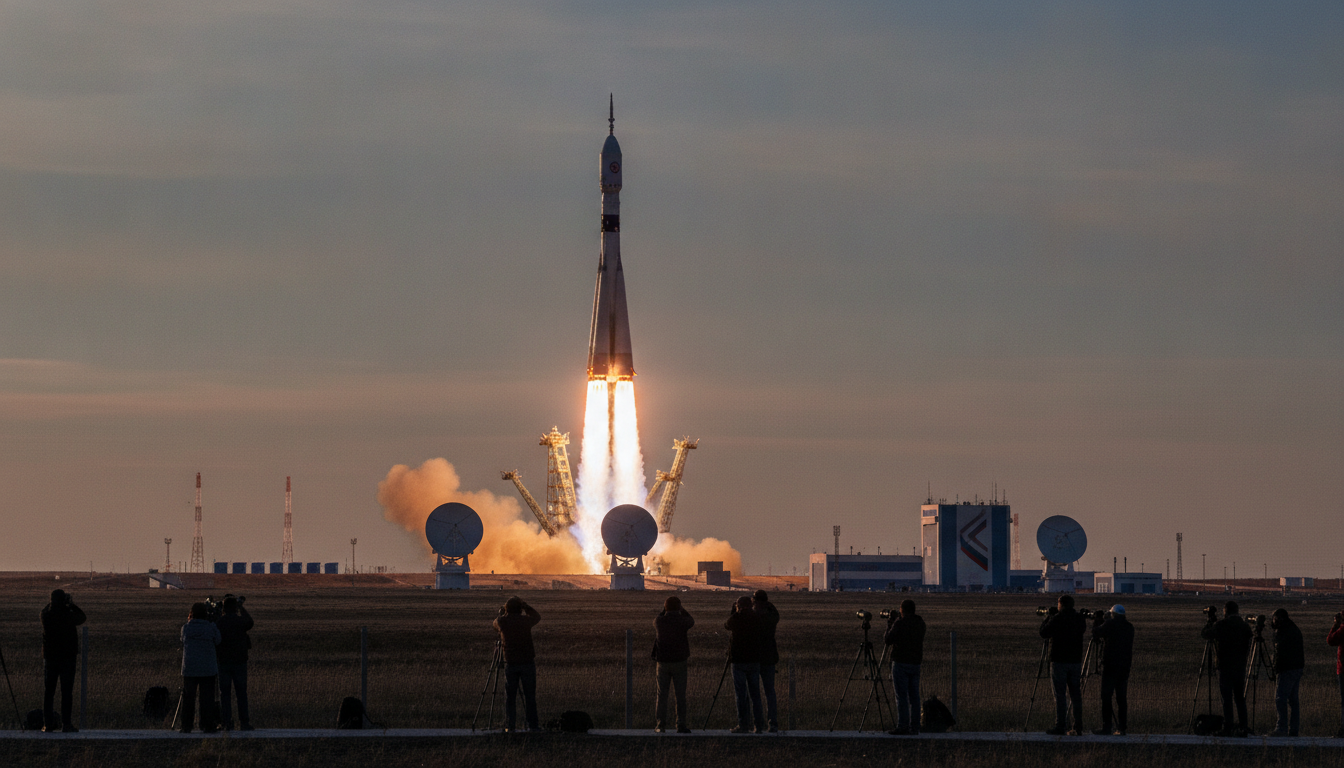
Soyuz launch sends U.S.-Russian crew to ISS for eight-month mission
Soyuz launch sends U.S. and Russian crew to the ISS for an eight-month mission, highlighting continued orbital cooperation despite tensions over Ukraine.
Soyuz launch lifts off for eight-month International Space Station mission
The Soyuz launch on July 14, 2026, carried a mixed U.S.-Russian crew bound for the International Space Station for an eight-month expedition. The liftoff marked a continuation of routine crew rotations that keep the station staffed and scientific programs on schedule. Officials said the mission will maintain critical human presence on the station while enabling long-duration experiments.
The flight manifested as a standard handover mission for the ISS, with the arriving crew scheduled to join an international contingent already aboard. Mission control teams in multiple countries coordinated launch and early orbit procedures. The operation emphasized the technical interoperability that underpins station logistics.
Crew composition and primary goals aboard the Soyuz
The flight roster includes astronauts from the United States and cosmonauts from Russia, selected for scientific and station maintenance roles. Their tasks will include microgravity research, life sciences experiments, and upkeep of station systems over roughly eight months. This crew will also participate in technology demonstrations intended to inform future deep-space missions.
Medical monitoring, material science work, and experiments studying long-term human exposure to microgravity are prioritized. The crew will hand over operations with departing members to ensure continuity of research programs. Training and mission planning before launch focused on procedural compatibility and emergency readiness.
Orbital cooperation continues despite Ukraine war tensions
The mission highlights continuing U.S.-Russian collaboration in low Earth orbit even as geopolitical tensions persist on the ground over Russia’s war in Ukraine. Space agencies have maintained a working relationship for station operations, citing safety and scientific benefit as driving factors. Analysts say the ISS remains a rare domain of sustained cooperation amid broader diplomatic strains.
Both agencies reiterated their commitment to keep the station operational and safe for all crew members. Technical links, supply chains, and mission planning remain coordinated through established channels. The persistence of this cooperation underscores how shared infrastructure and safety protocols can bridge geopolitical differences.
Mission timeline, docking and planned research
Following ascent, the Soyuz spacecraft will follow an orbital rendezvous profile to dock with the ISS within hours to days, depending on flight dynamics and operational checks. Once aboard, the crew will transition through a period of acclimation and system handovers. Their eight-month schedule includes regular science runs, maintenance windows, and time allocated for public outreach and education.
Research objectives span biomedical studies, Earth observation, and materials processing experiments that leverage microgravity. The station’s research agenda is driven by international partners and is periodically updated to reflect scientific priorities. Data collected during this mission will feed into long-term studies on human health and technology readiness.
Safety oversight and international coordination for long-duration flight
Safety and logistics oversight for the mission involves multiple national space agencies, mission control centers, and flight surgeons monitoring crew health. Contingency plans for medical evacuation or emergency return remain a central element of mission readiness. The presence of mixed-nationality crews necessitates clear protocols and regular cross-team training.
Resupply and waste management flights are coordinated to ensure consumables and spare parts are available throughout the crew’s stay. The Soyuz spacecraft also serves as a lifeboat during the mission, providing assured crew return capability. Ensuring redundancy across vehicles and systems is a continuing priority for the ISS partnership.
How the ISS benefits from multinational crews and continued flights
Multinational crews bring complementary skills and scientific perspectives that enhance the station’s research output and operational resilience. The long-duration flight will allow experiments that require extended observation windows, improving the quality of scientific results. Cooperative missions also support diplomatic channels and institutional relationships that underpin future space endeavors.
Sustained human presence on the ISS provides a platform for testing technologies needed for lunar and Mars missions. Cross-training of astronauts and cosmonauts on each other’s systems strengthens emergency response and day-to-day station operations. The continuity of these missions ensures that the station remains a productive laboratory for the international science community.
The Soyuz launch on July 14, 2026, reaffirmed the ISS partnership’s operational continuity and the prioritization of science and crew safety despite complex geopolitical conditions. As the newly arrived crew settles in, station partners will monitor progress, report milestones, and coordinate upcoming handovers to keep research and maintenance on track.
