
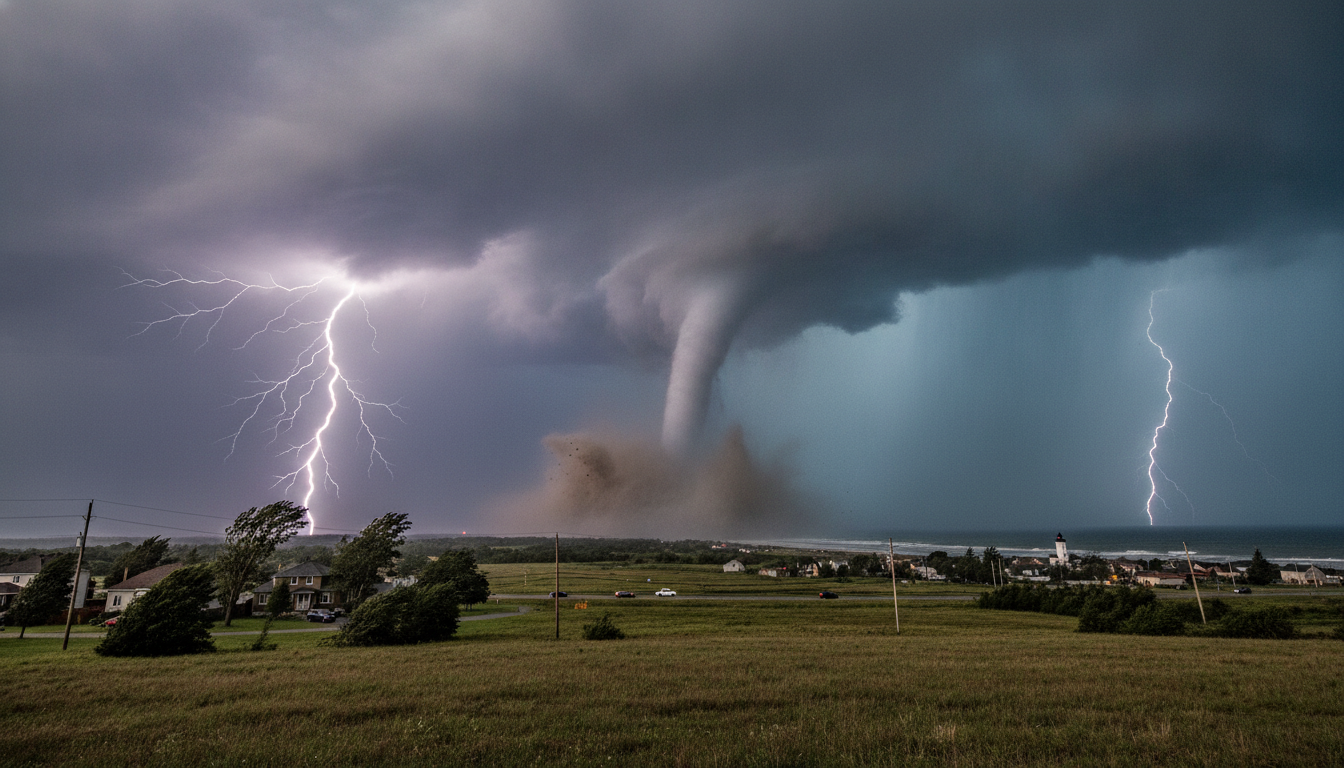
Severe storm warnings and tornado watches issued across Quebec, Ontario and New Brunswick
Environment Canada issues severe storm warnings, tornado watches, heat advisories and air-quality alerts for regions of Quebec, Ontario and New Brunswick.
A widespread set of severe storm warnings and tornado watches has been issued for large parts of southern Quebec, with related alerts extending into Ontario and New Brunswick. Environment Canada says atmospheric conditions are favourable for severe thunderstorms capable of producing strong winds, large hail, heavy rain and possible tornadoes. The agency also issued heat and air-quality advisories for other parts of the region, prompting officials to urge residents to take precautions.
Orange tornado watches issued for southern Quebec
Environment Canada raised orange-level tornado watches Tuesday morning for about two dozen sectors across the province. The watches indicate conditions that could produce tornadic storms and the potential for major damage to infrastructure, homes and the natural environment.
Forecasters cautioned that an orange watch does not confirm a tornado will occur in every listed area, but warns that the ingredients for such storms are present and that localized alerts will be sent if a threat becomes imminent.
Municipalities and sectors named in the watches
The orange watches affect communities from Trois-Rivières and Drummondville to Lac-Mégantic and Thetford Mines. Included municipalities and sectors named by Environment Canada include Bécancour-Villeroy, Berthierville-Saint-Gabriel, Cookshire, Drummondville, Lac-aux-Sables and Lac-Mégantic among others.
Additional areas under watch include Louiseville, Mascouche, Nicolet, Rawdon-Joliette, Richmond, Saint-Hyacinthe-Acton Vale, Shawinigan, Sorel-Yamaska, Victoriaville and Weedon. Residents in those locations were urged to stay alert for updates.
Conditions expected on the island of Montreal and surrounding areas
On the island of Montreal Environment Canada warned conditions are favorable for violent storms this afternoon, with risks of strong gusts, large hail and heavy downpours. The agency specifically noted there is also a tornado risk for the Montreal area during peak heating hours.
Authorities encouraged Montrealers to monitor local alerts, secure loose outdoor items and avoid travel during intense thunderstorms as sudden gusts and flash flooding can rapidly reduce visibility and create hazardous road conditions.
Heat and air-quality advisories in other regions
A separate yellow heat advisory covers much of southern Quebec, where daytime highs are expected to reach 30 to 37°C, with humidex values climbing between 38 and 45. Health officials reminded vulnerable populations to stay hydrated, seek cool indoor spaces and check on neighbours, particularly seniors and young children.
In northwestern Ontario a wide orange air-quality alert remains in effect as smoke from distant wildfires continues to degrade air quality and visibility. Environment Canada advised residents to limit outdoor time and to postpone or relocate sporting events and other outdoor gatherings where possible.
Public guidance and recommended precautions
Environment Canada advised the public to prepare now rather than wait for a warning to become a direct alert for their neighbourhood. Suggested measures include identifying a safe indoor refuge, securing loose objects outdoors, moving vehicles to covered locations and having an emergency kit ready.
For smoky conditions the agency recommended reducing time spent outdoors, avoiding strenuous activity and following local public health guidance. For heat warnings the consistent advice is to drink fluids regularly, avoid prolonged sun exposure during the hottest hours, and check cooling options for those at risk.
Meteorologist emphasizes watches are precautionary and actionable steps matter
Simon Legault, a meteorologist with Environment Canada, told reporters that a watch signals the presence of atmospheric ingredients capable of generating severe phenomena but does not guarantee an event. He urged residents to consider what they would do if an alert were issued later in the day and to take early steps such as tightening down outdoor objects and identifying shelter options.
Legault said that if storms begin to organize and pose immediate danger, Environment Canada will issue targeted warnings for specific sectors and the public should follow instructions from local authorities and emergency services.
Community officials and emergency managers in the affected provinces are standing by to respond to any reports of damage from storms or flooding. Police and municipal crews often coordinate to clear roadways and assist residents after severe weather, and utilities prepare for possible power outages.
Weather monitoring services will continue to update the public through alerts and broadcasts as storm systems evolve. Residents in Quebec, Ontario and New Brunswick should keep mobile devices charged, monitor official channels and take the recommended precautions for severe storms, heat and poor air quality.
