
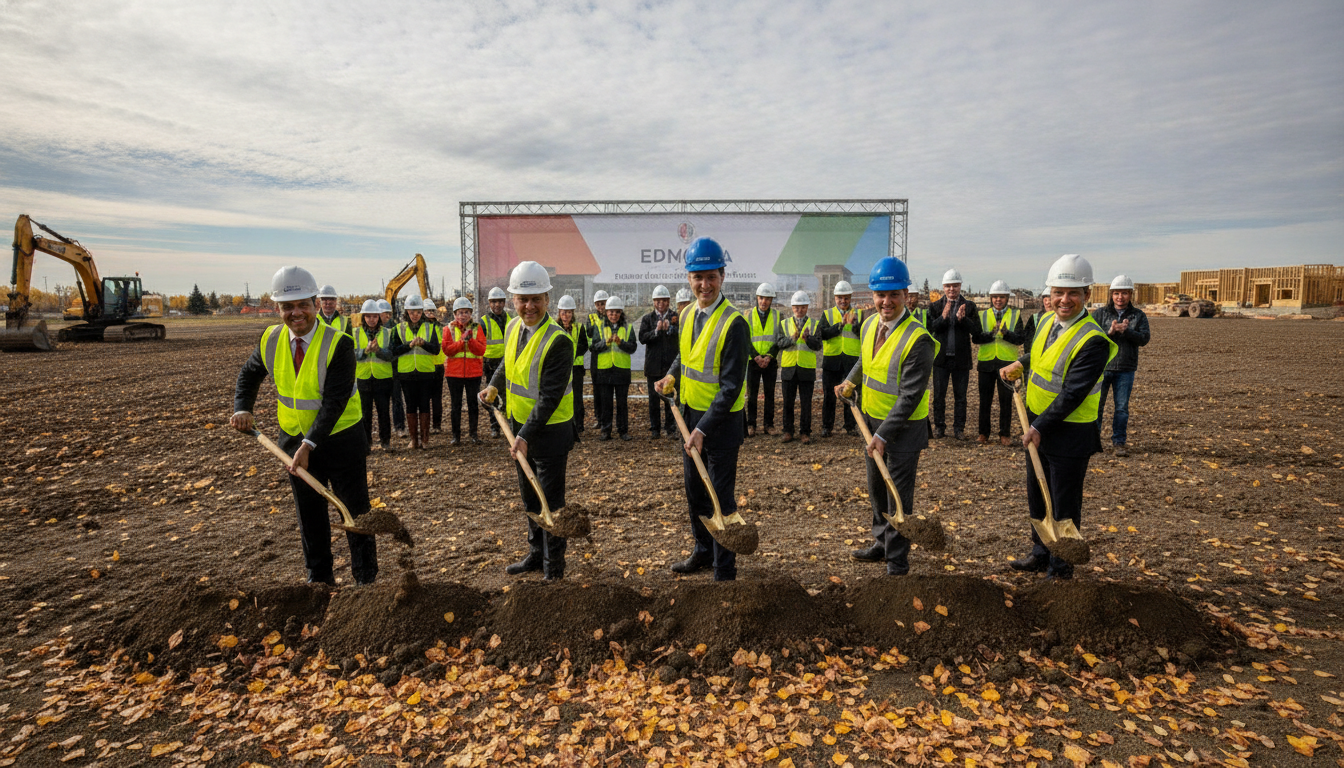
Construction begins on Kiniski Gardens affordable housing project in Mill Woods
Construction starts on Kiniski Gardens affordable housing in Edmonton’s Mill Woods: 68 homes, rent capped for 40 years part of 11 surplus-school projects.
Kiniski Gardens affordable housing broke ground on July 9, 2026, as crews began construction of 68 new homes on a former surplus school site in Mill Woods. The project, led by Right at Home Housing Society, will provide a mix of one-bedroom and three-bedroom townhouses with rents set below market levels. City officials and federal and provincial representatives attended a ceremony that marks the first of 11 developments planned on surplus school lands.
Groundbreaking in Mill Woods
The ceremony for Kiniski Gardens took place adjacent to Julia Kiniski School in the Burnewood neighbourhood, where municipal leaders emphasized the role of land reuse in addressing housing shortfalls. Mayor Andrew Knack said selling surplus school sites to developers is a key tool for accelerating housing supply. He noted the city has held the land since 2009 and that the Kiniski project is one of the earliest to move from planning to construction.
Community representatives and board members from the Burnewood Community League joined Right at Home Housing Society and elected officials for the launch. The presence of local leaders signaled cooperation between the developer and neighbouring residents, a point underscored by Right at Home’s executive director. The society framed the project as long-term housing infrastructure rather than a short-term intervention.
Project design and housing mix
Kiniski Gardens will deliver 68 homes split evenly between three-bedroom townhouses and single-bedroom units, designed to serve a range of household sizes. The site plan includes a parking lot with capacity for 76 vehicles and is sited within walking distance of three other schools and local amenities. Architects and planners described the scale as intended to blend with the surrounding residential character of Mill Woods.
Design details emphasize durable materials and layouts suitable for families and individuals, with ground-oriented units to maintain neighbourhood scale. The mix of unit sizes aims to accommodate both larger households needing three bedrooms and smaller households seeking affordable one-bedroom options. Project proponents said amenity space and pedestrian connections were included to support community integration.
Affordability rules and funding commitments
Funding agreements tied to Kiniski Gardens require that rents remain capped below average market rates, using Canada Mortgage and Housing Corporation benchmarks to set limits. The affordability commitment is written for a minimum of 40 years, with Right at Home Housing Society stating its intention to preserve affordability beyond that term. The society said rents will be between roughly 60 and 80 per cent of market rates once occupied.
The $23.6-million project is financed through a mix of public and private contributions. The city contributed the land, valued at $2.5 million, and secured a $3.4-million construction grant from the federal housing accelerator fund. An additional $5 million comes from a joint provincial-federal agreement that supports several of the surplus-school conversions, while the non-profit will cover the remaining costs through conventional financing.
Surplus school lands and wider housing program
Kiniski Gardens is part of a broader municipal initiative announced last year to repurpose 11 surplus school sites for housing. City documents project roughly 1,300 new units across those sites, with about 950 designated as affordable. The federal housing accelerator fund contributed $100 million to the package, and a separate $77 million joint provincial-federal allocation is supporting seven projects within the group.
Other neighbourhoods identified for developments include Belmont, Blue Quill, Caernarvon, Dunluce, La Perle, Lymburn, Miller, Overlanders and Summerlea. City officials said the projects are at varying stages of planning and construction and stressed that reuse of municipal land can shorten delivery timelines compared with greenfield builds. The strategy is framed as part of a coordinated push to increase supply while targeting affordability.
Community response and legal challenges
While several communities have welcomed conversion of surplus school land into housing, some projects have drawn opposition from nearby residents and community leagues. Earlier this year a proposed project at Wedgewood Heights stalled after residents challenged the city’s process in court. The Court of King’s Bench found the council’s original sale, completed without a public hearing, was invalid, prompting a court-ordered public hearing.
Following the hearing, council proceeded with a sale of the Wedgewood Heights site to the Treaty 8 First Nations of Alberta, but Mayor Knack acknowledged ongoing discussions around that location. Right at Home and city staff said they are engaging local leagues and neighbours at Kiniski Gardens to address concerns and to keep lines of communication open through construction and occupancy.
Timeline for construction and occupancy
With site work under way, project leaders expect construction activities to advance through the coming months, with completion timelines to be announced as the build progresses. Funding stipulations and municipal approvals set guardrails for tenant selection and ongoing management, which Right at Home will oversee once units are ready. The society said it aims to move quickly to house families and individuals in need of stable, affordable homes.
The Kiniski Gardens build is being positioned as a model for how surplus public land can be converted into long-term affordable housing, subject to continued funding and community cooperation. As the project advances, municipal and non-profit partners say they will report on occupancy plans and timelines to ensure transparency.
The opening of construction at Kiniski Gardens marks a visible step in Edmonton’s broader effort to convert underused public land into affordable homes, with municipal leaders pledging continued work to reduce overcrowding and housing insecurity across the city.
