
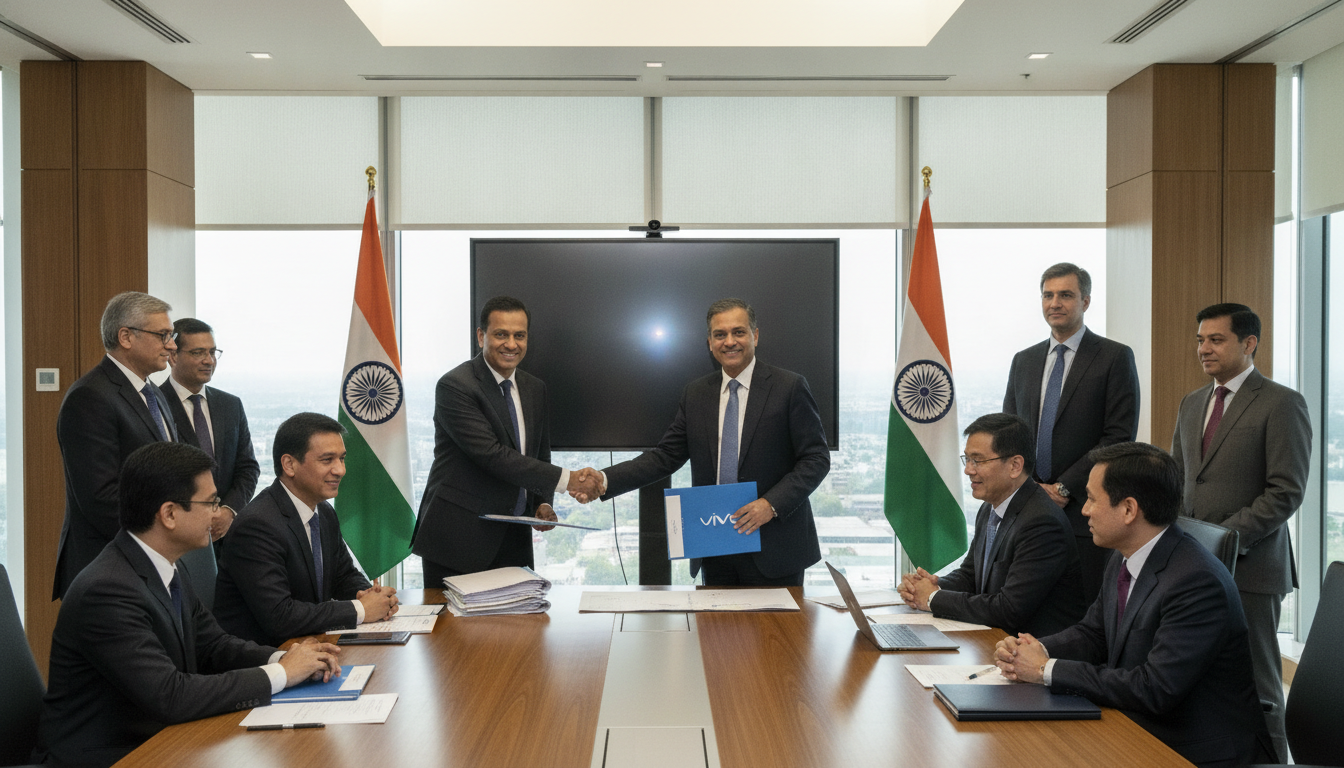
India approves Vivo-Dixon joint venture to scale smartphone manufacturing in India
India approves Vivo-Dixon joint venture, a 51/49 manufacturing deal to expand smartphone production, boost exports and deepen local electronics value chains.
India’s government has approved the Vivo-Dixon joint venture, clearing the way for a majority-Indian manufacturing partnership between Chinese smartphone leader Vivo and local assembler Dixon Technologies. The decision allows the 51/49 venture—majority-owned by Dixon—to acquire manufacturing assets from Vivo and begin producing a portion of Vivo’s smartphone orders in India. The approval marks a notable step in India’s effort to broaden its global smartphone manufacturing base beyond devices assembled by Apple and its suppliers.
Government Clears Dixon–Vivo Manufacturing Joint Venture
The investment clearance follows rules introduced in 2020 requiring extra scrutiny of investments from countries that share a land border with India, a category that includes China. Officials evaluated the proposal under those measures and authorized the transaction, enabling the transfer of specific production facilities and the formal start of joint operations. The go-ahead effectively ends a delay that began after the venture was first announced in December 2024.
51/49 Structure Aimed at Policy Compliance
Dixon will hold 51% and Vivo 49% of the new entity, a structure industry analysts say is designed to align with India’s regulatory and political sensitivities. Granting majority control to an Indian firm reduces perceived risk in the eyes of regulators and can ease access to government incentives tied to local ownership and value-addition. Company filings indicate the joint venture can also make electronics for other brands, not solely Vivo-branded phones.
Manufacturing Volumes and Export Ambitions
Dixon’s management has estimated the partnership could add annualized volumes in the tens of millions of units based on Vivo’s current sales, a boost that would materially expand Dixon’s production footprint. Industry observers note that Apple’s suppliers helped convert India into a major smartphone exporter, and Chinese brands ramping local production could similarly lift export volumes. If the JV pushes beyond domestic assembly to higher-value manufacturing and export, it may narrow the gap between Chinese-brand market share in India and their contribution to exports.
Implications for Chinese Smartphone Brands in India
The Vivo-Dixon joint venture may become a template for other Chinese manufacturers seeking to scale production while navigating tightened investment scrutiny. Several Chinese brands have faced regulatory actions or investigations in India in recent years, prompting some to pursue local partnerships or increased indigenization. The Dixon arrangement shows how ceding operational control can deliver policy alignment while preserving commercial access to India’s large consumer market.
Dixon’s Position in India’s Electronics Ecosystem
Dixon is already a leading electronics manufacturing services provider in India and produces devices for multiple smartphone brands. The addition of Vivo volumes would deepen its role as a major assembler and could accelerate investment in tooling, component sourcing and workforce expansion. For Dixon, the JV represents both revenue growth and a strategic push to capture higher levels of local value addition across the handset supply chain.
Regulatory Context and Risk Management
New Delhi’s 2020 investment rules were introduced after border tensions and are intended to scrutinize investments from neighboring countries more closely. The Dixon–Vivo structure reflects a pragmatic response: it mitigates regulatory risk for the Chinese investor while supporting India’s Make-in-India objectives. Analysts caution that ongoing compliance with tax, customs and export regulations will remain a critical operational focus for the joint venture.
The Vivo-Dixon joint venture arrives as India consolidates its status as a global smartphone manufacturing hub, a role propelled in recent years by Apple’s supply chain diversification and incentives for local production. The approved partnership offers a pathway for Chinese brands to expand local manufacturing at scale while giving Indian partners a larger share of production and export opportunity. If the venture translates into significant exports and higher-value manufacturing, it may reshape how global smartphone makers structure operations in India and contribute to a broader shift in the country’s electronics industrial landscape.
