
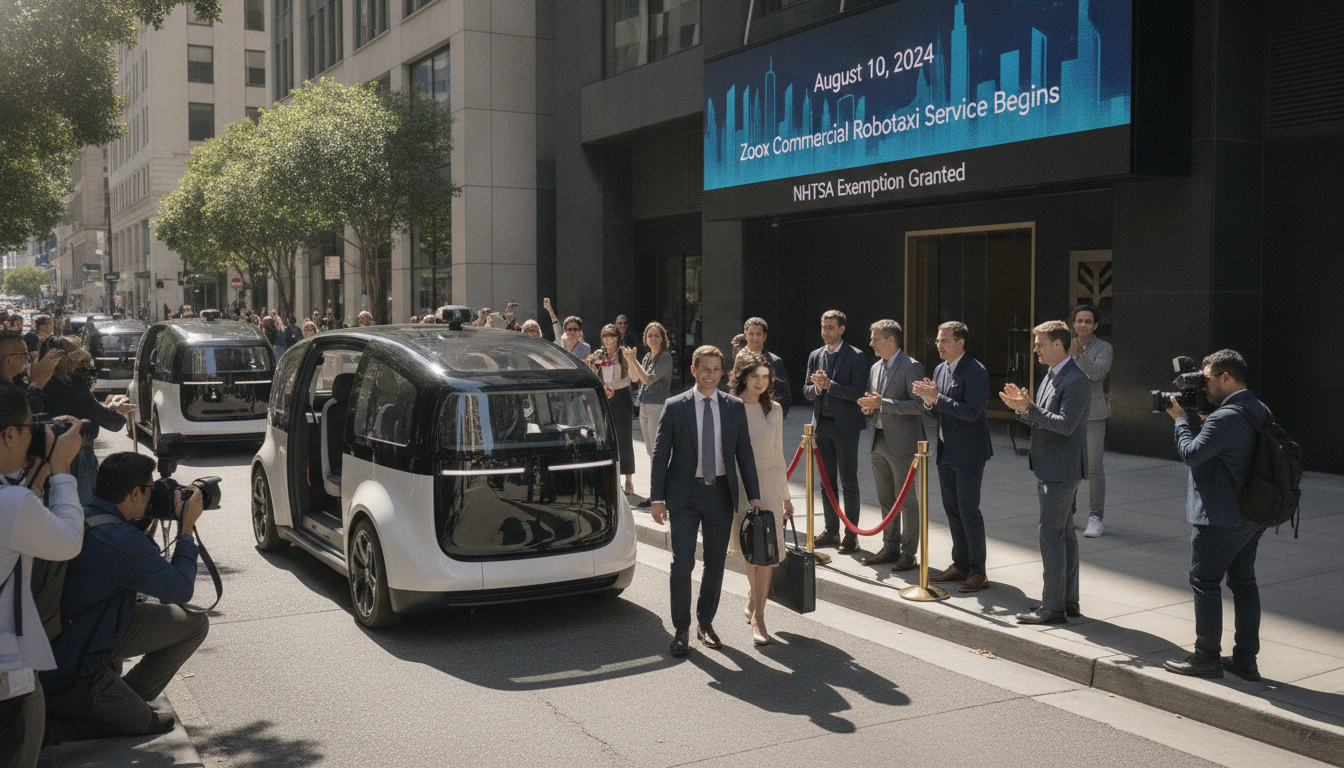
Zoox robotaxi cleared to start paid service after NHTSA exemption, commercial operations begin August 10, 2026
Zoox robotaxi gets NHTSA exemption to operate 2,500 commercial vehicles for two years, enabling paid rides from August 10, 2026 amid AV industry moves.
Zoox’s robotaxi program received a pivotal regulatory green light from the National Highway Traffic Safety Administration, allowing the company to begin commercial operations on August 10, 2026. The exemption permits a fleet of up to 2,500 vehicles to operate commercially for two years and removes a key barrier for vehicles built without traditional driver controls. With paid rides set to start in Las Vegas and early programs expanding to Miami and Austin, the Zoox robotaxi move marks a major step toward scaled autonomous mobility. The decision underscores how regulatory pathways are shaping which companies can rapidly transition from testing to revenue-generating services.
NHTSA exemption paves way for Zoox commercial service
The NHTSA exemption replaces Zoox’s prior demonstration-only allowance and explicitly acknowledges that some federal motor vehicle equipment standards are not applicable to vehicles without human drivers. The granted waiver covers devices and features typically required on conventionally driven cars — such as steering wheels and pedals — which Zoox eliminated by design. The agency limited the exemption to 2,500 vehicles and a two-year term, creating a defined window for Zoox to deploy and refine commercial operations.
Industry observers say the exemption is significant because it creates a template other autonomous vehicle developers can follow. Companies designing purpose-built driverless vehicles often remove components that are unnecessary or counterproductive to automated operation, and the NHTSA decision signals regulatory willingness to accommodate that architecture. The term-limited nature of the waiver also leaves room for further rulemaking or additional applications as commercial experience accumulates.
How Zoox plans to start charging for robotaxi rides
Zoox will transition from offering demonstration rides to charging customers beginning August 10, 2026, with initial operations concentrated in Las Vegas where its vehicles already operate for passengers. The company has also been expanding early rider programs to other cities, including San Francisco, Miami, and Austin, to gather usage data and scale service models. Moving to paid rides will allow Zoox to test pricing, routing, and customer support at scale while integrating lessons into fleet operations.
Operationally, the Zoox robotaxi will rely on an integrated sensor suite and software stack rather than traditional driver interfaces, which the NHTSA exemption accommodates. That design shifts emphasis toward remote monitoring, fleet management, and software updates as primary levers for safety and service quality. For riders, the transition to paid service will be the clearest signal that autonomous vehicles are moving from novelty demonstrations to routine transportation options.
Broader implications for AV makers, including Tesla
Regulators’ willingness to grant exemptions for driverless vehicle architectures opens the door for firms beyond Zoox to pursue commercial robotaxi rollouts. Tesla’s two-seater Cybercab and other purpose-built autonomous platforms stand to benefit from a clearer path to market if they meet safety and performance thresholds. Companies can also seek similar waivers to omit rearview mirrors, pedals, or other legacy equipment when sensor suites and software provide equivalent or superior functionality.
The exemption could accelerate competition among automakers, tech firms, and fleet operators by lowering a structural obstacle to deployment. At the same time, it raises questions about oversight, testing standards, and how performance will be measured as services expand into complex urban environments.
Moove raises $250M to position itself as robotaxi fleet backbone
Separately, mobility provider Moove announced a $250 million Series C round led by Mubadala that values the company at $2.1 billion and directs new capital toward autonomous fleet management. Moove, which evolved from a vehicle-financing fintech to a global fleet owner across 13 countries, plans to hire roughly 350 employees to scale its autonomous vehicle division. The company already operates as a fleet manager for Waymo in markets including Phoenix, Miami, and Las Vegas, and said it intends to acquire robotaxi units — including Waymo vehicles — to expand its holdings.
Moove’s fundraising underscores growing investor appetite for the middle layer of the robotaxi ecosystem: operators that can procure, finance, maintain, and deploy fleets at scale. By combining fleet ownership with operator services, Moove aims to be a commercial counterpoint to vehicle developers focused on software and sensors.
Funding, partnerships and product moves reshape the mobility week
The autonomous and broader mobility sectors saw a flurry of financial and strategic activity this week, reflecting momentum across hardware, software, and services. Uber reiterated a multibillion-dollar commitment to autonomous deployment, while dozens of startups reported financing rounds, from battery and motor makers to defense tech firms pursuing automated manufacturing. Nvidia released a commercially licensed driving model intended for AV adaptation, and Joby detailed partnerships to develop integrated transportation hubs that link air taxis and autonomous ground vehicles.
Traditional automakers also moved, with Ford announcing its midsize EV pickup name and price plans, and Lucid outlining a cost-saving turnaround tied partly to future robotaxi programs. Meanwhile, heavyweight industrial projects such as a proposed chip factory by Tesla and SpaceX in Texas drew attention for large-scale capital commitments that could ripple into mobility supply chains.
Regulatory and labor pressures on autonomous rollout
Not all developments were celebratory; legal and labor pressures surfaced alongside industry advances. The Teamsters in California filed suit against the state DMV, alleging insufficient economic analysis for permitting self-driving heavy trucks. Industry trade groups pushed back, arguing that litigation could be obstructive. Such disputes highlight the dual challenge facing autonomous deployment: technical readiness and public-policy acceptance.
Public concerns about safety, jobs, and local economic impacts are likely to shape the next phase of rulemaking and deployment. As companies scale pilots into paid services, regulators and stakeholders will be watching real-world performance metrics and community outcomes closely.
Zoox’s NHTSA exemption sets a clear milestone for autonomous mobility, but it does not conclude the debate over how driverless vehicles should be regulated, operated, and integrated into transportation networks. The coming months, beginning with paid rides on August 10, 2026, will test operational assumptions, commercial models, and the industry’s ability to address safety and societal concerns while scaling new services.
